There is a specific moment that every business hits at some point. You have invested real money, real time, and real trust into your telephony setup. Exotel numbers that your customers recognise. IVR flows that actually work. Call routing logic that took three months to configure. Agents trained on the system. And then someone from the leadership team walks in and says, “we need to add AI to our calls.”
The instinctive fear is that AI calling means replacing everything. New numbers. New infrastructure. New training. A complete rebuild that risks breaking the thing that currently works.
That fear is understandable. And for most businesses using Exotel, it is also completely unnecessary.
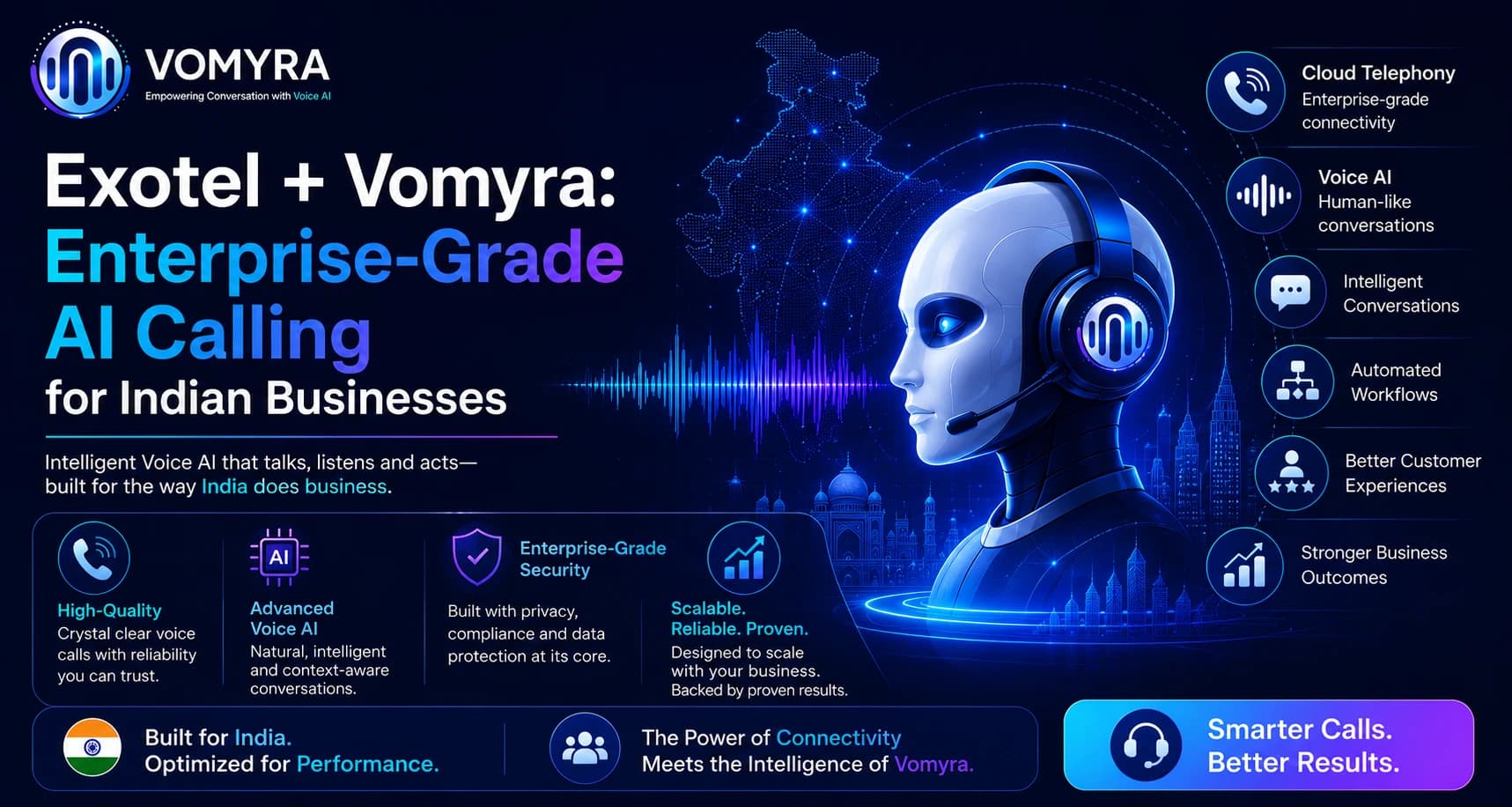
Vomyra AI Voice Agent sits as an AI intelligence layer on top of your existing Exotel telephony setup. Your numbers stay the same. Your call routing logic stays intact.
Your callers keep reaching the same trusted +91 numbers they have always called. What changes is what happens during the conversation, instead of a static IVR or a human agent fielding every routine inquiry, an AI voice agent handles the call, qualifies the lead, answers the question, books the appointment, and hands off to a human only when the conversation actually needs one.
Why Most Businesses with Exotel Actually Need This
Let’s be direct about what Exotel does well. It handles Indian telephony infrastructure brilliantly. Reliable call routing. Solid recording. DLT compliance. Number provisioning. IVR configuration that mid-market and enterprise Indian businesses depend on every day.
What it does not do, and was never designed to do, is hold a natural, intelligent, multilingual conversation with a caller. That is not a criticism. It is just an architectural reality. Exotel is the telephony layer. The conversation intelligence layer sits on top of it.
Most Indian businesses running Exotel in 2026 are in one of two positions. Either they still have human agents handling every call that comes through the system, which works until the call volume gets large enough that it stops working.
Or they have some basic IVR automation, press 1 for sales, press 2 for support, which frustrates callers and produces meaningful call abandonment rates that translate directly into lost business.
The gap between “static IVR” and “human agent” used to have nothing in between. That is what changed. The AI conversation layer now fills that gap at a quality level that is genuinely production-ready for Indian calls, Indian languages, and Indian telephony audio conditions.
How the Three-Layer Architecture Actually Works
If you want to understand why the Exotel plus Vomyra combination makes sense at an enterprise level, it helps to think about what each layer does.
Layer one is telephony. That is Exotel’s job. Number provisioning. PSTN connectivity. DLT registration and classification. Call recording at the transport layer. DND scrubbing. The actual mechanics of making a call connect between one device and another across Indian mobile networks. Exotel has spent fifteen years building this and it shows. Indian businesses trust it for exactly this reason.
Layer two is the conversation. That is where Vomyra AI Voice Agent operates. When a call enters your Exotel flow, a webhook passes the call to Vomyra. The AI agent takes over the conversation. It listens, understands the caller in Hindi, Hinglish, Tamil, Telugu, Kannada, or whichever of the 32 supported Indian languages the caller uses. It asks questions. It processes answers. It accesses your CRM in real time to pull up customer data or push call outcomes. It qualifies the lead, books the appointment, handles the FAQ, or takes the order. When the call needs a human, because the issue is complex, the caller is frustrated, or a high-value negotiation is about to start, it transfers back through Exotel’s routing to the right agent with full context.
Layer three is your enterprise systems. CRM, ERP, scheduling software, billing platform, or whatever your business actually runs on. Vomyra connects to these through API, webhook, or MCP integration, so data from every call lands in the right system automatically without anyone typing it in manually.
The beauty of this architecture is that each layer is doing what it is genuinely best at. Exotel is not being asked to run conversation AI. Vomyra is not being asked to manage telephony infrastructure. Your CRM is not being asked to handle real-time audio processing. Everyone stays in their lane and the whole system works better than any single platform trying to do all three things at once.
What Enterprise Compliance Looks Like in This Setup
Indian businesses in fintech, BFSI, healthcare, and regulated industries lose sleep over compliance. Rightly so.
The Exotel plus Vomyra setup handles compliance at both layers, which is actually an advantage over single-platform solutions. Exotel handles DLT registration, TRAI mandated call recording, and transport-layer compliance that Indian carriers require.
Vomyra handles the conversation-layer compliance requirements, TRAI calling hour enforcement between 9 AM and 9 PM IST, DND scrubbing before outbound campaigns, DPDP Act consent and audit logging for every AI interaction, and the identity disclosure requirements that RBI’s Fair Practices Code mandates for lending and insurance calls.
For a fintech NBFC running outbound loan inquiry qualification calls, this means the system is compliant at every layer. Exotel’s DLT registration satisfies the telecom regulator. Vomyra’s calling hour enforcement satisfies TRAI.
The identity disclosure in the opening of every AI call satisfies RBI. The consent logging satisfies DPDP. And all of it runs automatically without a compliance manager manually auditing every call.
That is not a small thing for a regulated business. Compliance failures in Indian financial services carry real consequences. Building compliance into the infrastructure rather than depending on human agents to follow a checklist on every call is the more reliable approach.

The Specific Scenarios Where This Combination Delivers Most
Large-Volume Outbound Qualification Campaigns
A business running outbound qualification, loan inquiries, insurance follow-ups, real estate lead campaigns, recruitment screening, quickly hits a capacity ceiling with human agents. There are only so many agents and only so many calling hours in a day.
When Vomyra AI Voice Agent sits on top of Exotel’s outbound infrastructure, that ceiling goes away. Outbound calls go out simultaneously across a campaign list, within the TRAI-compliant 9 AM to 9 PM window, in whatever language each prospect is most comfortable with.
The AI handles the qualification conversation. Qualified leads go to human agents with a full context brief from the AI call. Unqualified leads are logged and either removed from the pipeline or scheduled for a follow-up at a configured interval.
The cost comparison here is straightforward. A human telecaller in India costs ₹40,000 to ₹65,000 per month fully loaded. An AI voice agent running through Vomyra’s platform handles the equivalent call volume for a fraction of that, with no attrition, no bad days, and no quality variation between the first call of the morning and the last call of the evening.
Inbound Overflow and After-Hours Coverage
Indian businesses lose real revenue to calls that arrive when agents are unavailable. Weekend inquiries. Late-evening calls from working professionals who can only call after 9 PM, which for TRAI-compliant outbound is outside the window, but inbound calls can still come in. Calls during peak hours when the agent queue is full and callers hang up rather than wait.
The AI layer handles all of these automatically. Callers still reach the same Exotel number they know. The AI answers immediately. It helps them or takes down the inquiry or books the callback for the next morning. No revenue lost to an unanswered phone.
For a real estate developer running a weekend campaign, this is the difference between capturing weekend inquiry momentum and watching it go to the competitor who has AI coverage. For a fintech company, it is the difference between qualifying a Monday morning loan application from the weekend campaign and calling back four hours later when the applicant has moved on.
High-Volume Customer Support Triage
Enterprise businesses with large customer support operations face a specific version of the capacity problem. Human agents are expensive and slow to hire. But not every inbound support call actually needs a human.
Balance inquiries, application status checks, appointment rescheduling, payment confirmation, policy renewal status, these are answerable by AI in under two minutes and represent a significant share of total inbound volume at most businesses.
Vomyra handles the AI-resolvable portion. Exotel’s routing logic passes the complex ones to human agents. The split reduces the load on the human team substantially, which typically means shorter wait times for the complex cases that actually need human attention, which improves the customer experience at both ends of the triage.
Setting Up the Integration Without an Engineering Sprint
The way most businesses approach telephony integration, this sounds like a four-week project minimum. In practice, the Exotel and Vomyra integration works through Exotel’s existing webhook system.
When a call enters your Exotel flow, a webhook call tells Vomyra to take over. The AI handles the conversation. When it needs to transfer, it passes back through Exotel’s routing to the configured destination. Call outcomes, transcripts, and qualification data push to your CRM via Vomyra’s integration layer.
Your Exotel numbers are unchanged. Your existing call routing logic continues to work for the cases it was built for. The AI layer sits between the call arriving and the human agent engaging, handling the volume that does not need human involvement.
For non-technical teams, Vomyra AI Voice Agent configures the conversation flow, knowledge base, language settings, and CRM integration through a no-code interface. The Exotel webhook connection is a URL paste and a configuration change, not a development project.
What This Costs, Honestly
Enterprise pricing conversations in Indian tech tend to involve a lot of “contact sales” and “custom quote” language that makes it hard to plan a budget in advance.
The Exotel infrastructure cost is whatever your current Exotel plan costs, this integration does not change that. The Vomyra AI layer is priced at ₹5 per minute on the pay-as-you-go plan. No minimum commitment. No separate charges for multilingual support.
No per-language fees for Hindi, Tamil, Telugu, Kannada, Gujarati, Bengali, Punjabi, or the other 26 supported Indian languages. Free tier includes 500 monthly credits that renew every month.
For a business evaluating whether the economics work before committing: a 5-minute average call at ₹5 per minute costs ₹25 per call. At 1,000 calls per month, that is ₹25,000. Against the ₹40,000 to ₹65,000 monthly cost of one human telecaller who cannot physically handle 1,000 quality calls per month, the math is not complicated.
The more important number for most enterprises is cost per qualified lead rather than cost per call. That depends on the qualification rate the AI achieves on the specific campaign, which is why testing on real call volume before committing to a scaled plan matters more than any benchmark number this post could provide.
A free trial of Vomyra AI Voice Agent covers 500 monthly credits, full Exotel integration capability, multilingual support across all supported Indian languages, and complete CRM connectivity. The trial is the right starting point for any enterprise evaluating this combination before a full-scale rollout.
Frequently Asked Questions
Do we need to change our Exotel phone numbers to use Vomyra?
No. Your existing Exotel numbers stay exactly as they are. Vomyra integrates through Exotel’s webhook system, so callers continue reaching the same trusted +91 numbers while the AI handles the conversation layer.
What languages can the AI handle on an Exotel-routed call?
Vomyra supports 32-plus Indian languages including Hindi, Hinglish, Tamil, Telugu, Kannada, Bengali, Marathi, Gujarati, Punjabi, and Assamese. Language detection is automatic from the caller’s first response with no menu required.
Does the combination handle TRAI and DPDP compliance?
Yes. Exotel handles transport-layer compliance including DLT registration. Vomyra handles conversation-layer compliance including calling hour enforcement, DND scrubbing, consent logging, and DPDP audit trails.
How long does the integration take to set up?
The Exotel webhook configuration is a URL paste and a setting change. Vomyra’s conversation flow, knowledge base, and CRM integration configure through a no-code dashboard. Most businesses are live within a week.
What happens when the AI cannot handle a call?
The AI transfers to a human agent through Exotel’s routing with full call context, so the agent knows what was discussed and the caller does not need to repeat themselves.