How to Choose the Right Foundation for Production Voice Experiences
The Short Answer
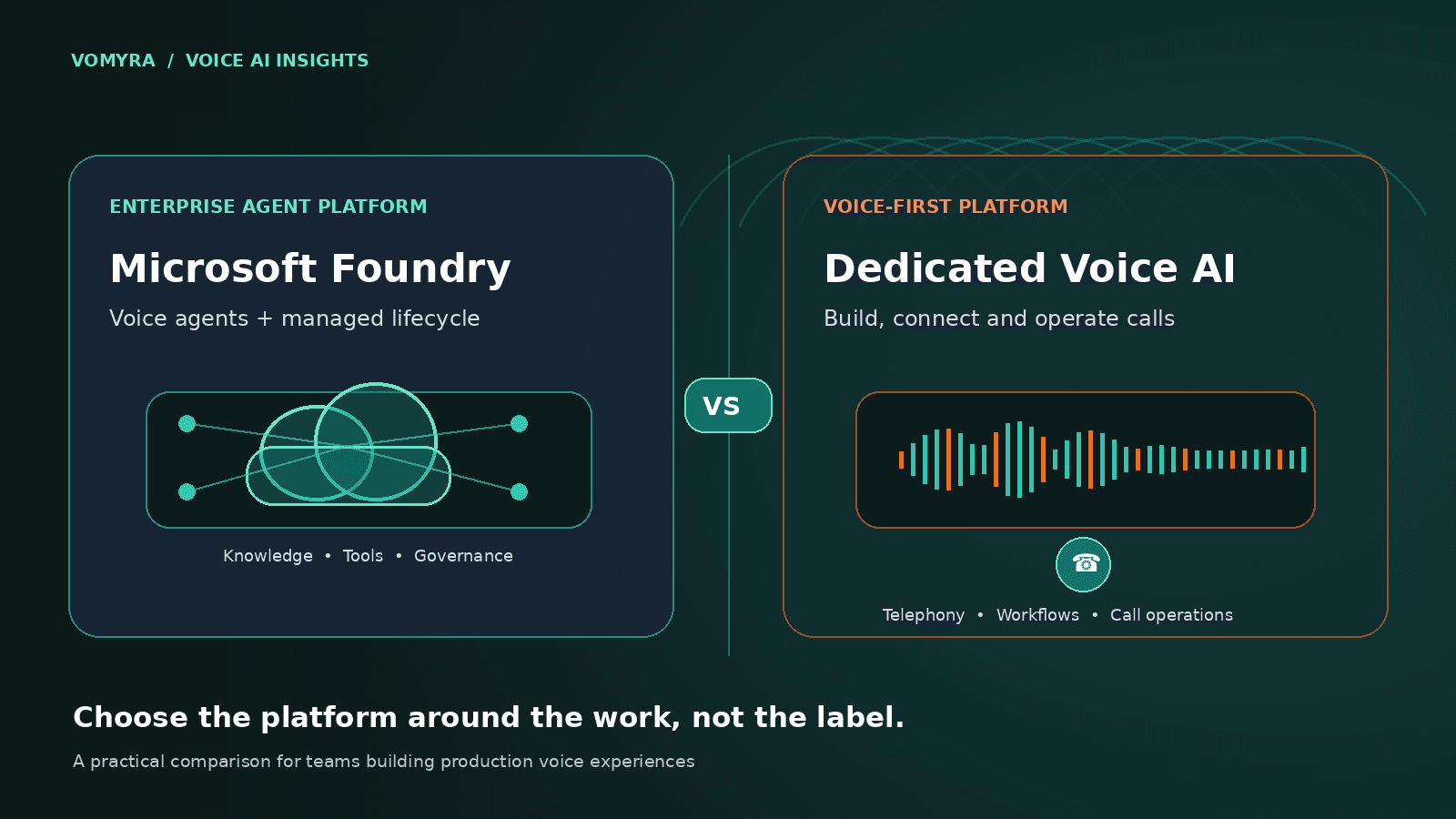
Microsoft Foundry is a compelling choice when an organisation wants voice agents to sit inside a broader Azure and Microsoft agent ecosystem, with managed agent lifecycle capabilities, enterprise identity, knowledge connections, governance and monitoring.
A dedicated voice AI platform is often the more direct route when the immediate job is to launch and operate phone or web voice agents, connect telephony and business systems, iterate on conversations, and manage voice-specific workflows.
These options are not mutually exclusive in every architecture. Microsoft Foundry can provide the agent and enterprise foundation while a specialist platform or service supplies parts of the voice application, telephony or operational workflow.
The right decision depends on what the team needs to own, what it wants managed, and how quickly it needs to reach production.
Why This Comparison Matters Now
Voice AI has moved beyond a speech interface bolted onto a chatbot. Production systems must handle interruptions, pauses, turn-taking, noisy audio, tool calls, identity, routing, analytics, escalation and the operational work that happens after a conversation.
A platform decision therefore affects more than model quality: it shapes the engineering workload, release process, observability, integrations and the experience customers actually receive.
Microsoft announced general availability of voice agents in Microsoft Foundry Agent Service on 18 November 2026. Microsoft describes the service as supporting the agent lifecycle, including building, deployment, operation and continuous improvement.
Its capabilities include real-time speech, knowledge grounding, tools, guardrails, tracing and evaluation, with channel options that include web and telephony integrations. Availability and feature support can vary by region, model and channel.
What Is Microsoft Foundry Voice Agent?
Microsoft Foundry Agent Service provides a managed environment for building and operating AI agents. Its voice-agent capabilities use Microsoft Voice Live for real-time speech interaction, including speech recognition, synthesis, turn detection and interruption handling. Developers can configure agents through the Foundry portal or SDK and connect them to knowledge and tools.
The important distinction is that Microsoft is offering more than a speech API. Foundry brings voice into a broader agent platform, so teams can use the same environment for agent configuration, knowledge, tool access, governance and operational visibility. For organisations already standardised on Azure, that can reduce the number of separate platforms they need to govern.
What Are Dedicated Voice AI Platforms?
Dedicated voice AI platforms focus on the end-to-end work involved in building, deploying and improving voice agents. Depending on the provider, that can include phone numbers and SIP connectivity, inbound and outbound calling, speech and model selection, call transfers, tools and APIs, testing, conversation logs, analytics and deployment controls.
Examples include developer-oriented platforms such as Vapi and business-focused voice agent platforms such as Retell AI. Their feature sets differ, so buyers should validate each requirement against current product documentation rather than assume every provider offers the same capabilities.
Microsoft Foundry vs. Dedicated Voice AI Platforms
| Decision Area | Microsoft Foundry | Dedicated Voice AI Platforms |
| Primary orientation | Broader enterprise agent platform with voice as a managed agent capability. | Voice-agent application and operating layer focused on conversations and deployment. |
| Best-fit starting point | Organisations already invested in Azure, Microsoft identity, data and governance. | Teams prioritising voice-agent rollout, phone workflows and rapid voice-specific iteration. |
| Voice interaction | Voice Live provides speech recognition, synthesis, turn detection and interruption handling. | Typically offers voice-oriented configuration and provider choices; exact controls vary by platform. |
| Agent and tool layer | Foundry agents, knowledge connections, tools, MCP and guardrails within Microsoft’s ecosystem. | Tools, APIs, integrations and orchestration designed around voice workflows; breadth varies by vendor. |
| Telephony | Supports telephony routes and integrations; confirm required carrier, SIP, region and channel details. | Often places telephony and call handling closer to the core product experience; verify coverage and transfer behaviour. |
| Monitoring and evaluation | Foundry offers tracing, monitoring and evaluation capabilities, subject to feature support. | Voice-specific logs, testing and analytics are common differentiators; compare depth and export options. |
| Customisation and control | Strong fit for teams that want to build within Microsoft’s managed agent and cloud environment. | Can offer a more voice-focused developer surface and model/provider flexibility; implementation differs. |
| Operational ownership | Microsoft manages significant platform components, while teams still design, test and operate their agent experience. | Provider may abstract more voice application and telephony plumbing, but teams remain responsible for prompts, workflows, integrations and quality. |
| Commercial model | Consumption and connected-service charges may include models, speech, telephony, monitoring and other Azure services. | Usually provider-specific usage or subscription pricing; compare complete per-minute and infrastructure costs. |
Explore the underlying Vomyra voice AI orchestration platform to see how telephony, speech models, language models and business tools work together.
For a closer look at the available technology stack, browse Vomyra’s 46+ integrations, including speech-to-speech models such as Azure Voice Live, GPT Realtime and Nova 2 Sonic.
Where Microsoft Foundry Has an Advantage
1. A Broader Enterprise Agent Foundation
If voice is one interface among many, Foundry can be attractive. A business may want the same agent capabilities to support voice, web and internal workflows, with shared knowledge, tools and governance.
2. Alignment with the Microsoft and Azure Estate
Organisations already using Azure services, Microsoft Entra, private networking and Microsoft operational tooling may prefer to keep agent infrastructure within that environment. This can simplify procurement, identity and governance, although it does not remove solution-design work.
3. Managed Lifecycle and Operational Visibility
Foundry’s proposition extends beyond a real-time audio connection. Agent configuration, deployment, tracing and evaluation are part of the platform story. Buyers should still verify which monitoring and evaluation functions are generally available for their chosen agent type and region.
Where a Dedicated Voice AI Platform May Be a Better Fit
1. The Primary Product Is Phone-Based Automation
If the core requirement is to launch inbound or outbound calling, handle transfers, connect phone systems and tune call flows, a specialist voice platform may offer a more direct workflow.
2. The Team Wants a Voice-Specific Developer Experience
Specialist platforms are built around voice-agent concepts such as assistants, call sessions, telephony, turn-taking, voice providers and call testing. This can shorten the path from prototype to a working voice application, depending on the use case and team’s skills.
3. Provider Choice and Iteration Speed Matter
Some platforms expose multiple speech, language-model and voice providers through one integration surface. This can make experimentation easier, but provider availability, pricing, quality and feature parity must be checked rather than inferred from a headline model count.
For teams assessing voice-specific workflows, review Vomyra’s tools and workflow integrations for CRM updates, calendar booking, WhatsApp follow-ups, payments and automation.
A Practical Decision Framework
Choose Microsoft Foundry First When…
- Your organisation is already Azure-first and has established cloud governance.
- Voice is part of a wider agent strategy across channels and internal systems.
- You need Microsoft-aligned identity, networking, knowledge and operational controls.
- Your engineering team is comfortable configuring and owning the application layer.
Evaluate a Dedicated Voice AI Platform First When…
- Phone calls are the primary customer or employee interface.
- You need a focused path to telephony, call routing, transfers and voice workflow iteration.
- Your team values a voice-specific developer experience and integrated call operations.
- You want to compare multiple speech and model providers through a single platform.
Consider a Hybrid Architecture When…
- Foundry is the preferred enterprise agent and governance layer, but specialist telephony or voice workflow capabilities are needed.
- Different business units have different channel, compliance or operational requirements.
- You want to retain flexibility while avoiding unnecessary duplication of orchestration and monitoring.
Questions to Ask Before Choosing
- Which channels are mandatory: browser, mobile app, PSTN, SIP, contact centre or messaging?
- Which countries, phone-number types, carriers and regions must be supported?
- What are the required languages, accents and code-switching patterns, and how will they be tested?
- Can callers interrupt naturally? How are silence, barge-in, background noise and end-of-turn detection handled?
- Can the agent safely call APIs, access business data, authenticate users and complete transactions?
- How are human handoffs, warm transfers, failed calls and fallback paths handled?
- Can teams inspect transcripts, audio, tool calls, latency and outcomes? Can they export the data?
- What are the complete costs per connected minute, including models, speech, telephony, storage, monitoring and support?
- What data residency, retention, consent, recording and security controls are available in the target deployment region?
- How will quality be evaluated before launch and monitored after release?
Related Vomyra resources: speech-to-speech capabilities · telephony and model integrations · platform pricing · partner and white-label programme.
How Vomyra Fits Into This Landscape
For buyers evaluating Microsoft Foundry against a dedicated voice AI platform, Vomyra should be assessed on the practical work required to get business voice agents into production: how quickly teams can configure an assistant, connect telephony and business systems, select speech and model components, test real conversations, and manage agents after launch. To understand the product architecture, see How Vomyra works.
Vomyra’s website and product materials describe a voice-agent platform with integrations spanning telephony, speech-to-text, text-to-speech, language models, speech-to-speech and tools. That breadth is relevant to buyers who want a platform-oriented route rather than assembling every component themselves. The exact fit should be demonstrated against the buyer’s call volumes, languages, channels, workflows, compliance requirements and operational needs.
The strongest positioning is not that one platform universally replaces another. It is that different platforms solve different layers of the problem. Microsoft Foundry is compelling for a broader enterprise agent foundation. Dedicated voice AI platforms are compelling when voice deployment and conversation operations are the centre of the project. Vomyra should make its own differentiators concrete through product demonstrations, supported integration lists, measured call outcomes and transparent implementation guidance.
Conclusion: Choose the Platform Around the Work, Not the Label
Microsoft Foundry’s voice-agent release is an important signal: enterprise buyers can now bring real-time voice into a managed agent lifecycle rather than treating speech as a separate add-on. But a broad enterprise platform and a specialist voice AI platform are not identical products.
If your organisation is building a multi-channel agent estate on Azure, Foundry deserves a close look. If your priority is to deploy and operate voice agents across phone and digital channels with voice-specific workflows, compare dedicated platforms carefully. In either case, run a proof of concept using real calls, real integrations and measurable success criteria.
See Vomyra in action: explore the platform, compare available plans, or book a conversation with the team about your voice-agent requirements.

Frequently Asked Questions
Is Microsoft Foundry a voice AI platform?
Microsoft Foundry is a broader AI agent platform that now includes managed voice-agent capabilities. Voice Live supplies real-time speech capabilities, while Foundry Agent Service adds agent configuration and lifecycle features.
What Is the Difference Between Microsoft Voice Live and Foundry Voice Agents?
Voice Live is the real-time voice interaction layer. Foundry voice agents build on that foundation with managed agent configuration, tools, knowledge connections and lifecycle management.
Are Dedicated Voice AI Platforms Better Than Microsoft Foundry?
Not universally. Dedicated platforms may be a better fit for voice-first deployments and telephony workflows, while Foundry may suit organisations seeking a broader Azure-aligned agent platform.
Can Microsoft Foundry Voice Agents Make Phone Calls?
Microsoft documents telephony integrations and phone-channel options. The exact setup depends on the selected channel, region, telephony provider and supported features.
Can a Business Use Microsoft Foundry with a Dedicated Voice AI Platform?
Potentially. A hybrid design can use different services for agent intelligence, telephony or voice operations. The architecture should avoid duplicated orchestration and should be validated for latency, security, cost and support.
What Should Businesses Compare Before Choosing a Voice AI Platform?
Compare supported channels and regions, language quality, interruption handling, telephony, integrations, tool execution, human handoff, monitoring, evaluation, security, data residency, pricing and support.