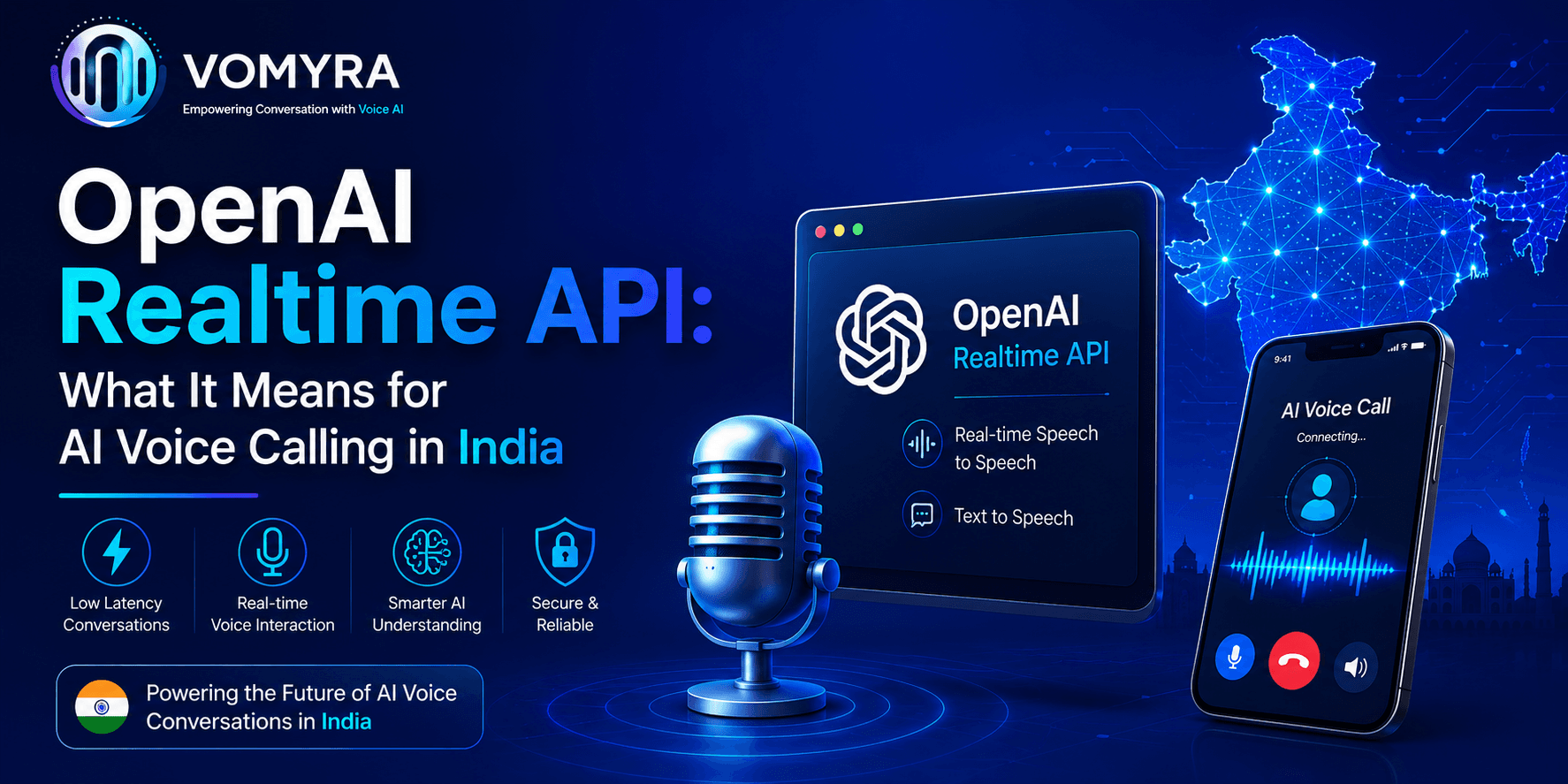
Artificial intelligence is transforming business communication at an unprecedented pace, and voice technology is leading this evolution. The introduction of the OpenAI Realtime API represents a significant advancement in how developers and businesses create natural, low-latency voice interactions.
Instead of relying on traditional IVR systems or scripted voice bots, organizations can now build intelligent AI-powered conversations that understand context, respond instantly, and handle complex customer interactions with remarkable accuracy.
For businesses exploring openai realtime voice india, this technology creates new possibilities across customer support, appointment scheduling, lead qualification, sales assistance, and multilingual communication. As demand for automated voice solutions grows, companies are looking for platforms that simplify deployment while delivering human-like conversations over real phone networks.
The Indian market, with its rapidly expanding digital economy and multilingual customer base, is well-positioned to benefit from realtime AI calling capabilities powered by modern AI models. Organizations can automate repetitive phone conversations while maintaining natural interactions, reducing operational costs, and improving customer satisfaction.
Understanding the OpenAI Realtime API
The OpenAI Realtime API enables developers to build applications capable of processing speech and generating spoken responses in real time. Unlike conventional voice systems that require separate speech recognition, text processing, and text-to-speech pipelines, the realtime architecture minimizes latency and creates smoother, more natural conversations.
This technology is particularly valuable for businesses requiring immediate voice interactions. Whether responding to customer inquiries, handling inbound support calls, or conducting outbound engagement campaigns, AI-powered voice systems can maintain conversational flow without noticeable delays.
The capabilities associated with the gpt-4o audio api further strengthen real-time communication by supporting advanced speech understanding and audio generation. Businesses can create voice experiences that respond naturally to interruptions, changing contexts, and follow-up questions, making AI interactions feel significantly closer to human conversations.
Why OpenAI Realtime Voice Matters for India
India represents one of the world’s largest opportunities for AI-powered communication. Millions of businesses rely on phone calls as their primary customer engagement channel. Industries including healthcare, education, banking, logistics, real estate, hospitality, and e-commerce receive thousands of inquiries every day.
Traditional call centers often struggle with high staffing costs, long wait times, and inconsistent service quality. AI-powered voice systems offer an effective alternative by handling repetitive conversations automatically while allowing human agents to focus on more complex customer needs.
The adoption of openai realtime voice india can support businesses in several ways. Organizations can provide 24/7 customer assistance, automate appointment confirmations, qualify leads before transferring them to sales teams, answer frequently asked questions, collect customer information, and manage outbound reminder calls without requiring large support teams.
The ability to communicate naturally over phone calls also makes AI solutions particularly effective in markets where voice remains the preferred communication channel.
The Evolution of AI Voice Calling in 2026
The landscape of openai voice calling 2026 is expected to focus on faster response times, greater conversational intelligence, improved multilingual capabilities, and seamless integration with business software.
Modern AI voice systems no longer rely solely on predefined scripts. Instead, they understand customer intent, generate dynamic responses, and continue conversations while maintaining context. This allows businesses to deliver personalized customer experiences rather than repetitive automated interactions.
For Indian businesses, this advancement means AI can assist customers with product information, booking requests, payment reminders, customer verification, and post-sales support through realistic conversations that feel more engaging than traditional IVR menus.
The continued development of realtime AI infrastructure also enables businesses to scale customer communication without proportionally increasing staffing costs.
AI Phone Agents with Indian Numbers
One of the most significant developments in business communication is the emergence of the AI phone agent with Indian number. Rather than interacting through web-based voice interfaces alone, businesses can deploy AI agents capable of making and receiving calls using local Indian phone numbers.
This creates a familiar customer experience while maintaining the trust associated with domestic communication channels. Customers are more likely to answer local numbers, making outbound campaigns significantly more effective.
An AI phone agent can perform numerous business functions, including appointment scheduling, customer verification, payment reminders, order confirmations, lead qualification, customer feedback collection, and inbound query handling. These capabilities enable organizations to automate high-volume communication without sacrificing responsiveness.
Simplifying Deployment with No-Code Platforms
Although the OpenAI Realtime API provides powerful developer capabilities, many organizations prefer solutions that eliminate the complexity of coding and infrastructure management.
A no-code AI voice agent platform India enables businesses to configure workflows, connect business applications, assign phone numbers, and launch AI voice agents without building custom software from scratch.
This approach significantly reduces implementation time while making AI voice technology accessible to startups, small businesses, educational institutions, healthcare providers, and enterprises seeking faster deployment.
Instead of investing months in software development, organizations can focus on designing conversation flows that improve customer engagement and operational efficiency.
Enhancing Business Communication with AI Voice Technology
The growing adoption of AI-powered voice systems is reshaping how organizations interact with customers across every stage of the customer journey. From the first inquiry to post-purchase support, intelligent voice agents can deliver consistent, accurate, and timely responses without the limitations associated with traditional call centers.
The combination of the gpt-4o audio api and realtime processing enables conversations that adapt dynamically to customer intent. Instead of following rigid scripts, AI voice systems can understand follow-up questions, manage interruptions, retain conversational context, and generate responses that align with the ongoing discussion. This creates a significantly better customer experience while improving operational efficiency.
Businesses operating in sectors such as healthcare, education, finance, logistics, insurance, hospitality, and real estate often receive repetitive inquiries throughout the day. Automating these interactions allows human representatives to focus on higher-value conversations that require personal attention and decision-making.
Integration with Existing Business Systems
Modern AI voice solutions become even more valuable when connected to existing business applications. Customer relationship management systems, appointment scheduling software, help desk platforms, payment gateways, and internal databases can all work together with AI voice technology to deliver personalized customer experiences.
For example, an AI voice agent can identify an incoming customer, retrieve previous interaction history, verify appointment details, provide order updates, or answer account-specific questions without requiring manual intervention. This level of automation improves both customer satisfaction and employee productivity.
Organizations implementing realtime ai calling can also collect valuable conversational insights, enabling continuous optimization of customer communication strategies.
Vomyra AI Voice Agent for Indian Businesses
Businesses adopting AI-powered voice automation need solutions that are easy to deploy and scalable. Vomyra AI Voice Agent enables organizations to automate inbound and outbound calls with natural, AI-driven conversations.
As an AI phone agent with Indian number, it supports customer support, appointment booking, lead qualification, payment reminders, and follow-up calls. Being a no-code AI voice agent platform India, businesses can launch AI voice workflows without extensive development, making implementation faster and more efficient.

The Future of AI Voice Calling in India
The future of openai voice calling 2026 will focus on faster, more intelligent, and multilingual voice interactions. Businesses using openai realtime voice india can improve customer service, reduce operational costs, and automate high-volume conversations while delivering a more natural calling experience.
Advancements in realtime ai calling will continue to enhance customer engagement by enabling AI voice agents to understand context, personalize responses, and integrate seamlessly with business systems.
Conclusion
The OpenAI Realtime API is transforming AI-powered communication by enabling low-latency, natural voice interactions. Combined with the gpt-4o audio api and realtime ai calling, it provides businesses with a strong foundation for scalable voice automation.
For organizations looking to deploy AI voice solutions quickly, Vomyra AI Voice Agent offers a practical option. As a no-code AI voice agent platform India, it enables businesses to use an AI phone agent with Indian number to automate customer interactions efficiently.
Frequently Asked Questions
1. What is the OpenAI Realtime API?
The OpenAI Realtime API enables developers to build applications with low-latency voice conversations, making AI-powered customer interactions faster and more natural.
2. How does openai realtime voice india benefit businesses?
It helps automate inbound and outbound calls, improve customer support, qualify leads, schedule appointments, and reduce operational costs.
3. What is an AI phone agent with Indian number?
An AI phone agent with Indian number can make and receive calls using local Indian numbers while handling customer queries, bookings, reminders, and follow-ups.
4. Why choose a no-code AI voice agent platform India?
A no-code AI voice agent platform India allows businesses to deploy AI voice agents without coding, reducing development time and simplifying implementation.
5. Is there an AI voice agent free trial India available?
Many businesses prefer platforms offering an AI voice agent free trial India to evaluate voice quality, automation features, workflow capabilities, and overall performance before deployment.