High-volume hiring runs into the same bottleneck almost every time: too many applicants, not enough recruiter hours to call and screen each one. A single job posting for an entry-level or high-turnover role can generate hundreds of applications, and every one of them technically deserves a phone screen – but few recruitment teams have the calling capacity to actually deliver that.
The result is familiar to most recruiters: candidates who never get a callback, screening calls that pile up and get delayed, and good candidates lost simply because a competing offer moved faster.
AI voice agents are increasingly used to close this gap – calling candidates immediately after application, conducting initial screening conversations, and keeping the hiring pipeline moving without recruiters drowning in repetitive first-round calls.
This guide covers where AI voice agents fit into recruitment, key use cases, a practical workflow, and best practices for using them without losing the human judgement that hiring genuinely needs.
Why Recruitment Is a Strong Fit for AI Voice Agents
A few characteristics of recruitment communication make voice AI particularly effective here:
- High application volume, especially for high-turnover roles. Retail, delivery, customer support and entry-level roles often generate far more applicants than recruiters can call promptly.
- Speed matters enormously. Strong candidates in competitive job markets often accept the first solid offer they receive – slow first contact loses candidates to faster-moving competitors.
- Screening questions are largely repetitive. Availability, basic qualifications, salary expectations, and role fit follow a fairly standard structure across most first-round screens.
- Scheduling coordination consumes recruiter time. Coordinating interview times across candidates and interviewers by phone or email is time-consuming and error-prone at volume.
These conditions make high-volume recruitment one of the clearer, most measurable use cases for AI voice agents – every candidate reached faster is a direct improvement in time-to-hire.
Key Use Cases for AI Voice Agents in Recruitment
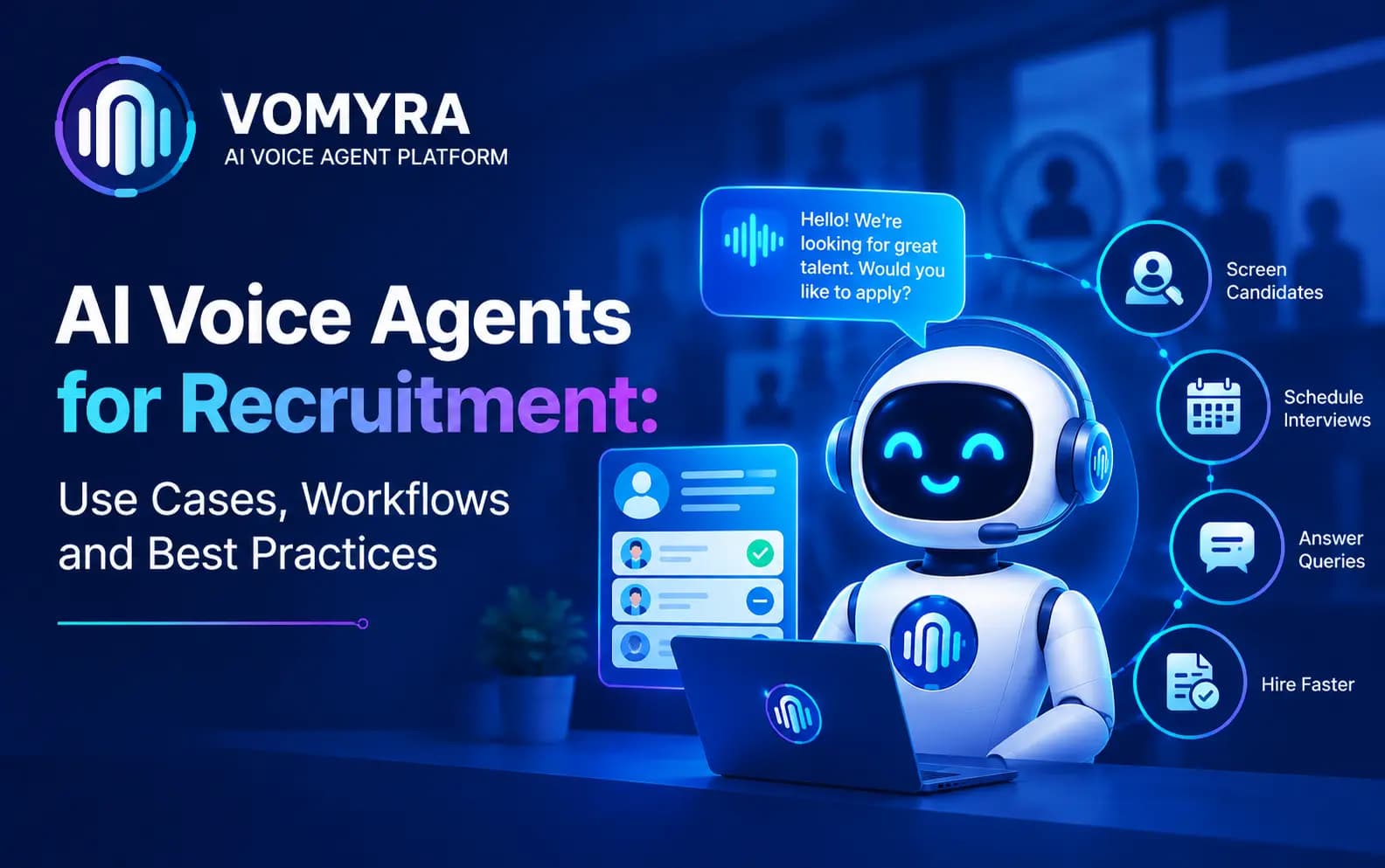
1. Initial Candidate Screening
The moment a candidate applies, an AI voice agent can call to conduct a first-round screen – confirming basic qualifications, availability, salary expectations and role interest – within minutes of application rather than days.
2. Interview Scheduling and Confirmation
Once a candidate passes initial screening, the agent can offer available interview slots, confirm the booking, and sync it directly with the recruiter’s or hiring manager’s calendar.
3. Interview Reminders and Confirmations
A reminder call ahead of a scheduled interview reduces no-shows, confirming the candidate still plans to attend or offering to reschedule if needed.
4. Candidate Status Updates
Rather than candidates left wondering about application status, an AI voice agent can proactively call with updates – moving to next round, not selected, offer extended – keeping the candidate experience professional even at high volume.
5. Reference Check Coordination
Initial outreach to references – confirming availability for a reference call and basic logistics – can be handled by an AI voice agent before a recruiter or hiring manager conducts the actual reference conversation.
6. Re-Engagement of Past Applicants
For roles similar to ones a candidate previously applied for, AI voice agents can re-engage a database of past applicants – a talent pool most recruitment teams don’t have the calling capacity to revisit systematically.
7. Onboarding Coordination Calls
Once a candidate accepts an offer, AI voice agents can handle logistical coordination calls – confirming start dates, document submission reminders, and basic onboarding queries – freeing HR teams for more substantive onboarding work.
A Practical AI Voice Agent Workflow for Recruitment
- Application trigger – A candidate applies through a job portal, careers page, or referral.
- Instant screening call – The AI voice agent calls within minutes, asking structured screening questions relevant to the role.
- Scoring and routing – The candidate is scored based on responses and routed accordingly – advanced to interview scheduling, held for recruiter review, or politely declined.
- Interview scheduling – Qualified candidates are offered interview slots and the booking is confirmed directly.
- Reminder call – A follow-up call or message confirms the interview ahead of time.
- Handoff to recruiter or hiring manager – Full context – screening answers, transcript, and scheduling details – travels with the candidate to the human interviewer.
- Status update calls – Candidates receive timely updates at each stage, whether advancing or not.
- Talent pool nurture – Candidates not selected for the current role but otherwise strong are added to a re-engagement sequence for future openings.
Manual Recruitment Calling vs AI Voice Agent Calling
| Factor | Manual Recruiter Calling | AI Voice Agent |
| Time to first contact | Hours to days, depending on volume | Minutes, 24/7 |
| Screening call capacity | Limited by recruiter headcount | Scales instantly with application volume |
| Consistency of screening questions | Varies by recruiter | Same structured questions every time |
| Interview no-show rate | Depends on manual reminder discipline | Reduced with automated reminder calls |
| Candidate status communication | Often delayed or skipped at scale | Timely updates at every stage |
| Cost per screened candidate | High during high-volume hiring drives | Significantly lower at scale |
| Talent pool re-engagement | Rarely done systematically | Ongoing, automated outreach |
| Language coverage | Limited to recruiter’s languages | Multiple languages, including regional Indian languages |
Read Also: AI Voice Agent for Lead Follow-Up: Workflow, Benefits and What to Automate
Key Benefits of AI Voice Agents in Recruitment
Faster time-to-hire Candidates are screened within minutes of applying, rather than waiting days for a callback – a meaningful advantage in competitive hiring markets.
Higher screening capacity without more recruiters High-volume hiring drives no longer require proportionally scaling up recruiter headcount to keep pace with applicant volume.
Better candidate experience at scale Even high-volume applicant pools receive timely contact and status updates, rather than silence that damages employer brand.
Reduced interview no-shows Consistent reminder calls ahead of scheduled interviews meaningfully cut down on missed appointments.
Recruiters focus on judgement-heavy conversations Human recruiter time shifts toward in-depth interviews and hiring decisions, rather than repetitive first-round screening calls.
A usable talent pool, not a static database Past applicants become an ongoing, re-engageable resource rather than a list that’s never revisited.

Best Practices for Deploying AI Voice Agents in Recruitment
Keep hiring decisions with humans The agent should screen and gather structured information – it should not make final hiring decisions. Human recruiters and hiring managers retain judgement over who advances and who’s selected.
Design fair, consistent screening questions Structured, consistent questions reduce variability and bias compared to ad hoc phone screens, but the question set itself should be reviewed carefully to ensure it’s fair and job-relevant.
Be transparent with candidates Candidates should know they’re speaking with an AI voice agent during initial screening, with a clear path to a human recruiter for questions the agent can’t answer.
Prioritise candidate experience, not just speed Fast contact matters, but so does a respectful, professional tone – the agent represents the employer brand on every call, including with candidates who aren’t selected.
Protect candidate data carefully Recruitment calls involve personal and sometimes sensitive information. Data handling should meet the same standards applied to any other candidate record system.
Match language to your candidate base For high-volume, regional hiring, an agent that can screen candidates in their preferred language improves both experience and screening accuracy compared to English-only screening.
FAQs
Can an AI voice agent make hiring decisions?
No, and it shouldn’t be configured to. AI voice agents in recruitment should be scoped to screening, scheduling and communication – actual hiring decisions should remain with human recruiters and hiring managers.
Will candidates find it off-putting to be screened by an AI?
Response varies, but for high-volume roles, most candidates value a fast callback over a long wait for a human recruiter – as long as the process is transparent and a human is reachable for follow-up questions.
Is this only useful for high-volume, entry-level hiring?
It’s most immediately valuable there, given the volume-to-recruiter-capacity mismatch, but scheduling, reminders and status updates are useful across hiring levels, even if screening depth differs for senior or specialised roles.
Can an AI voice agent screen candidates in regional Indian languages?
Yes. Platforms built for Indian businesses support multiple languages, so screening calls can happen in the language candidates are most comfortable with – particularly valuable for regional, high-volume hiring drives.