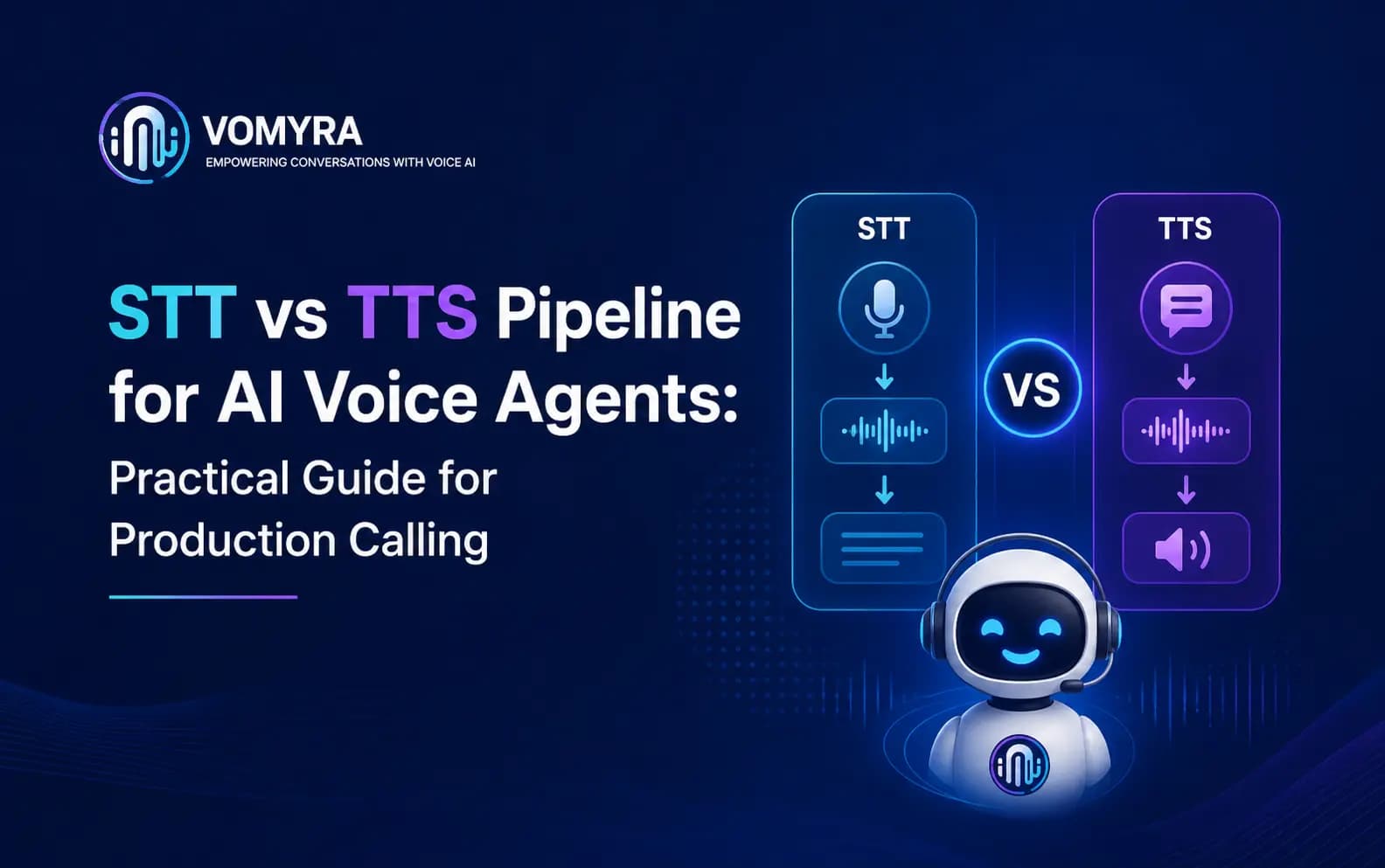
Speech-to-text (STT) and text-to-speech (TTS) sit at opposite ends of every AI voice agent’s pipeline – one turns what the caller says into text the system can reason over, the other turns the agent’s response back into speech the caller hears. They’re often discussed together, but they solve different problems, fail in different ways, and need to be evaluated differently when building a production voice agent.
This guide breaks down what STT and TTS actually do, where each one commonly causes problems in production calling, and how to think about choosing and tuning both for a real deployment – not just a demo.
STT and TTS: Two Different Jobs in the Same Pipeline
In a standard cascaded AI voice agent architecture, the flow looks like this:
Caller speaks → STT converts speech to text → Language model reasons and generates a response → TTS converts the response to speech → Caller hears the agent
STT sits at the input side, turning unpredictable, noisy human speech into clean text. TTS sits at the output side, turning the agent’s planned response into speech that sounds natural and holds the caller’s attention.
Because they sit at opposite ends of the pipeline, an issue with one doesn’t necessarily mean an issue with the other – a voice agent can transcribe perfectly but sound robotic, or sound wonderfully natural while frequently mishearing what the caller said. Evaluating them separately is the only way to actually diagnose production issues.
Speech-to-Text (STT): What It Needs to Get Right
STT is the layer most responsible for whether an AI voice agent actually understands the caller – and it’s often where production quality quietly breaks down.
Accuracy Under Real Conditions
Demo environments are quiet and controlled. Real phone calls aren’t. Production STT needs to hold up against:
- Background noise from mobile calls, traffic, or crowded environments
- Variable call quality across different networks and carriers
- A wide range of accents and speaking speeds
- Code-switching – for example, Hindi-English mixed speech, common across Indian conversations
An STT engine that performs well in testing but hasn’t been evaluated against these real-world conditions is one of the most common causes of AI voice agents that “don’t understand” callers in production.
Streaming vs Batch Transcription
Production voice agents need streaming STT – transcribing speech continuously as the caller talks, rather than waiting for them to finish and processing the whole utterance at once. Batch transcription adds latency that makes conversations feel slow and unnatural, and it also makes real-time interruption handling far harder to implement well.
Domain and Vocabulary Handling
Generic STT models can struggle with domain-specific vocabulary – product names, industry terms, local place names. Production deployments often need STT tuned or configured with relevant vocabulary to avoid consistent mis-transcription of the terms that matter most to the business.
Read Also: Speech-to-Speech vs Text-Based Voice Agents: Which Should You Use?
Text-to-Speech (TTS): What It Needs to Get Right
TTS is the layer that determines how human the agent feels – and it has an outsized effect on caller trust and engagement, even when everything else in the pipeline is working correctly.
Naturalness and Prosody
Flat, monotone TTS is one of the fastest ways to make an AI voice agent feel obviously artificial. Production-grade TTS needs natural pacing, appropriate pauses, and intonation that matches the content of what’s being said – a question should sound like a question, not a flat statement with a question mark.
Language and Accent Support
For Indian businesses, TTS needs to support the languages and accents customers actually use – not just English, but Hindi and regional languages, spoken with pronunciation and rhythm that sounds native rather than transliterated.
Generation Latency
TTS generation time adds directly to response latency. A high-quality voice that takes too long to generate can make the agent feel slow, even if the underlying reasoning was fast. Production systems typically need TTS that streams audio as it’s generated, rather than waiting for the full response to render before playback begins.
Consistency Across Long Conversations
Some TTS systems drift in tone, pacing or pronunciation across a longer conversation. For calls that run several minutes – a detailed support query, a real estate qualification call – consistent voice quality throughout matters as much as quality at the start.
STT vs TTS: Where Problems Typically Show Up
| Symptom | Likely Cause | Layer to Investigate |
| Agent frequently misunderstands what caller said | Poor accuracy under noise, accents, or code-switching | STT |
| Conversation feels slow to respond | Batch transcription instead of streaming | STT |
| Agent mishears product names or specific terms | Missing domain vocabulary tuning | STT |
| Agent sounds robotic or flat | Poor prosody and intonation | TTS |
| Long pause before agent starts speaking | Slow TTS generation, not streaming | TTS |
| Agent’s accent or pronunciation feels unnatural for the audience | Language/accent model mismatch | TTS |
| Agent’s voice quality changes partway through a call | Inconsistent TTS rendering over longer responses | TTS |
| Agent responds to the wrong thing entirely | Language model reasoning, not STT/TTS | Dialogue layer |
This table is a useful first diagnostic step when a voice agent isn’t performing well in production – most issues trace clearly back to one side of the pipeline once isolated this way.

Evaluating STT and TTS for a Production Deployment
Before committing to a voice AI platform or vendor, it’s worth testing both layers under realistic conditions, not just a clean demo call:
- Test with real phone audio, not a studio microphone – mobile network quality changes everything.
- Test across the accents and languages your actual customers use, not just standard English.
- Time the full round-trip, from caller finishing a sentence to agent starting to respond, not just individual component benchmarks.
- Listen for naturalness over a longer conversation, not just the first few seconds.
- Check how domain-specific terms are handled – your product names, local place names, and industry vocabulary.
A platform that performs well on all of these under real conditions is a meaningfully different proposition from one that only sounds good in a controlled demo.
Production-Grade STT and TTS, Already Tuned
Getting both ends of the voice pipeline right – accurate transcription under real call conditions, and natural, low-latency speech generation across languages – is a significant, ongoing engineering effort on its own.
Vomyra is India’s Agentic Voice AI Platform, built on voice infrastructure already tuned for real Indian phone conditions: accents, code-switched speech, regional languages, and mobile network variability. Businesses can launch AI voice agents – Research, Outreach, Qualification, Closing and Follow-Up – with STT accuracy and TTS naturalness already handled, using real Indian mobile numbers and human-like conversations in multiple languages.
If you’re evaluating a voice AI platform for production calling, it’s worth testing how Vomyra performs under your own real call conditions, not just a demo script.
FAQs
Which matters more for a good AI voice agent – STT or TTS?
Both matter, but for different reasons. Poor STT means the agent doesn’t understand the caller, which breaks the conversation entirely. Poor TTS means the agent sounds unnatural, which hurts trust and engagement even when understanding is fine. Production quality requires both to be strong.
Can I mix and match STT and TTS providers with different language models?
In a cascaded architecture, yes – this is one of its advantages. Many production systems use different specialised providers for STT, the language model, and TTS, chosen for their individual strengths.
Do STT and TTS need separate tuning for Indian languages?
Generally yes. Accuracy and naturalness for Hindi and regional Indian languages, including code-switched speech, often require models specifically trained or tuned for that context, rather than relying on general-purpose English-first models.
How much does STT/TTS quality affect conversion or resolution rates?
Significantly. Mis-transcription leads to wrong or irrelevant responses, and unnatural-sounding TTS reduces caller trust and engagement – both directly affect whether a call actually achieves its goal, whether that’s qualifying a lead or resolving a support query.