AI voice agents are becoming useful for businesses that handle customer enquiries, sales calls and appointment bookings. However, a voice agent needs more than speech recognition and natural-sounding responses to work effectively in real business environments. It also needs access to relevant information, external tools and business systems.
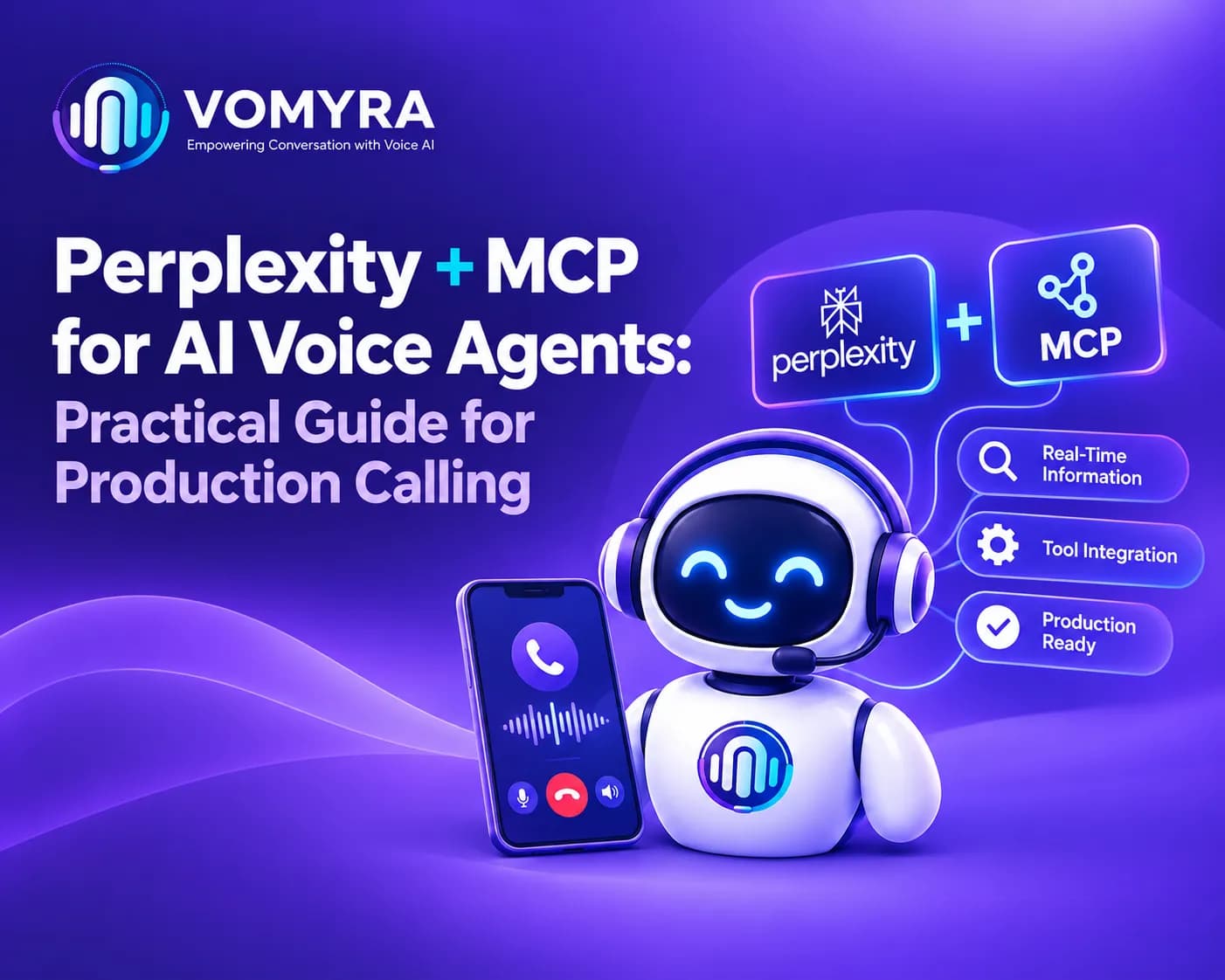
This is where Perplexity MCP for AI voice agents becomes relevant. By combining Perplexity’s search capabilities with the Model Context Protocol (MCP), developers can build systems that retrieve information and connect AI agents with external tools during conversations.
For businesses developing production calling systems, this approach can support more informed responses, better tool access and flexible conversation workflows.
What Is Perplexity MCP and Why Does It Matter for Voice Agents?
Perplexity provides AI-powered search and research capabilities that help applications retrieve relevant information from the web. MCP, or Model Context Protocol, is an open standard that allows AI applications to communicate with external tools and data sources through a structured interface.
When used together, they can extend what a voice agent can do beyond answering questions using previously supplied information.
For example, a customer may call a travel company and ask about a destination’s current travel conditions. The voice agent can use an available search tool to retrieve relevant information and generate a response.
Perplexity MCP for AI voice agents can therefore be useful when applications need access to changing information during customer conversations.
How Does MCP Work in an AI Voice Agent?
MCP creates a standard way for AI applications to discover and use external tools. Instead of building a separate connection for every tool, developers can use MCP-compatible servers to expose available capabilities.
A typical architecture includes three main components:
- MCP Host: The AI application that manages the interaction and decides when tools are needed.
- MCP Client: The component that communicates with an MCP server.
- MCP Server: The service that exposes tools, resources or prompts to the application.
In an AI voice agent MCP integration, these components work alongside speech recognition, a language model and text-to-speech technology.
The voice system receives the customer’s speech, converts it into text and sends the request to the AI model. When external information is required, the model can request an available tool through MCP. The result is then used to prepare a spoken response.
How to Set Up Perplexity MCP Integration
Building a working setup requires connecting the search service, MCP server and voice application correctly.
1. Prepare the Perplexity Connection
Start by reviewing the available Perplexity developer tools and selecting the integration method suitable for your application.
Perplexity offers API-based search capabilities, while MCP-compatible tools can provide a standard interface for supported workflows. Developers should check the current documentation for authentication, supported operations and usage limits.
For a Perplexity MCP integration, keep API credentials in secure environment variables rather than placing them directly inside application code.
2. Configure an MCP Server
An MCP server exposes specific tools that an AI application can access. Depending on the implementation, these tools may support web searches, information retrieval or other external operations.
Configure the server with only the capabilities required by the voice application. This makes tool access easier to manage and reduces unnecessary complexity.
3. Connect the MCP Client to the AI Application
The MCP client communicates with the server and helps the application discover available tools.
During development, test whether the client can connect successfully, identify the available tools and receive valid responses. This is an important step in building a reliable Model Context Protocol for voice agents.
4. Connect the Workflow to the Voice System
Once the tool connection works, integrate it with the voice agent’s conversation logic.
For example, when a customer asks about a product’s latest details, the AI model can determine whether an external search is necessary. If required, it requests the appropriate tool, processes the returned information and generates a response.
This AI voice agent MCP integration should also include clear handling for unavailable tools, timeouts and incomplete results.
Practical Use Cases of MCP-Powered Voice Agents
The value of MCP becomes clearer when it is connected to real business tasks.
Customer Support and Information Retrieval
A customer support agent may need to answer questions about updated services, policies or product information. Search tools can help retrieve relevant information instead of relying entirely on static conversation data.
Sales and Lead Qualification
During sales calls, an agent may need customer information from a CRM or details about available products. Connected tools can help retrieve relevant records and support the qualification process.
Appointment Management
A voice agent connected to a scheduling tool can check available slots and assist with appointment booking. The system can also update connected business applications after confirmation.
Travel and Service Enquiries
Businesses handling travel or service enquiries may need changing information to answer customer questions. MCP-powered voice agents can access suitable external tools when those details are not already available in the application.
Read More: Claude + MCP for AI Voice Agents: A Practical Guide for Production Calling
These use cases show how MCP can connect conversational AI with practical business operations.
Using the Perplexity API for AI Agents in Production
Not every voice conversation needs a web search. In fact, calling external services for every question can increase response time and operating costs.
The Perplexity API for AI agents is most useful when the conversation requires current information that is not available in the application’s existing knowledge base.
Developers should consider the following practices:
- Use tool selection carefully: Trigger searches only when the request requires external information.
- Control response length: Retrieve relevant information instead of processing unnecessarily large results.
- Handle failures: Provide a useful fallback when a search service is unavailable.
- Protect sensitive data: Avoid sending personal customer information to external services without an appropriate reason and permission.
- Validate responses: Check retrieved information before using it in important business decisions.
These practices help maintain a balance between response quality, reliability and system performance.
Production Challenges When Building AI Voice Agents with MCP
A development setup may work well in testing but behave differently under real calling conditions. Production systems need careful attention to several technical factors.
Latency: External searches and tool calls can delay spoken responses. Developers should use timeouts, efficient workflows and short responses to reduce unnecessary waiting.
Security: MCP servers should use appropriate authentication and access controls. Sensitive operations should require additional checks rather than being executed automatically.
Error handling: The voice agent should know what to do when a tool returns an error, incomplete data or no results.
Scalability: High call volumes can create additional demand on APIs and connected services. Rate limits, concurrency and infrastructure capacity should be tested before deployment.
Conversation quality: Technical integrations should not interrupt natural conversations. The agent should explain when it needs time to retrieve information and avoid reading long search results aloud.

How Vomyra Approaches Connected Voice AI Workflows
Building a useful voice agent requires more than connecting different APIs. The system must understand customer requests, choose suitable actions and communicate the results clearly.
Vomyra, India’s Agentic Voice AI Platform, focuses on AI-powered voice conversations and business automation workflows. Its approach aligns with the growing need to connect voice agents with external systems and useful business tools.
With the right architecture, developers can explore MCP-based integrations for information retrieval, CRM operations and other supported workflows. These connections can help businesses create voice experiences that go beyond basic scripted conversations.
Conclusion
Perplexity MCP for AI voice agents offers developers a practical way to explore external search capabilities and tool connectivity in conversational applications. By combining search, structured tool access and voice technology, businesses can build agents that handle more complex customer requests.
However, production success depends on more than integration. Latency management, secure access, reliable error handling and natural conversation design all matter. With careful implementation, Vomyra can support businesses exploring more connected and capable voice AI workflows.
Frequently Asked Questions
1. What is Perplexity MCP for AI voice agents?
It refers to using Perplexity’s search capabilities alongside MCP-based tool connectivity to help voice agents retrieve external information during conversations.
2. What is the purpose of MCP in voice AI?
MCP provides a standard communication method between AI applications and external tools, allowing voice agents to access supported services.
3. Is Perplexity MCP integration suitable for production calling?
It can be suitable when properly configured, tested and secured. Developers should evaluate latency, API limits, authentication and failure handling before deployment.
4. Can MCP-powered voice agents connect with CRMs?
Yes. An MCP server can expose CRM-related tools when the required integration is developed and authorised. The voice agent can then access supported CRM operations.
5. Does the Perplexity API for AI agents replace a voice AI platform?
No. Search APIs provide information retrieval capabilities, while a voice AI platform handles speech processing, conversation management and spoken responses. They serve different purposes.