Something Structural Is Changing
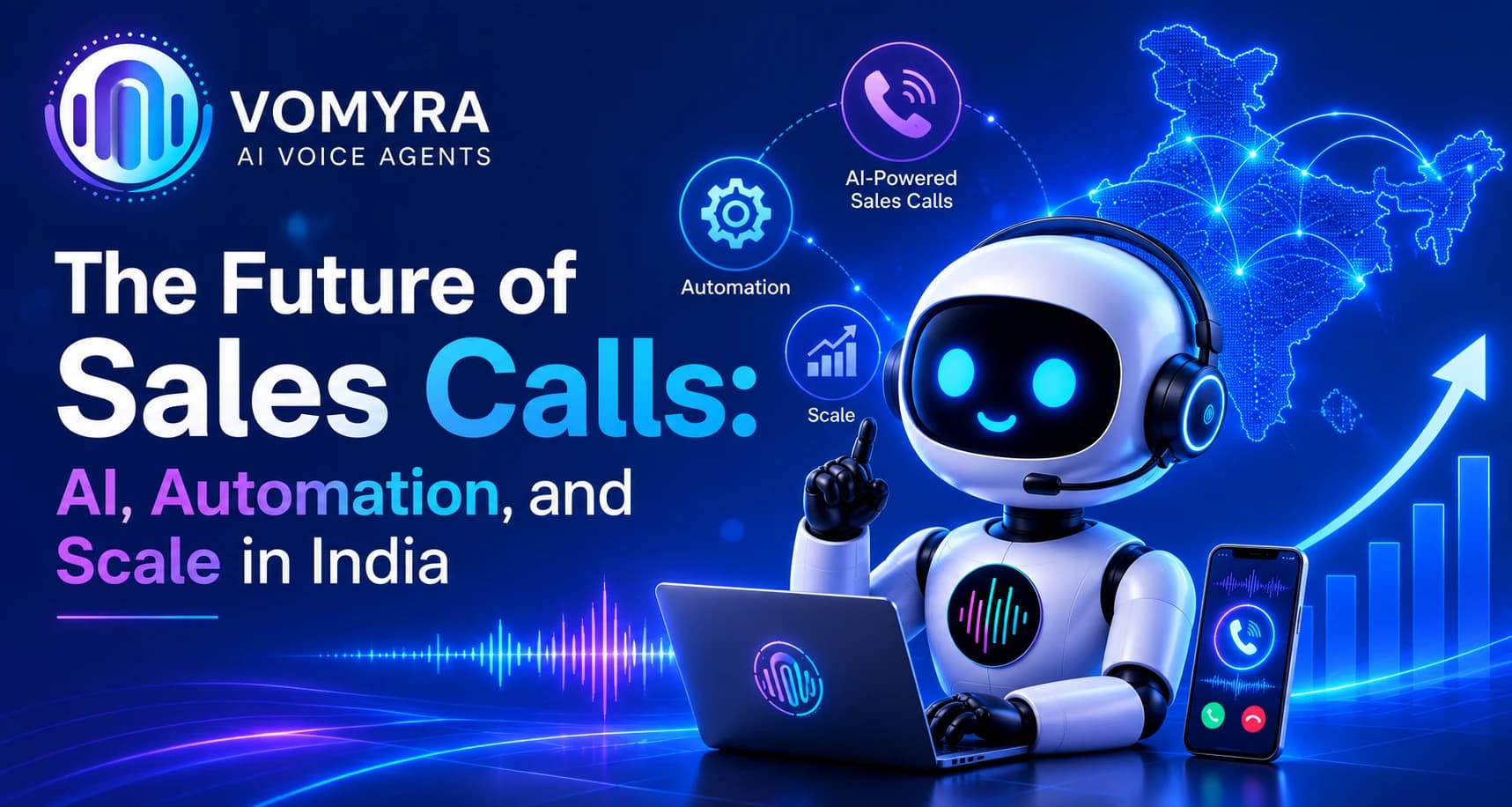
The Indian sales call as it existed five years ago – a human SDR with a calling list, a script, and a target of 80 to 100 dials per day – is not disappearing. It is being restructured from the ground up. The restructuring is already underway, and the data behind it is specific enough to make planning concrete rather than speculative.
India is the fastest-growing AI calling market in the world in 2026, expanding at 94 percent year-over-year by deployment volume.
A human SDR averages 15 to 25 dials per hour. An AI voice agent executes 100 to 500 simultaneous calls – a 20 to 50 times scale advantage.
By 2030, Gartner projects 70 percent of routine sales tasks will be automated globally, with India tracking ahead of that curve given the structural cost differential and language model progress that make AI calling economics uniquely compelling in this market.
Vomyra AI Voice Agent is one of the platforms reshaping what sales calling looks like for Indian businesses – a no-code AI voice agent platform India businesses across real estate, BFSI, hospitality, restaurants, fintech, and recruitment deploy to qualify leads, follow up automatically, and scale outbound calling without adding headcount.
This is not a prediction about what might happen. It is an analysis of what is already happening, what comes next, and what Indian sales teams need to understand to compete in the environment being built right now.
Where Sales Calls Are Today in India
The baseline is useful to establish before discussing where things are going. A mid-market Indian sales operation in 2026 looks something like this: a team of four to eight SDRs handling inbound and outbound calling across multiple lead sources, a CRM that is partially updated, a follow-up process that is reliable on the best days and inconsistent on the worst, and a persistent gap between the number of leads generated and the number of leads meaningfully engaged.
The gap exists because of capacity arithmetic. Four SDRs working six-day weeks can realistically make meaningful first contact with 280 to 320 leads per month. Most Indian businesses generate more than that – and a significant share of those leads arrive outside working hours, where no one is available to call. The leads that get called quickly convert. The leads that wait convert at a fraction of that rate.
This baseline is the starting point for understanding what AI voice sales agents change and why Indian businesses are adopting them faster than any comparable market globally.
The Shift Already Happening: AI for Top-of-Funnel Volume

The first and most immediate application of AI in Indian sales calls is the top-of-funnel volume problem. Every lead that enters a CRM needs a first contact. That first contact needs to happen fast – ideally within 60 seconds of form submission – and it needs to qualify the prospect for the right next step.
An AI lead qualification voice bot India businesses deploy today handles this automatically, around the clock, in Hindi, Hinglish, Tamil, Telugu, Marathi, Gujarati, Bengali, Punjabi, or Assamese depending on how the prospect responds.
The economics of this shift are significant. When AI handles first contact and initial qualification, human SDRs stop spending the majority of their time on cold dials and repetitive FAQ calls. Instead, they spend it on warm conversations with prospects who have already confirmed interest, provided their budget range, and indicated a purchase timeline.
The conversion rate on those conversations is higher. The morale of the SDR team running them is better. The cost per qualified lead drops by 60 to 75 percent.
This top-of-funnel application is the one most Indian sales teams are deploying first in 2026, and the results are consistent enough that the question has shifted from “does this work?” to “which workflow do we automate first?”
What Changes in the Next Three Years
The current deployment phase is primarily about speed and coverage – responding faster, reaching more leads, covering after-hours.
The next phase, already visible in the deployments happening at scale in 2026, is about intelligence: AI voice agents that do not just qualify leads but genuinely contribute to moving them forward.
Predictive dialling based on intent signals. Rather than calling leads in the order they entered a CRM, AI outbound calling India systems will increasingly prioritize outreach based on real-time intent signals – website activity, email opens, portal re-visits, pricing page views – calling the highest-intent prospects at the moment their interest is peaking rather than working through a list in sequence.
The effect is a meaningfully higher connect-to-qualified-conversation rate without any increase in call volume.
Contextual follow-up based on call history. The next generation of AI voice agents does not start every follow-up call from zero. It references what was said in previous conversations, the specific objections raised, the timeline the prospect indicated, and the product features they asked about – and builds the follow-up conversation around that context.
This is the difference between a follow-up call that feels like a continuation of a relationship and one that feels like a reset.
Multilingual personalisation at scale. A multilingual AI calling bot India businesses use today switches languages based on what the prospect speaks.
The next evolution is personalisation within language – adjusting tone, register, and reference points based on whether the caller is a business owner in Mumbai, a government procurement manager in Lucknow, or a first-time buyer in Coimbatore. The prospect receives a conversation calibrated to their context, not a generic script in their language.
Voice AI integrated into the full revenue stack. The separation between calling tools, CRM, and marketing automation is collapsing.
By 2028, the expectation in most Indian mid-market sales operations will be that a call by an AI calling agent India system updates the CRM in real time, triggers the next step in a marketing sequence, alerts the AE responsible for the account, and generates a call summary that feeds back into predictive lead scoring – all within seconds of the call ending.
This integration is already possible in 2026 for businesses using the right platform. It will be the default operating assumption in two to three years.
Sector-by-Sector: How This Plays Out Across Indian Industries
Real estate. The AI voice agent for real estate India is already the first call every portal lead receives. The next phase is contextual follow-up across the full buying cycle – from initial inquiry to site visit to post-visit re-engagement – with AI handling every touch that does not require a human negotiator.
A developer running a weekend campaign launches on Saturday morning, and by Sunday evening, every lead has been qualified, site visits are booked, and the human sales team arrives Monday with a sorted pipeline.
BFSI. The AI voice agent for fintech India is moving from basic EMI reminders and loan inquiry qualification toward full onboarding support – collecting KYC details over voice, guiding first-time borrowers through documentation requirements, and answering compliance-sensitive questions in a structured, auditable format.
Regulatory frameworks are evolving to accommodate this, and the BFSI sector’s familiarity with AI calling at scale means adoption here runs ahead of most other sectors.
Restaurants and food service. An AI voice agent for restaurants India today handles order-taking and reservations during peak hours. With Petpooja AI integration voice support, the phone order goes directly into the kitchen ticketing workflow.
The future development is proactive outreach – AI calling regular customers on their typical order day, suggesting reorders based on purchase history, and offering reservation slots during low-traffic periods to improve capacity utilisation.
Healthcare. An AI dental appointment booking India clinic uses today focuses on reminders and rescheduling. The next application is longitudinal patient engagement – follow-up after consultations, check-in calls at intervals recommended by the treating doctor, and preventive care reminders in the patient’s regional language.
Voice AI for ISP technical support follows a similar trajectory, with AI handling tier-one support and proactive outreach when network issues are detected before the customer calls.
Hospitality. The AI voice agent for hotel booking India property deploys today to capture the 40 percent of calls that go unanswered during check-in hours. The next phase is guest relationship management – pre-arrival personalisation calls, post-stay feedback collection, and loyalty programme engagement in the guest’s preferred language.
Recruitment. An AI recruitment calling bot India HR team uses scales candidate screening to volumes no human team can sustain.
The next phase is multi-stage screening – an initial AI call that covers availability and basic fit, a second AI call that probes role-specific skills through structured questions, and escalation to a human interviewer only when both automated stages produce a positive outcome.
The Human Sales Role in an AI-Automated Sales Stack
The consistent finding across deployments in India in 2026 is that human sales performance improves when AI handles the top-of-funnel volume layer. This is counterintuitive until the mechanism is clear.
SDRs who spend 55 to 60 percent of their day on cold dials, voicemails, and repetitive FAQ calls are not doing sales. They are doing information transfer and list management.
When AI handles that layer, SDRs spend 65 to 70 percent of their day on warm conversations with pre-qualified prospects – the work that requires the interpersonal skill, the ability to read the conversation, and the judgment to know when to push and when to wait.
Quota attainment goes up. Turnover goes down. The quality of the relationship established in each conversation improves because the SDR is not fatigued by the 50 cold dials that preceded it.
The Hindi AI voice assistant for business does not replace the human who closes the deal. It creates the conditions in which that human can focus on closing rather than on finding and qualifying. Vomyra AI Voice Agent is built on exactly this principle – AI handling the volume layer so human sales teams spend their time on the conversations that genuinely require them.
What Indian Sales Leaders Should Do Now
The businesses that compound the advantage of AI in sales are not the ones that deploy every available tool simultaneously.
They are the ones that identify the single highest-volume, most repetitive element of their current sales call operation and automate that one thing first – measuring the outcome against the previous period’s data before expanding.
For most Indian sales operations, that starting point is inbound lead response: an AI phone agent with Indian number calling every new inquiry within 60 seconds, in the caller’s language, with a structured qualification conversation that produces a scored, annotated lead for the human team to work.
Thirty days of data from that single workflow produces the business case for the next one – outbound follow-up sequences, dormant lead reactivation, no-show recovery – each added in sequence as the previous one is measured and validated.
Vomyra AI Voice Agent supports this phased approach. A no-code AI voice agent platform India sales teams configure without engineering involvement, with native Hindi, Hinglish, Tamil, Telugu, Marathi, Gujarati, Bengali, Punjabi, and Assamese support, Petpooja POS and CRM integration, and Indian +91 numbers included in the platform.
A free trial allows a team to run the first workflow against real lead volume and see actual contact rate, qualification quality, and CRM integration before any payment commitment.
FAQs
1. How is Vomyra Voice AI Agent shaping the future of sales calls in India?
Vomyra Voice AI Agent is helping businesses embrace the future of sales calls in India by automating lead qualification, follow-ups, appointment scheduling, and customer engagement. With AI-powered voice conversations available 24/7, businesses can scale their sales operations while improving customer experience and reducing operational costs.
2. Why is AI important for the future of sales calls in India?
AI is transforming the future of sales calls by enabling faster, smarter, and more personalized customer interactions. Solutions like Vomyra Voice AI Agent help businesses automate repetitive sales tasks, respond instantly to customer inquiries, and empower sales teams to focus on closing high-value opportunities.
3. Can Vomyra Voice AI Agent replace human sales representatives?
No. Vomyra Voice AI Agent is designed to enhance human sales teams, not replace them. It automates routine tasks such as lead qualification, follow-up calls, reminders, and appointment booking, while human representatives handle complex discussions, negotiations, and relationship building.
4. Which businesses can benefit from Vomyra Voice AI Agent in India?
Businesses across real estate, healthcare, education, BFSI, e-commerce, logistics, recruitment, and travel can benefit from Vomyra Voice AI Agent. It helps organizations manage high volumes of sales and customer service calls efficiently, making it easier to scale operations without increasing team size.
5. Why choose Vomyra Voice AI Agent for the future of sales calls in India?
Vomyra Voice AI Agent combines AI, automation, and scalable voice technology to help businesses modernize their sales process. It offers intelligent voice interactions, CRM integration, multilingual support, real-time analytics, and automated follow-ups, enabling organizations to improve conversions, increase productivity, and stay competitive in India’s evolving sales landscape.