The Question That Matters More Than It Sounds
If you have been evaluating AI voice agents for your business in 2026, you have almost certainly encountered two different types of demos. In one, the AI responds within what feels like a natural conversational pause, the voice sounds warm and immediate, and the back-and-forth feels close to a real human exchange.
In another, there is a half-second gap between when you stop speaking and when the AI begins responding. The voice is clear. The response is accurate. But something about the rhythm feels slightly off.
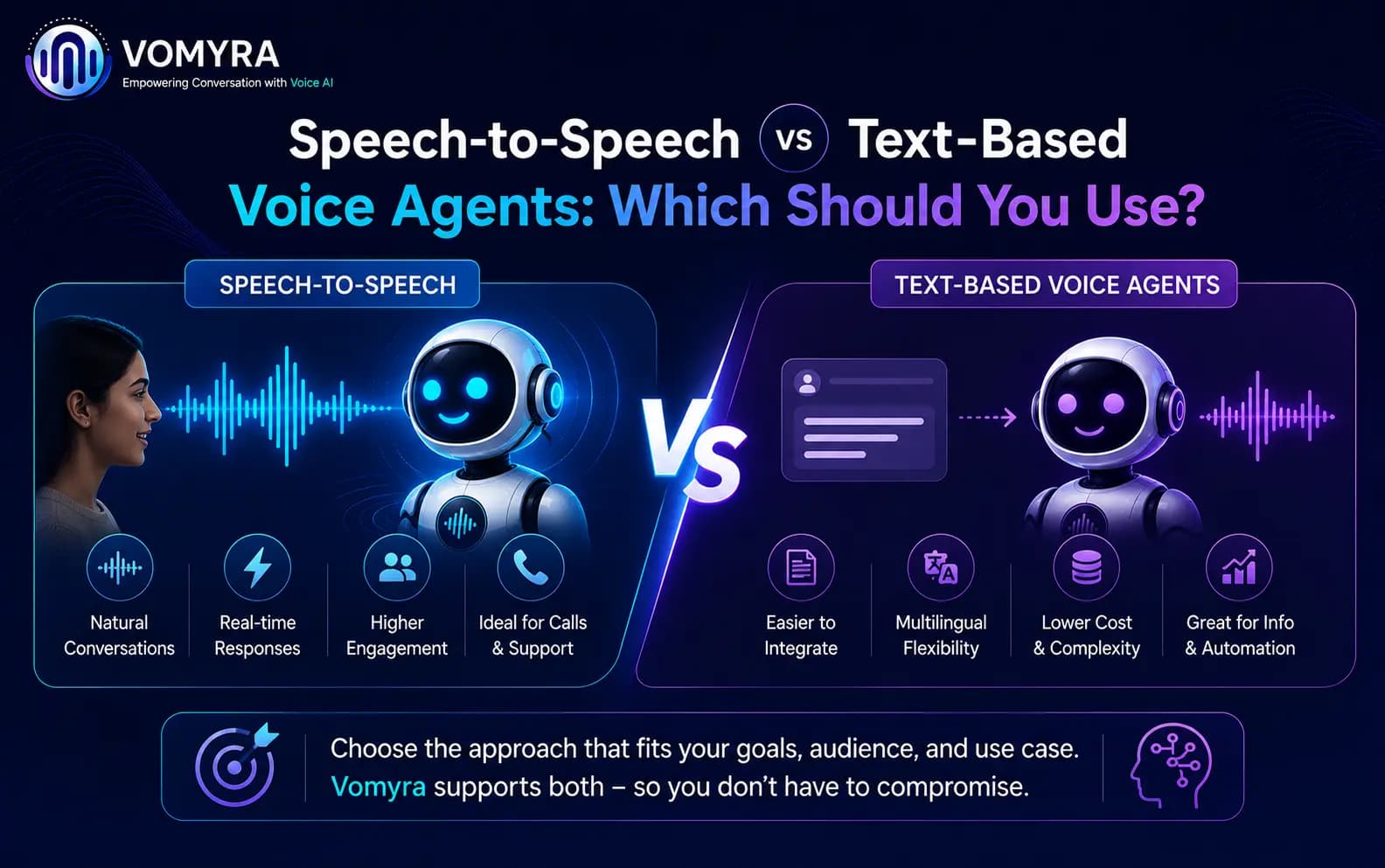
The difference between those two experiences usually comes down to the underlying architecture. Speech-to-speech (S2S) models take audio in and return audio directly, without converting to text in between.
Text-based cascaded pipelines convert speech to text first, pass the text through a language model, then convert the response back to speech. Each approach has real strengths and real limitations, and the choice between them determines a significant part of the caller experience your customers will have.
Vomyra AI Voice Agent runs both architectures in production on its platform today. AWS Nova 2 Sonic and OpenAI GPT Realtime handle speech-to-speech. Cartesia, Sarvam Bulbul V3, and other models handle the text-based cascaded pipeline.
The choice between them depends on your specific use case, your caller population, and what you are optimising for. This guide explains both approaches, where each performs best in the Indian calling context, and how to choose.
Understanding the Two Architectures
Text-Based Cascaded Pipeline: The Standard Architecture
The cascaded pipeline has three sequential stages. Audio from the caller’s phone goes to a speech-to-text (STT) model that transcribes what was said into text. That text goes to a large language model that processes the meaning, accesses any tools or databases it needs, and generates a text response.
That text response goes to a text-to-speech (TTS) model that converts it back into audio, which is played to the caller.
A 500ms gap between a user finishing a sentence and the agent responding is noticeable. 200ms is not. The cascaded pipeline in a well-optimised streaming implementation delivers response times in the 400 to 700 millisecond range on good infrastructure.
In a non-streaming implementation where each stage completes fully before the next begins, response time can reach 1,000 to 1,500 milliseconds, which callers experience as an unnatural pause.
The text layer in the middle of the cascade is both its limitation and its greatest practical strength. It creates latency because three sequential processing stages take longer than one unified stage.
But it also creates a natural audit trail, a structured surface for tool calling, and a clear point for compliance logging that are genuinely valuable for Indian business deployments.
Speech-to-Speech Models: The Newer Architecture
Speech-to-speech models collapse the three-stage pipeline into a single multimodal model that takes audio directly as input and generates audio directly as output. There is no text intermediary. The model processes the acoustic signal end-to-end.
The latency advantage of this architecture is significant in controlled conditions. AWS Nova 2 Sonic, OpenAI GPT Realtime, and Azure Voice Live, all running in production on Vomyra, achieve response times in the 200 to 400 millisecond range under good conditions.
That speed produces a conversational rhythm that callers experience as genuinely natural rather than subtly mechanical.
Because there is no text layer, S2S models also preserve acoustic information that the STT transcription step discards: the emotional tone in the caller’s voice, the specific prosodic pattern of a question versus a statement, the hesitation that signals uncertainty.
An S2S model can hear that the caller sounds frustrated even when their words are neutral, and calibrate the response accordingly. A cascaded pipeline working from a text transcript loses this signal at the STT step.
The India-Specific Factors That Change the Comparison
Most architectural comparisons for voice agents are written for Western markets where broadband WebRTC connections are the primary deployment environment. Indian business calling operates under different conditions, and those conditions shift the trade-offs meaningfully.
8 kHz PSTN Audio: The Indian Telephony Reality
Standard Indian telephony transmits audio at 8 kHz, half the sample rate of the 16 kHz audio at which most voice AI models are evaluated. This compression removes the upper frequency range of human speech, affecting both the emotional signal that S2S models are designed to process and the phoneme clarity that STT models depend on.
S2S models that were trained primarily on high-quality broadband audio perform below their benchmark numbers on 8 kHz Indian PSTN audio. The acoustic features they use to detect emotion, intent, and prosody are partially stripped by the telephony codec before the model receives the signal.
AWS Nova 2 Sonic is specifically trained with native Hindi and optimised for telephony conditions, which is why it performs better on Indian PSTN calls than S2S models not trained on Indian telephony data.
Text-based cascaded pipelines that use STT models specifically trained on Indian 8 kHz telephony audio, such as Sarvam’s Saarika, maintain consistent accuracy on Indian PSTN audio because the STT model was built for this specific degraded acoustic environment. The cascaded pipeline’s modular architecture allows the STT component to be independently optimised for Indian telephony without changing the LLM or TTS components.
Hinglish Code-Switching: Where Architecture Choice Matters
Hinglish, the mid-sentence mixing of Hindi and English that characterises urban Indian business conversation, creates specific challenges for both architectures.
For cascaded pipelines, Hinglish is primarily an STT problem. The transcription must correctly capture both the Hindi and English portions of a code-switched utterance as a single coherent input. STT models trained on monolingual Hindi or monolingual English produce fragmented or incorrectly transcribed Hinglish, which causes the LLM to misunderstand the caller’s intent.
STT models trained specifically on Indian telephony Hinglish audio, such as Sarvam’s Saarika, handle code-switching accurately because they have seen this specific input distribution in training.
For S2S models, Hinglish requires the model to process code-switching at the audio level, without the benefit of a text intermediary that makes the language boundary explicit.
This is technically harder for the model, and the performance gap between S2S models trained on Indian data versus those adapted from English-first models is more pronounced on Hinglish input than on clean Hindi or clean English.
Tool Calling: The Enterprise Integration Requirement
One of the most important practical differences between the two architectures is reliability of tool calling, the ability to make a function call to an external system during a live call and incorporate the result into the response.
When a caller asks what loan EMI would be for a Rs 50,000 loan at the current rate, the agent needs to call an API, retrieve the calculation, and respond accurately. When a caller asks whether a specific apartment is still available, the agent needs to query a live inventory system.
When a caller books an appointment, the agent needs to write to a calendar system. All of these require reliable tool calling that produces a structured function call, receives a structured response, and incorporates it into a natural spoken reply.
Tool calling in text-based cascaded pipelines is mature and reliable because it operates in the text domain where structured JSON function calls are natural. The LLM layer generates a function call specification, the orchestration layer executes it, and the result returns to the LLM as context for the response. This pattern is battle-tested across millions of production deployments.
Tool calling in S2S models is improving but is still maturing in 2026. The challenge is that the model needs to recognise that a tool call is needed from audio input, generate the call specification, and resume the audio output incorporating the result, without the clear structural separation that text-based orchestration provides. For complex multi-step tool calls, the cascaded pipeline remains more reliable.
Side-by-Side: When to Use Each
Use Speech-to-Speech When:
Conversational naturalness is the primary metric. Consumer-facing use cases where the caller experience is the product and emotional resonance matters more than complex task completion are the strongest current fit for S2S. A premium hotel pre-arrival personalisation call, a wellness coaching check-in, or a high-touch customer success touchpoint benefits from the shorter latency and emotional warmth that S2S delivers.
Call duration is short and intent is straightforward. S2S models perform best on calls where the interaction is focused and does not require multi-step tool use. A table reservation call, an appointment confirmation, or a simple product enquiry response are good fits.
Your caller population speaks primarily one language. S2S models are most consistent when the caller’s language is within the distribution of their training data. For Hindi-primary callers, AWS Nova 2 Sonic with native Hindi training is the right S2S choice. For Tamil, Telugu, or Kannada-primary callers, the cascaded pipeline with language-specific STT models currently outperforms general-purpose S2S on accuracy.
You want the fastest possible response time. For outbound campaigns where the agent’s opening statement needs to land immediately when the call connects, S2S models produce the natural conversational opening faster than the cascaded pipeline can complete its first STT pass.
Use Text-Based Cascaded Pipeline When:
Reliable tool calling is required. Any use case where the agent needs to check live inventory, retrieve customer account data, calculate a figure, or write to a system during the call is better served by the cascaded pipeline’s mature tool calling infrastructure.
Compliance logging and audit trails are required. The text transcript produced by the STT layer is a natural compliance artifact. For Indian BFSI deployments under RBI and IRDAI guidelines, for healthcare under DPDP requirements, and for any regulated industry where every AI interaction needs a documented record, the cascaded pipeline produces this record automatically. S2S deployments require a separate transcription step to generate the same documentation.
Hinglish or regional language accuracy is the primary requirement. For businesses serving callers who speak Hinglish, Tamil, Telugu, Kannada, Marathi, Gujarati, Bengali, Punjabi, or Assamese, the cascaded pipeline with a language-specific STT model such as Sarvam Saarika currently delivers better transcription accuracy on 8 kHz Indian PSTN audio than general-purpose S2S models.
Multi-turn qualification with complex logic. A five-question lead qualification flow that branches based on each answer, accesses different knowledge base sections depending on the qualifier’s profile, and produces a structured output to a CRM at the end is more reliably handled by the cascaded pipeline where each stage can be independently validated.
You are running outbound campaigns at scale. Outbound qualification campaigns where hundreds of calls run simultaneously benefit from the cascaded pipeline’s predictable cost structure, its ability to batch-process tool calls efficiently, and its mature retry and error handling infrastructure.
How Vomyra Handles Both: The Single Dashboard Advantage

The practical challenge for most Indian businesses is that the right architecture for one use case may not be the right architecture for another.
A real estate business running outbound qualification campaigns at scale benefits from the cascaded pipeline’s reliable tool calling and CRM integration. The same business’s premium property division running high-touch pre-appointment personalisation calls might benefit from S2S’s conversational warmth.
Having to choose a single architecture and stick with it across all use cases is a false constraint that most businesses should not accept. Vomyra AI Voice Agent runs all major models in production from a single dashboard, switchable without a development cycle. AWS Nova 2 Sonic for S2S Hindi-primary calls. OpenAI GPT Realtime for S2S with complex instruction-following. Azure Voice Live for enterprise S2S.
Cartesia for cascaded calls with voice cloning. Sarvam Bulbul V3 with Saarika STT for Hinglish and regional Indian language accuracy.
The switching is a dropdown selection in the agent configuration, not a vendor change, a new API integration, or a development project. An agent running on Cartesia can be switched to Nova 2 Sonic for a specific campaign without changing anything else in the configuration.
This matters specifically for Indian SMBs because the caller population is not uniform. A national real estate developer’s portal leads from Tamil Nadu require different language handling than leads from Uttar Pradesh.
A fintech running EMI reminder campaigns to urban Hinglish speakers and rural Hindi speakers from the same platform needs the flexibility to deploy the right model for each segment without building separate systems.
Latency in Practice: What the Numbers Actually Mean for Indian Calls
The latency numbers that voice AI platforms publish in their specifications are almost always measured under optimal conditions: high-bandwidth connections, clean audio, simple single-turn queries. The numbers that matter for Indian calling are the production numbers under realistic conditions.
A 500ms gap is noticeable; 200ms is not. For the Indian PSTN calling environment specifically, the targets that produce natural conversation are:
Time-to-first-audio under 400 milliseconds for S2S models. This is achievable on Vomyra’s production infrastructure with AWS Nova 2 Sonic and OpenAI GPT Realtime on simple turns.
Total turn time under 700 milliseconds for cascaded pipelines on well-optimised streaming implementations. Vomyra’s streaming cascaded pipeline achieves this range on Indian PSTN calls for most turn types.
Barge-in latency under 60 milliseconds for TTS flush when the caller interrupts. This is the metric most platforms do not publish, but it is what determines whether the agent feels responsive when a caller tries to cut in.
The gap between these numbers and what some platforms publish is the 8 kHz PSTN acoustic environment, regional accent processing overhead, and tool call execution time. A realistic assessment for your specific calling use case requires testing on actual Indian mobile call audio, not on the platform’s demo interface.
The Practical Decision Framework
Before choosing an architecture for a specific voice agent deployment, answer these four questions.
Does this use case require real-time tool calls to external systems? If yes, start with the cascaded pipeline. The tool calling reliability advantage is significant enough that it overrides the latency advantage of S2S for any use case where tool execution is part of the main call flow.
What is the primary language of your caller population? If it is Hindi-primary urban callers, AWS Nova 2 Sonic’s native Hindi S2S is competitive with the cascaded pipeline. If it is Hinglish, Tamil, Telugu, Kannada, or another regional Indian language, the cascaded pipeline with a language-specific STT model currently delivers better accuracy on Indian PSTN audio.
Does this use case require compliance documentation? If yes, the cascaded pipeline’s automatic transcript is a structural advantage that reduces the compliance implementation burden compared to adding transcription on top of an S2S deployment.
Is conversational warmth or response speed the primary caller experience metric? If warmth and naturalness matter more than feature completeness for this specific use case, S2S’s lower latency and emotional signal preservation are worth the trade-offs on tool calling and compliance complexity.
Most Indian SMB deployments answer these four questions in a way that points to the cascaded pipeline as the primary architecture, with S2S for specific high-touch or consumer-facing applications where the conversational experience is the product.
Getting Started
The most useful way to evaluate the S2S versus cascaded pipeline choice for your specific business is to run both architectures on the same call type and compare the outputs directly. Vomyra’s model selection makes this possible without separate vendor contracts or development work.
A free trial of Vomyra AI Voice Agent includes 500 monthly credits that renew every month, full access to both S2S models (AWS Nova 2 Sonic, OpenAI GPT Realtime) and cascaded pipeline models (Cartesia, Sarvam Bulbul V3), Indian 98/94 mobile numbers, 70-plus Indian language support, and call transcripts that make comparing the two architectures straightforward.
Run five test calls on S2S and five on the cascaded pipeline for the same use case. Review the transcripts for accuracy, listen to the call recordings for naturalness, and let the actual outputs for your specific caller population and use case determine the choice rather than an architectural preference made in the abstract.
Frequently Asked Questions
What is the main difference between speech-to-speech and text-based voice agents?
Speech-to-speech (S2S) models take audio in and return audio directly, with no text intermediary in between. Text-based cascaded pipelines convert speech to text first, pass it through a language model, then convert…
Which architecture is better for Hinglish calls in India?
For Hinglish code-switching on Indian 8 kHz PSTN audio, the cascaded pipeline with a Hinglish-trained STT model currently delivers better transcription accuracy than general-purpose S2S models. AWS Nova 2 Sonic with…
Does Vomyra support both speech-to-speech and text-based architectures?
Yes. Vomyra runs Nova 2 Sonic, GPT Realtime, and Azure Voice Live for S2S, and Cartesia with Saarika STT for the cascaded pipeline. All switchable from one dashboard, no separate vendor accounts needed. Vomyra runs AWS Nova 2 Sonic, OpenAI GPT Realtime, and Azure Voice Live for speech-to-speech, alongside Cartesia and Sarvam Bulbul V3 with Saarika STT for the cascaded pipeline.