A voice agent that can only generate speech is not particularly useful in production. The harder problem is connecting that agent to live business systems, order databases, booking calendars, POS software, while keeping response latency low enough that a phone conversation still feels natural.
This piece looks at how that connection works at the protocol level, building on our earlier explainer on what an MCP server is, and breaks down the architecture behind a production MCP server voice agent technical stack.
The Core Architecture: Host, Client, Server
MCP follows a three-part model: the host, the application a user interacts with, in this case the voice engine handling speech recognition and generation; the client, which lives inside the host and maintains a connection with each MCP server; and the server itself, which exposes tools that perform actions, resources that provide read-only data, and prompts that act as reusable instruction templates.
This separation matters because it keeps the voice engine decoupled from the systems it connects to. The host does not need built-in logic for Petpooja, Google Sheets, or a hotel booking API it only needs to speak MCP, and any server implementing the protocol correctly becomes available to it. Adding a new integration means standing up a new MCP server, not rewriting the core voice pipeline.
How Messages Actually Travel Between Client and Server
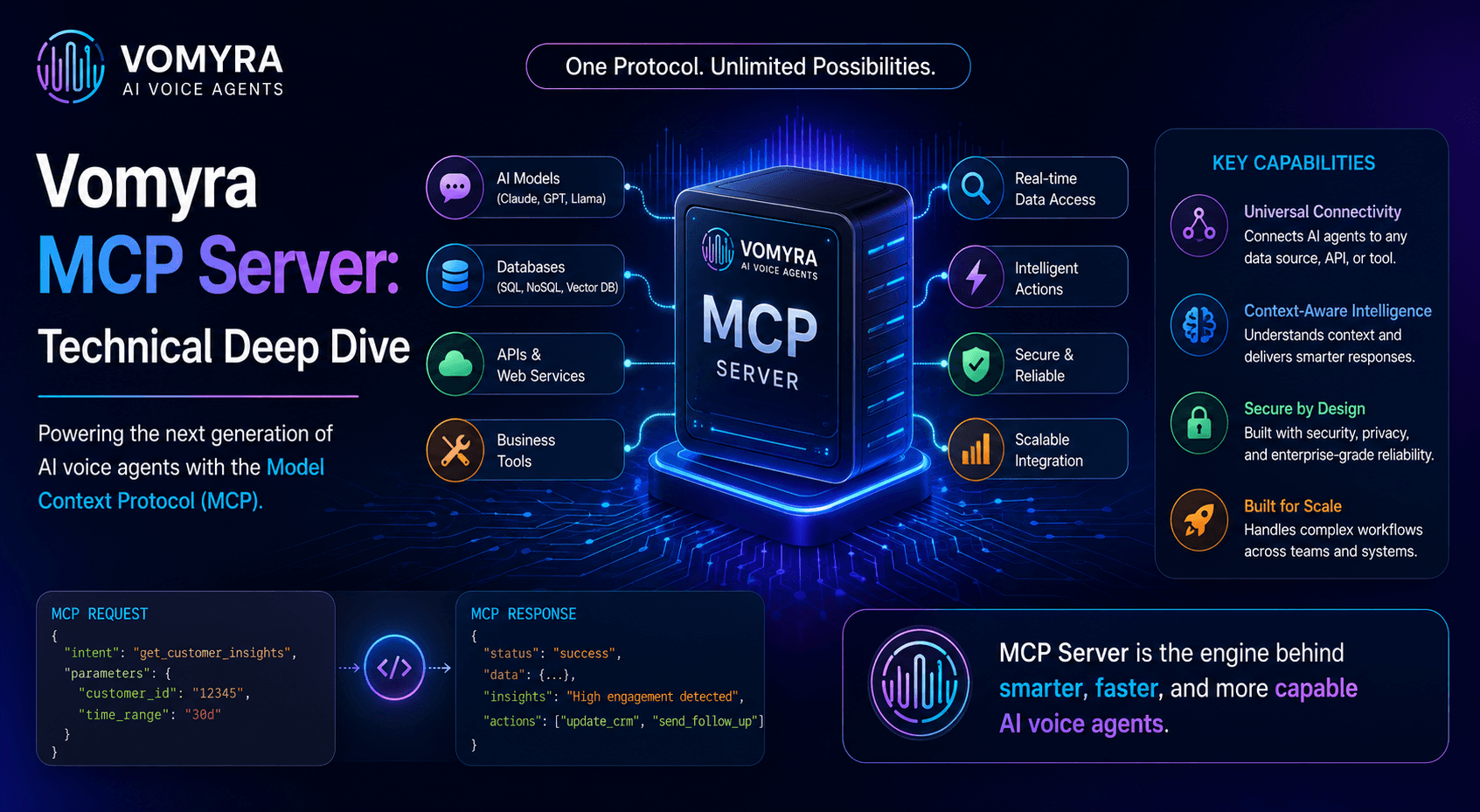
Every message exchanged between an MCP client and server follows a structured request-and-response format. When the voice engine wants to call a tool, it sends a request naming the tool and supplying the arguments it needs, such as an order number or a customer’s phone number. Each request carries a unique identifier so the server’s reply can be matched back to the original call.
The server answers with either a result containing the requested data, or an error describing what went wrong. There is also a category of one-way messages, called notifications, used for things like alerting the client that a server’s list of available tools has changed these skip the usual reply step since no response is expected. Building the protocol on this kind of structured exchange means any client that understands the format can talk to any properly built server without learning a custom, one-off contract.
Connection Lifecycle and Capability Negotiation
Before any tool can be called, the client and server go through a short handshake. The client opens the connection and shares its protocol version and supported capabilities. The server replies with its own list, naming the tools, resources, and prompts it exposes. The client confirms the handshake is complete, and only then does normal request traffic begin.
This negotiation step lets a voice engine discover what a given integration can do at runtime, rather than having that information hardcoded. If a restaurant’s POS server exposes the ability to place an order, check inventory, and update an existing order, those actions become available to the agent automatically once the handshake completes, without any change to the voice engine’s own codebase.
Transport Choices: Local Processes vs Remote Streaming

MCP supports two standard ways of moving messages between client and server. One runs the server as a local process on the same machine, exchanging messages directly, which suits local tooling well. The other is a remote, streaming connection over the internet, built for scenarios with multiple concurrent clients, authentication requirements, and the need to reconnect cleanly if a connection drops.
A production voice platform handling calls for many businesses at once cannot rely on a local process per integration. A Vomyra Ai Voice Agent connects to remote MCP servers over this streaming approach, which allows the same POS or CRM integration to serve multiple tenants concurrently while keeping each session isolated. Authentication on this path is handled per request, typically through bearer tokens issued via OAuth, so a compromised token cannot be replayed indefinitely without detection.
Why Latency Engineering Matters More for Voice
Most MCP use cases tolerate a tool call taking a second or two without anyone noticing. A phone call has no such tolerance. If a caller asks about room availability and the agent goes silent for three seconds while a tool call resolves, the conversation feels broken even if the answer is correct.
This pushes a few specific design choices for voice-oriented MCP servers:
- Tight timeouts on the voice path. Tool calls triggered mid-conversation use short timeout windows so the agent can fail gracefully and offer a fallback response instead of leaving dead air.
- Looser timeouts for background jobs. Tasks that do not block the live conversation, such as logging a lead after the call ends, can run with more relaxed timing.
- Parallel tool calls where possible. Issuing two independent calls at the same time, instead of one after the other, cuts the wait roughly in half.
- Caching for slow-changing data. Information like a menu or a clinic’s operating hours rarely changes mid-call and can be cached to avoid a round trip on every request.
Tool Schema Design
Every tool an MCP server exposes is described with a structured definition naming the tool, explaining what it does, and listing the parameters it expects. This lets the underlying language model decide, based on what a caller says, which tool to invoke and with what information.
A poorly written definition, vague descriptions or ambiguous parameter names, leads to the model picking the wrong tool or passing incomplete information, a common source of failures in early MCP implementations.
Well-designed voice tool definitions tend to be narrow and explicit. Instead of one generic tool covering ten operations, splitting it into separate, clearly named actions for rescheduling, cancelling, and confirming an appointment gives the model less room for ambiguity and produces more reliable tool selection during a live call.
Authentication and Permission Scoping
Because an MCP server often sits in front of sensitive business systems, access control is not optional. OAuth-based authentication in MCP lets a server issue scoped tokens that limit exactly what a given client is allowed to do.
A booking integration, for instance, should read and write calendar slots but have no path to a payment or financial record, even if both live behind the same backend.
In practice, this means structuring MCP servers around the principle of least privilege: one server per system, each exposing only the tools relevant to that system, with tokens scoped narrowly enough that a misbehaving or compromised client cannot reach beyond its intended boundary.
Logging every tool call with its arguments and response also matters here, since it gives engineering teams an audit trail for debugging and for verifying that access boundaries hold up under real traffic.
Error Handling and Reliability
A tool call can fail for ordinary reasons: a downstream API times out, a database connection drops, a rate limit gets hit. A clear error response, with a defined code and a readable message, gives the client enough information to decide how to respond.
For a voice agent, this usually means falling back to a safe spoken response, such as offering a human follow-up, rather than exposing a raw technical error to the caller.
Retry logic needs to be applied carefully on the voice path. Retrying a failed order placement without protection against duplicates risks creating two orders for the same request. Read-only calls, like checking availability, are generally safe to retry; write operations need built-in duplicate protection or explicit confirmation before a retry is attempted.
How This Comes Together in Practice
Tying these pieces together, a single phone call to a Vomyra-powered restaurant line might involve the voice engine completing the MCP handshake with a POS server at session start, checking inventory mid-conversation to confirm an item is available, and placing the order once the caller confirms their selection, all while a separate background server logs the interaction to a spreadsheet for the business owner.
Each is an independent MCP server, callable through the same standardized protocol, with its own scoped permissions and latency budget depending on whether it sits on the live voice path or runs after the call ends.
This architecture is what makes it realistic to support different industries on the same underlying platform. The voice pipeline, speech recognition, language understanding, and speech generation, stays constant, while the set of connected MCP servers changes based on what a given business actually needs.
Closing Notes
MCP gives voice engineering teams a standardized way to solve a problem that used to require custom integration work for every client and every tool.
The protocol itself is straightforward: structured messages, a defined handshake, and three capability types, but building a reliable voice experience on top of it requires careful attention to timeouts, schema design, permission scoping, and failure handling.
Teams building an MCP server voice agent technical stack should treat the protocol as the easy part; the real work is making tool calls fast, safe, and predictable enough to survive a live phone call. Anyone extending this kind of integration can review how a Vomyra Ai Voice Agent exposes these capabilities in practice.
FAQs
1. What is the Vomyra MCP Server?
The Vomyra MCP Server is an implementation of the Model Context Protocol (MCP) that enables AI voice agents to securely connect with external applications, databases, APIs, and business systems in real time.
2. How does the Vomyra MCP Server improve AI voice agents?
It allows AI voice agents to access live data, trigger actions, update records, and interact with multiple business tools during conversations, making responses more accurate and actionable.
3. Which business systems can be connected through the Vomyra MCP Server?
The Vomyra MCP Server can integrate with CRMs, calendars, helpdesk platforms, databases, ERP systems, payment gateways, and custom business applications through MCP-compatible connectors.
4. Is the Vomyra MCP Server secure?
Yes. The Vomyra MCP Server uses secure authentication, controlled permissions, and encrypted communication to ensure safe access to connected systems and sensitive business data.
5. Why is MCP important for scalable AI automation?
MCP provides a standardized way for AI agents to communicate with tools and services. This reduces integration complexity, improves interoperability, and enables scalable AI-powered workflows across multiple platforms.