Building an AI voice agent that works in a demo is easy. Building one that holds up across thousands of live calls a day – with real network conditions, real accents, real interruptions and real edge cases – is a different problem entirely.
Most teams underestimate this gap. A voice agent that sounds impressive in a controlled test can fall apart the moment it meets a noisy call centre floor, a patchy mobile network, or a customer who talks over it.
This guide breaks down what production-grade AI voice agent architecture actually looks like – the core components, the latency budget, and the design decisions that determine whether your agent is reliable at scale.
Why Architecture Matters More Than the Model
It’s tempting to think that a good AI voice agent is mostly about the language model behind it. In practice, the model is one component among many, and it’s rarely the reason production systems fail.
Most real-world failures come from architecture problems:
- Latency that makes conversations feel unnatural
- Poor handling of interruptions and overlapping speech
- Telephony issues like dropped calls or poor audio quality
- No fallback when a component fails mid-call
- Weak monitoring, so issues aren’t caught until customers complain
A strong architecture treats the language model as one part of a larger pipeline, and puts equal engineering effort into everything around it.
The Core Components of an AI Voice Agent
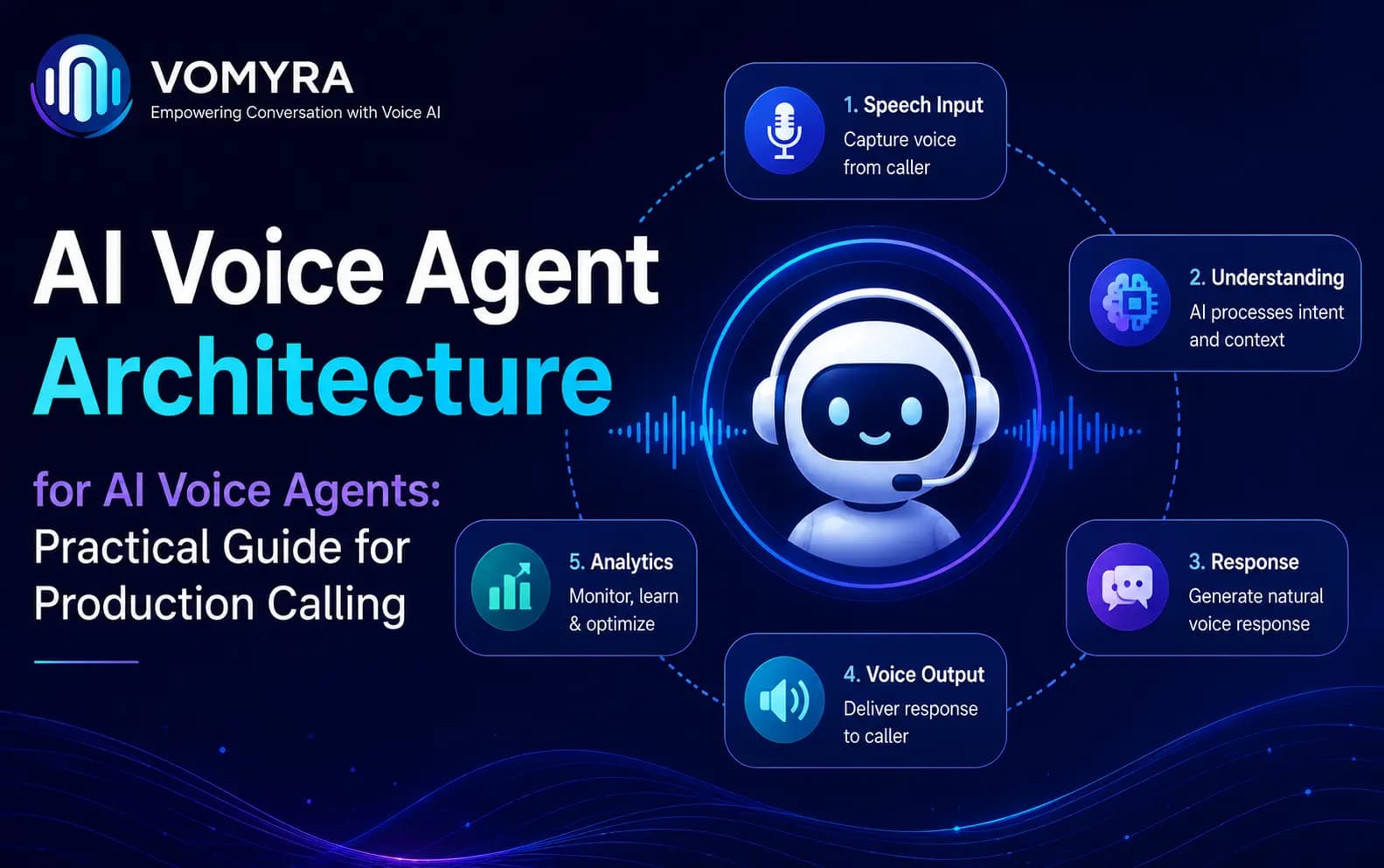
A production AI voice agent is typically built from five layers working together in real time.
1. Telephony Layer
This is the entry and exit point for every call – the layer that connects the AI agent to the phone network (PSTN), VoIP trunks, or a dialler for outbound calling.
Key responsibilities:
- Placing and receiving calls
- Handling call routing, transfers and voicemail detection
- Managing DTMF (keypad) input where needed
- Maintaining call quality across varying network conditions
For businesses calling Indian customers, this layer also needs to support local number formats and carrier behaviour, since call connect rates differ noticeably when using recognisable local mobile numbers instead of generic VoIP numbers.
2. Speech-to-Text (STT)
This layer converts the caller’s spoken audio into text the system can process. It needs to work in real time, streaming partial transcriptions as the caller speaks rather than waiting for them to finish.
Production considerations:
- Accuracy across accents, dialects and code-switching (for example, Hindi-English mixed speech)
- Handling background noise from mobile calls
- Low-latency streaming, not batch transcription
3. Dialogue and Reasoning Layer
This is where the language model sits – interpreting what the caller said, deciding how to respond, tracking conversation state, and deciding when to call external tools (like checking a CRM or booking a slot).
This layer typically includes:
- A system prompt or workflow definition specific to the agent’s job (qualification, support, booking, and so on)
- Conversation memory for the current call
- Business logic – what questions to ask, what counts as a qualified lead, when to escalate
- Tool-calling to fetch or update data mid-conversation
4. Text-to-Speech (TTS)
This layer converts the model’s text response back into natural-sounding speech. Quality here has an outsised impact on how “human” the agent feels.
What matters most in production:
- Natural pacing, intonation and pauses
- Support for the languages and accents your customers actually use
- Fast generation, since any delay here adds directly to response latency
5. Orchestration and Interruption Handling
This layer coordinates everything above it in real time – deciding when the caller has finished speaking, when the agent should respond, and what happens if the caller interrupts mid-sentence.
This is one of the hardest parts of voice agent architecture to get right, because natural conversation is full of pauses, overlaps and false starts. A system that waits too long feels slow; a system that responds too early talks over the customer.
The Latency Budget
In a phone conversation, humans expect a response within roughly 300–800 milliseconds. Beyond that, the conversation starts to feel unnatural, and callers begin talking over the agent or assuming the call has dropped.
That total budget has to be split across every component in the pipeline:
| Stage | Typical Latency Budget | What Affects It |
| Audio capture & network transit | 50–100 ms | Network quality, telephony provider |
| Speech-to-text (streaming) | 100–200 ms | STT engine, streaming vs batch processing |
| Dialogue reasoning (LLM response) | 150–400 ms | Model size, prompt complexity, tool calls |
| Text-to-speech generation | 100–200 ms | TTS engine, voice complexity |
| Audio playback & network transit | 50–100 ms | Network quality, jitter buffering |
If any single stage runs long – for example, a tool call to check inventory or CRM data – the whole conversation feels sluggish, even if every other component is fast. This is why production architectures often stream partial responses and use techniques like speculative generation to keep the conversation moving.
Handling Interruptions and Overlapping Speech

Real conversations aren’t turn-based in the way many demos assume. Callers interrupt, say “hmm” and “okay” while the agent is talking, and sometimes start answering before the agent finishes the question.
A production-grade voice agent architecture needs to handle:
- Barge-in detection – recognising when the caller has started speaking and stopping the agent’s speech immediately
- Backchannel filtering – not treating short acknowledgements like “okay” or “right” as a full interruption
- Turn-taking prediction – using pause length and intonation, not just silence, to judge when the caller has actually finished speaking
Getting this wrong is one of the fastest ways to make an AI voice agent feel unnatural, regardless of how good the underlying model is.
Reliability: What Happens When Something Fails
Production calling means components will occasionally fail – a network blip, a slow API response, a transcription error. A well-designed architecture plans for this rather than assuming it won’t happen.
Practical safeguards include:
- Fallback responses when a tool call times out, instead of the agent going silent
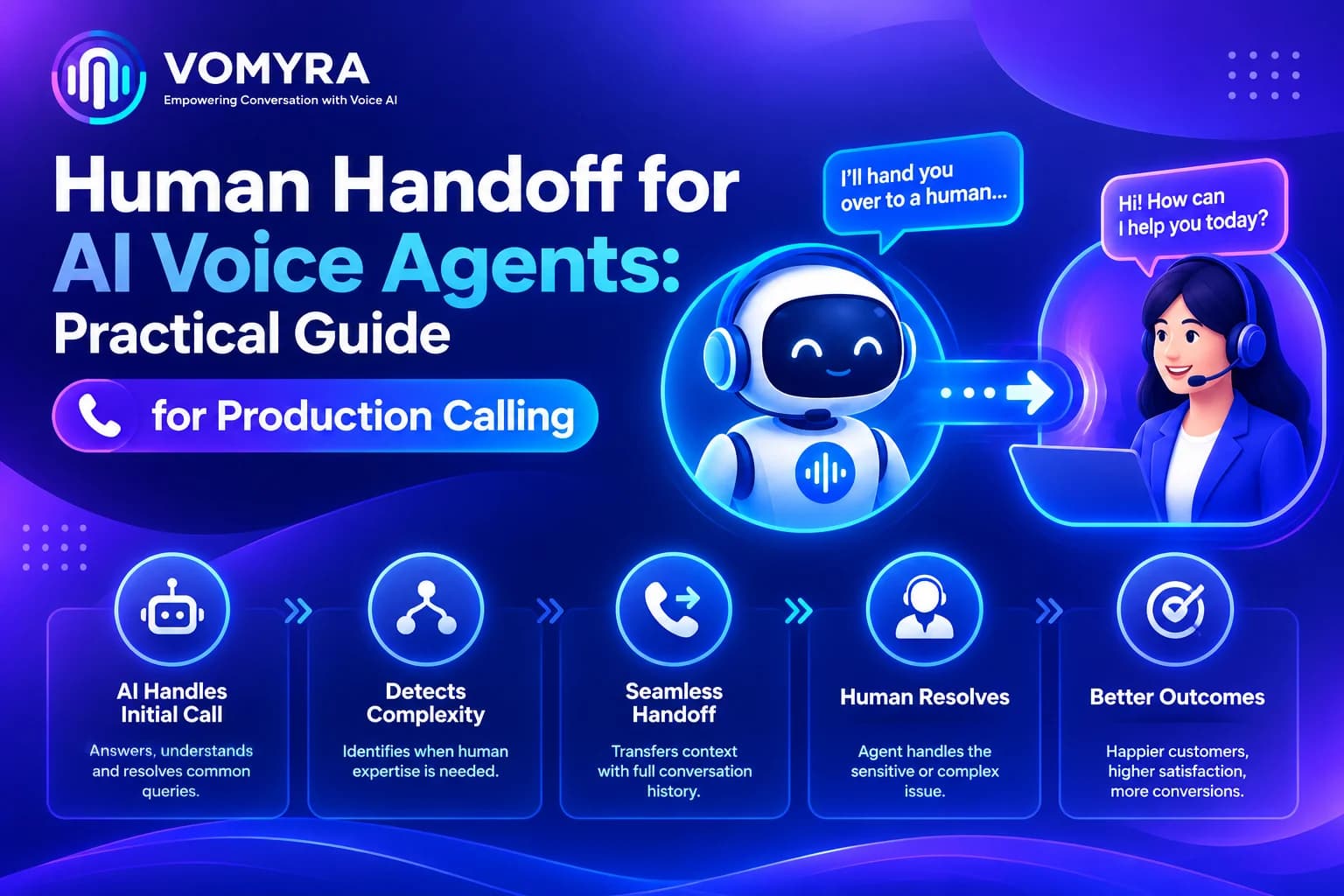
- Graceful handoff to a human agent when the AI can’t resolve the call
- Call recording and transcript logging for every call, so issues can be reviewed after the fact
- Real-time monitoring and alerting on latency, drop rates and failed tool calls
Without these, issues surface only when customers complain – usually too late to fix quietly.
Designing for Multiple Agents Working Together
Many businesses don’t need just one voice agent – they need several working together across the customer journey: one that researches a lead, one that qualifies it, one that handles objections and closes, and one that follows up afterwards.
This changes the architecture from a single conversational loop into a coordinated system, where agents:
- Share context and call history with each other
- Hand off leads based on qualification outcomes
- Update a shared CRM or database in real time
- Follow consistent scoring and routing logic across the whole pipeline
This is a meaningfully different design problem from building one good conversational agent, and it’s where most single-purpose “AI calling” tools fall short.
Production-Ready Architecture, Without Building It Yourself
Getting AI voice agent architecture right – low latency, natural interruption handling, reliable fallbacks, and multiple agents working in sync – is a significant engineering undertaking on its own.
Vomyra is built as an Agentic Voice AI Platform specifically for this: production-grade infrastructure already handling telephony, speech, reasoning and orchestration, so Indian businesses can launch AI voice agents – Research, Outreach, Qualification, Closing and Follow-Up – without building or managing the underlying architecture themselves.
If you’re evaluating how to move an AI voice agent from demo to production, it’s worth seeing how Vomyra’s infrastructure handles this out of the box.
FAQs
What’s the biggest cause of AI voice agents feeling unnatural?
Latency and poor interruption handling, far more often than the quality of the language model itself.
Do I need to build this architecture myself?
Not necessarily. Platforms built specifically for voice agent infrastructure handle the telephony, STT, TTS and orchestration layers, so businesses can focus on defining the conversation logic and workflows rather than the underlying engineering.
How important is the choice of phone number for outbound calling?
Significant for Indian businesses specifically – calls from recognisable local mobile numbers (98 and 94 series) tend to see meaningfully higher pickup rates than calls from generic VoIP numbers.
Can one architecture support multiple agent roles?
Yes, and it should. A well-designed architecture separates the conversation logic per role (research, qualification, closing, follow-up) while sharing the same underlying telephony, STT, TTS and orchestration infrastructure.