The Problem Every Indian D2C Brand Lives With Every Day
One in three COD shipments placed by Indian consumers fails to deliver. Not one in ten. One in three. At a Rs 1,500 average order value, every 100 unverified COD orders that ship without confirmation costs an Indian D2C brand Rs 52,500 in reverse logistics, restocking, and lost margin before a single rupee of revenue is recognised.
Run that across 5,000 COD orders per month at a 30 percent RTO rate and the math becomes brutal fast. Rs 4.95 lakh per month in avoidable losses. Rs 59 lakh per year, burned on orders that never needed to go out.
The three problems driving this are addressable. Fake or impulsive orders where the buyer clicked COD with no real intent to pay. Address errors where an incomplete pin code or missing landmark makes delivery physically impossible. Abandoned carts where a genuine buyer got distracted at checkout and never came back.
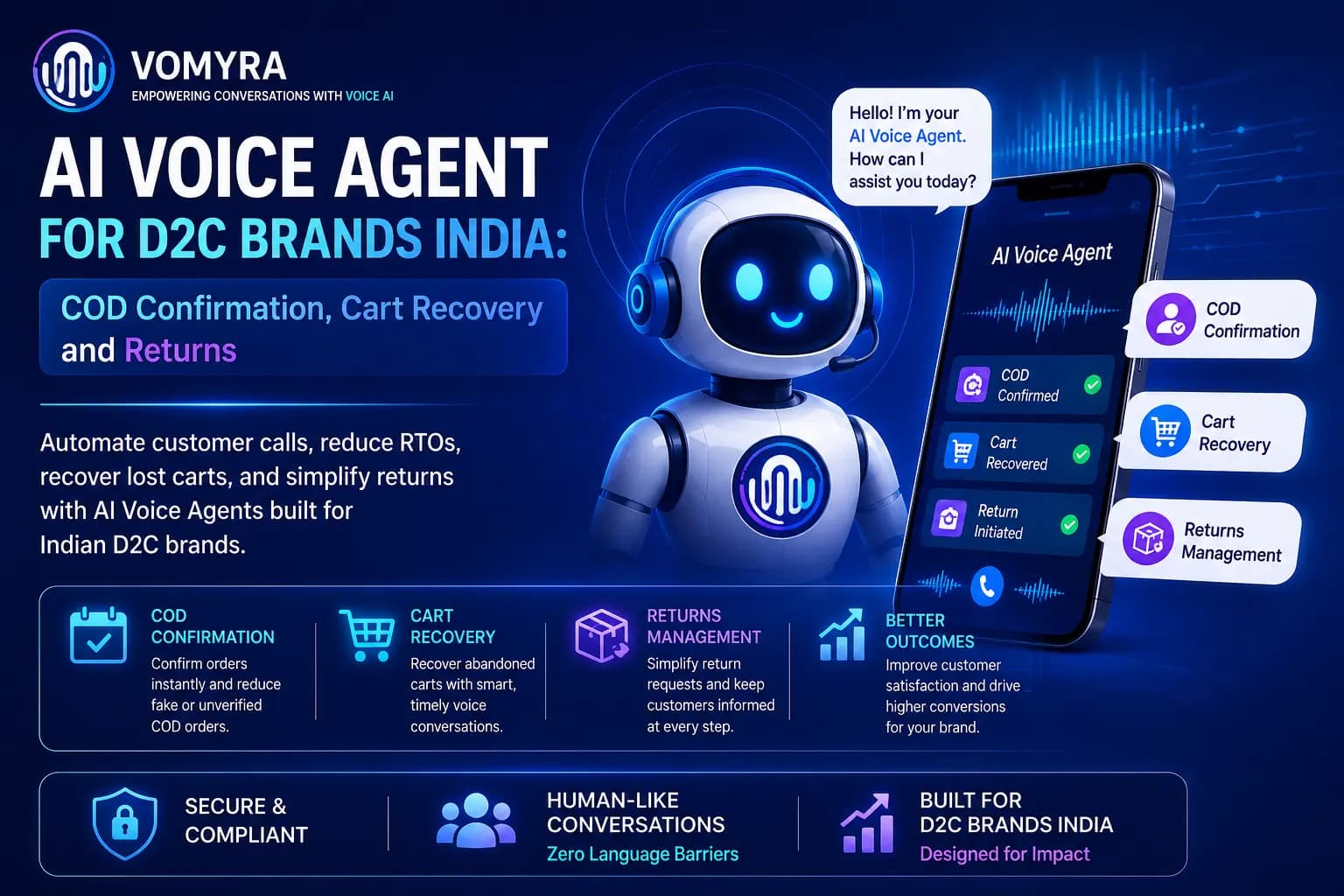
Vomyra AI Voice Agent is how Indian D2C brands are solving all three at scale, using outbound AI calls in Hindi, Hinglish, Tamil, Telugu, Marathi, Gujarati, and Bengali that go out automatically the moment an order is placed, a cart is abandoned, or a delivery fails. No call centre team. No manual follow-up process. No dependency on SMS open rates or email inbox placement.
Why SMS and Email Are Not Enough for Indian D2C
Before getting into what AI voice does, it is worth being honest about why the alternatives are insufficient for the Indian D2C context specifically.
SMS delivers an open rate of around 30 to 45 percent for transactional messages in India in 2026. It cannot handle an objection in real time. It cannot correct an address through a conversation. It cannot ask a customer why they abandoned their cart and adapt the response based on what they say. It is a one-way broadcast tool in a context that requires a two-way conversation.
Email performs even worse on delivery rate and open rate for COD confirmation specifically, because the buyers who place COD orders in Tier 2 and Tier 3 Indian cities are not the same buyers who check email habitually. They are WhatsApp-first, voice-first consumers who will answer a phone call from an Indian mobile number before they open a transactional email.
70 percent of Indian online shoppers abandon their cart before completing a purchase. Of that group, 1 in 4 will complete the order if contacted within 30 minutes of abandonment. The window is short. The medium that reaches them in 30 minutes on an Indian mobile network, in their own language, with a real conversational option to raise an objection and hear a response, is a voice call.
The Four D2C Workflows Where AI Voice Delivers Immediate ROI
Workflow 1: COD Order Confirmation
The moment a COD order is placed, Vomyra AI Voice Agent initiates an outbound call to the buyer’s mobile number within 60 to 90 seconds. The call opens in the buyer’s language, confirms the order details, and asks a simple verification question that distinguishes a genuine buyer from an impulsive or fake order.
For a genuine buyer, the call is a positive brand touchpoint. They hear a confirmation in their language within a minute of placing the order, which builds confidence in the brand and reduces the chance they call to cancel. For a fake or impulsive order, the call never gets answered or the buyer explicitly cancels. Either way, the order does not ship without real intent behind it.
A COD confirmation rate of 75 to 85 percent on contacted orders is achievable on a well-configured deployment. Orders that do not confirm within the window are held for a second contact attempt before dispatch. Orders that explicitly cancel are removed from the fulfilment queue before the warehouse team picks and packs them.
The reduction in RTO from this single workflow compounds significantly. A brand moving from 30 percent RTO to 18 percent on 5,000 monthly COD orders saves 600 failed shipments per month. At Rs 330 average reverse logistics cost per return, that is Rs 1.98 lakh per month in direct cost savings from one workflow.
Workflow 2: Abandoned Cart Recovery
Cart abandonment in Indian D2C has a specific pattern that differs from the global baseline. A significant proportion of Indian cart abandoners are price-sensitive buyers who added items with purchase intent but hesitated at the final payment screen, particularly when a COD option required a higher delivery fee or when the cart value triggered a minimum delivery threshold.
An AI voice agent calling within 30 minutes of cart abandonment, in the buyer’s language, with a specific response to the most common objection for that cart value range, converts 20 to 30 percent of those contacted back to completed orders.
The call does not need to offer a discount in every case. For many buyers, the call itself, arriving within minutes of their abandonment, signals brand responsiveness and resolves the hesitation that was more about uncertainty than price.
The agent identifies itself as calling from the brand, references the specific cart items, and asks a single open question about what was making the buyer hesitate. The response branches based on what the buyer says: price objection, delivery time concern, payment method question, or simple “I’ll do it later.”
Each branch has a prepared response and a closing action, whether confirming the original order, routing to a human agent for a high-value cart query, or scheduling a follow-up for the next day.
Workflow 3: NDR and Delivery Exception Handling
When a delivery attempt fails because the buyer was unavailable, the address was incomplete, or the buyer refused at the door, an NDR (non-delivery report) is filed by the logistics partner.
The window between the first failed attempt and a successful reattempt or a return-to-origin decision is typically 24 to 72 hours, and the conversation that happens in that window determines which direction the shipment goes.
An AI voice agent calling within two hours of an NDR event, in the buyer’s language, can resolve the three most common NDR causes in a single call. For unavailability: confirm a preferred delivery slot and communicate it to the logistics partner.
For address errors: collect the corrected address and update the shipment record. For refusal at the door: understand the reason, offer alternatives where appropriate, and either save the delivery or formally cancel before a second failed attempt generates additional reverse logistics cost.
A delivery attempt that arrives after a confirmed slot, to a corrected address, at a door where the buyer is genuinely expecting it, succeeds at a materially higher rate than a reattempt without any of that coordination.
Brands that run AI NDR calling report reattempt success rates of 55 to 70 percent on previously failed deliveries.
Workflow 4: Post-Delivery Feedback and Reorder
After successful delivery, an AI voice agent calling 48 to 72 hours later, in the buyer’s language, completes three tasks in a single two-minute call: collects a quick NPS feedback score, flags any product issue for the customer service team before the buyer posts a negative review, and introduces a reorder prompt or cross-sell for relevant adjacent products.
The post-delivery call is the most underutilised AI voice workflow in Indian D2C in 2026. It converts at a rate that email follow-up sequences cannot match, because the call arrives in the buyer’s preferred communication medium and gives them a real-time option to raise any issue before the satisfaction window closes.
Brands that run post-delivery AI calling report NPS scores 15 to 25 points higher than brands that rely on email-only post-purchase sequences.
The ROI Table: What AI Voice Calling Saves Indian D2C Brands
The following table covers a mid-market Indian D2C brand running 5,000 COD orders per month at a 30 percent baseline RTO rate and Rs 1,500 average order value.
| Metric | Before AI Voice | After AI Voice | Monthly Impact |
| COD RTO rate | 30% (1,500 returns) | 18% (900 returns) | 600 fewer returns |
| Reverse logistics cost saved | Rs 4.95 lakh | Rs 2.97 lakh | Rs 1.98 lakh saved |
| Cart recovery (500 abandoned/month) | 6% email recovery (30 orders) | 25% voice recovery (125 orders) | 95 additional orders |
| Additional revenue from cart recovery | Rs 45,000 | Rs 1.87 lakh | Rs 1.42 lakh added |
| NDR reattempt success | 35% | 60% | Rs 62,000 saved in avoidable returns |
| AI voice agent monthly cost (5,000 calls at Rs 5/min, 2 min avg) | , | Rs 50,000 | , |
| Net monthly benefit | , | , | Rs 3.52 lakh net positive |
These numbers use conservative estimates. Brands at higher COD volumes or higher AOVs see proportionally larger returns. The payback period for AI voice calling in Indian D2C is measured in days, not months.
What Makes Vomyra the Right Platform for Indian D2C

The D2C use case has specific requirements that differ from generic AI calling deployments, and not every platform meets them.
Language across the full customer geography. An Indian D2C brand selling nationally ships to buyers in every state. A buyer in Ahmedabad speaks Gujarati. A buyer in Coimbatore speaks Tamil. A buyer in Bhopal speaks Hindi. A single AI voice agent platform that handles all of these, with automatic language detection from the caller’s first response, is not optional. It is the baseline.
Vomyra AI Voice Agent supports 70-plus Indian languages including Hinglish with mid-sentence code-switching, Tamil, Telugu, Kannada, Marathi, Gujarati, Bengali, Punjabi, and Assamese. Language detection is automatic. A Gujarati-speaking buyer gets the confirmation call in Gujarati. A Tamil-speaking buyer gets it in Tamil. One platform, one campaign configuration, zero manual segmentation by language.
Indian mobile numbers for maximum pickup rate. A COD confirmation call from an international number or a landline-style 080 number gets answered at 25 to 30 percent. The same call from a 98 or 94 series Indian mobile number gets answered at over 80 percent. For a D2C brand where the entire ROI calculation depends on the buyer picking up the call, this is not a minor optimisation. It is the variable that determines whether the workflow works.
Vomyra provisions 98 and 94 series Indian mobile numbers natively. No separate telephony account. The call appears on the buyer’s screen as a local Indian mobile number, producing the pickup rate the ROI calculation requires.
TRAI compliance built in. Outbound COD confirmation calls are commercial calls subject to TRAI’s calling-hour restrictions. Vomyra enforces the 9 AM to 9 PM IST window automatically, holds calls queued outside this window, and runs DND scrubbing before every outbound campaign. A D2C brand deploying AI calling does not need a compliance team to manage these requirements. The platform handles them.
CRM and OMS integration. The AI call outcome needs to flow back into the order management system the brand uses. A confirmed order releases to fulfilment. A cancelled order is removed from the queue. A modified address updates the shipment record. A negative NPS flags the customer service queue.
Vomyra AI Voice Agent connects to standard OMS platforms and CRMs through webhooks and native integrations, pushing structured call outcomes at the end of each conversation without any manual data entry.
Getting Started
The fastest deployment path for a D2C brand is to start with COD confirmation on a sample of high-risk orders, run 500 calls as a pilot, and measure the RTO rate on pilot orders versus non-pilot orders over 30 days. The data from that comparison makes the case for expanding to cart recovery and NDR handling without any additional argument.
A free trial of Vomyra AI Voice Agent covers 500 monthly credits that renew every month, full access to multilingual calling in 70-plus Indian languages, Indian 98/94 mobile numbers, webhook and OMS integration, and complete call transcripts before any payment commitment.
Frequently Asked Questions
How much can AI voice calling reduce COD RTO for Indian D2C brands?
Well-configured AI voice confirmation calling reduces RTO from a 28-35 percent baseline to 18-22 percent within 60 days. At 5,000 monthly COD orders, that is roughly 500 to 700 fewer returns per month.
What languages does the AI call in for pan-India D2C campaigns?
Vomyra AI Voice Agent supports 70-plus Indian languages with automatic detection. A buyer from Gujarat gets a Gujarati call.
How quickly does the AI agent call after a COD order is placed?
Within 60 to 90 seconds of order placement when connected to the OMS via webhook or API. The 30-minute window for cart recovery and the 2-hour window for NDR follow-up are both achievable on Vomyra’s infrastructure.
Does the AI calling comply with TRAI regulations?
Yes. TRAI calling-hour enforcement (9 AM to 9 PM IST), DND registry scrubbing, and DPDP consent logging are built into the Vomyra platform at the infrastructure level.
What is the cost of running AI voice confirmation for a D2C brand?
Vomyra AI Voice Agent bills per second at Rs 5 per minute, with no minimum commitment. At a 2-minute average call and 5,000 calls per month, the total cost is Rs 50,000.