Outbound sales runs on volume and consistency — call enough of the right people, with the right message, at the right time, often enough. In practice, most sales teams struggle to do this well. Reps burn out on repetitive dialling, call lists sit untouched for days, and follow-up discipline breaks down the moment pipeline gets busy.
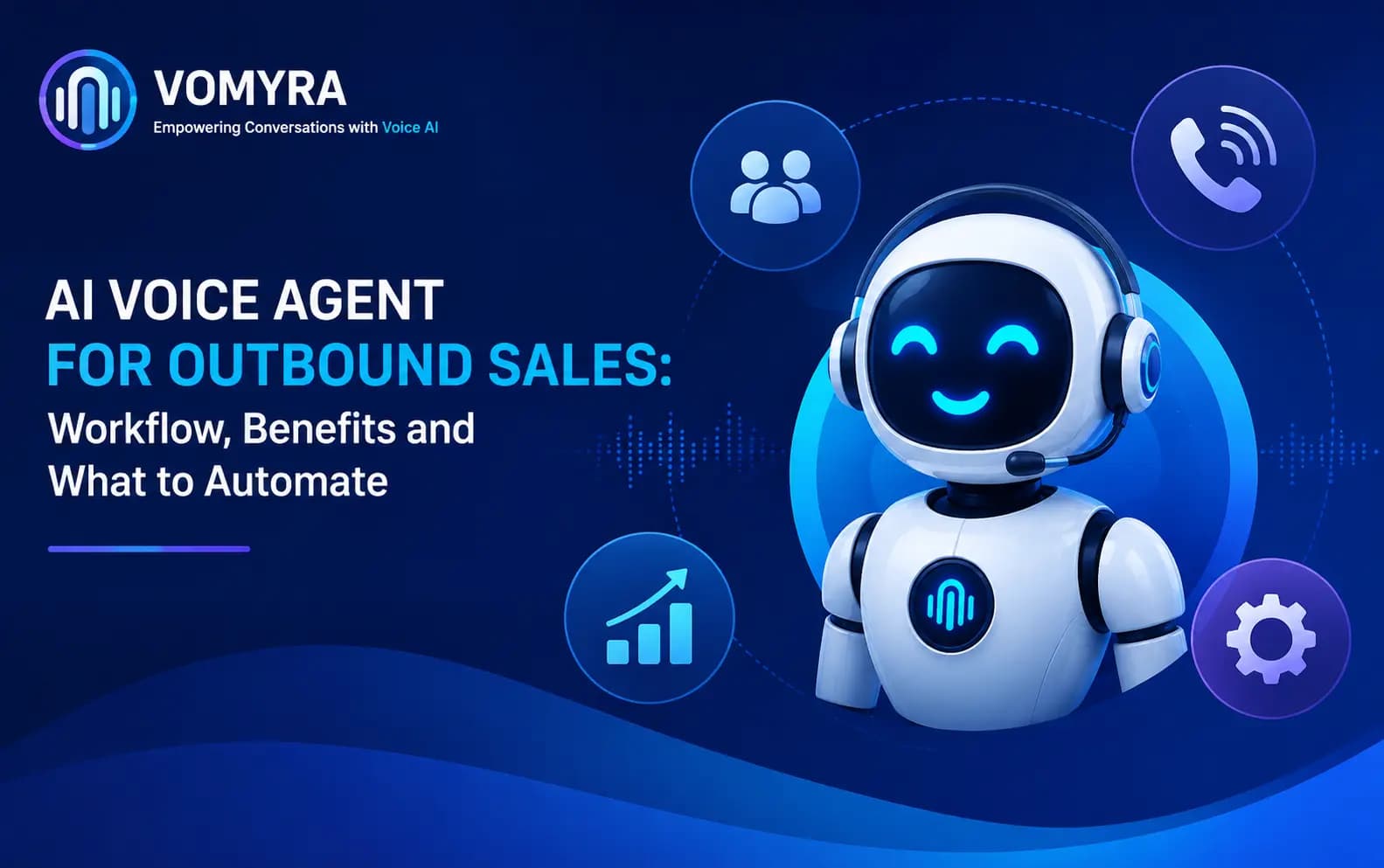
An AI voice agent changes the economics of outbound sales. Instead of a team working through a list one call at a time, an AI voice agent can call hundreds of prospects simultaneously, hold a natural conversation, and pass only the genuinely interested ones to a human rep.
This guide covers how outbound AI voice agents work, the workflow behind them, the benefits over manual outbound calling, and what to automate first.
What Is an AI Voice Agent for Outbound Sales?
An AI voice agent for outbound sales is a voice AI system that proactively calls prospects — cold leads, warm leads, or a re-engagement list — to introduce a product, qualify interest, handle objections, and either close or route the conversation to a human rep.
Unlike a predictive dialler that simply connects a rep to the next available number, an AI voice agent carries the entire conversation itself, using natural, human-like dialogue that adapts based on what the prospect says.
This makes it closer to an AI sales development rep than a calling tool — it’s not just placing calls, it’s having them.
Why Outbound Sales Needs Automation
Manual outbound calling has structural limits that don’t scale, regardless of team size:
- Dialling capacity is finite. A rep can realistically make a limited number of quality calls per day.
- Consistency drops under pressure. Scripts get shortened, questions get skipped, and follow-up gets deprioritised when reps are busy.
- Call lists go cold. Leads that aren’t reached in the first few attempts are often never called again.
- Time zones and working hours limit reach. Prospects outside standard calling windows are simply missed.
An AI voice agent removes each of these constraints. It can call every prospect on a list, every time, at the hours prospects are actually available, with the same quality of conversation on call one and call one thousand.
The AI Voice Agent Outbound Sales Workflow
A typical outbound workflow runs through these stages:
- List and segment upload — Prospect data is pulled from a CRM, spreadsheet, or ad platform and segmented by criteria like industry, source, or intent signal.
- Outbound dialling — The AI voice agent calls prospects using a real mobile number, at configured times and pacing.
- Opening and pitch — The agent introduces the product or service naturally, adapting tone and pacing based on prospect responses.
- Discovery questions — The agent asks qualifying questions to understand the prospect’s needs, budget and timeline.
- Objection handling — Common objections (“not interested,” “send me details,” “call me later”) are handled conversationally, without sounding scripted.
- Outcome routing — Interested prospects are booked for a demo, transferred live to a rep, or flagged as hot leads. Uninterested prospects are logged and removed from active outreach.
- Automated follow-up — No-answers and “call me later” responses are automatically re-attempted at the right time, without manual tracking.
- CRM sync and reporting — Every call outcome, transcript and recording is logged back to the CRM in real time.
The result is a continuous outbound engine that runs independently of rep availability.

Manual Outbound Calling vs AI Voice Agent Outbound Calling
| Factor | Manual Outbound Calling | AI Voice Agent Outbound Calling |
| Daily call volume | Limited by rep headcount and hours | Hundreds of simultaneous calls |
| Consistency | Varies by rep energy, training, mood | Same quality conversation on every call |
| Cost per call | High (salaries, dialler tools, overheads) | Significantly lower at scale |
| Follow-up discipline | Frequently missed under pipeline pressure | Automated, never skipped |
| Calling hours | Limited to team’s working hours | Can run across extended hours |
| Language flexibility | Limited to reps’ language skills | Multiple languages, including regional Indian languages |
| Ramp-up time | Weeks to hire and train new reps | Scales instantly with configuration changes |
| Data capture | Manual notes, often incomplete | Full transcripts and structured data on every call |
Key Benefits of Automating Outbound Sales
Higher call volume without higher headcount One AI voice agent can carry the outbound calling load of a much larger human team, without the hiring, training or attrition overhead.
Faster pipeline movement Prospects are called and qualified quickly after entering a list, rather than waiting in a queue for the next available rep.
Reps focus on closing, not dialling Human reps only join conversations once a prospect is engaged and qualified, spending their time where it converts.
Consistent messaging across every call The agent delivers the same core pitch and qualification questions every time, removing the variability that comes with rep fatigue or inconsistent training.
Full visibility into what’s working Every call is transcribed and logged, giving sales and marketing teams clear data on which scripts, segments and campaigns perform best.
Lower cost per meeting booked With higher volume and consistent qualification, the cost of generating a genuinely qualified meeting drops significantly compared to manual outbound.
Also read : What Is a Voice AI Agent and How It Works?
What to Automate First
Rolling out an AI voice agent for outbound sales works best in stages:
- Initial cold outreach calls — automate the first touch across your call list, freeing reps from pure volume dialling.
- Standard discovery questions — budget, timeline, current solution and decision-maker status.
- No-answer and callback follow-ups — automatic re-attempts at optimal times, without manual tracking in a spreadsheet.
- Basic objection handling — common, predictable objections that don’t need human judgement.
- CRM logging and lead scoring — automatic updates so reps always see prioritised, qualified prospects.
More advanced steps — live transfers to reps mid-call, multi-touch nurture sequences across calling and messaging, or full end-to-end closing conversations — can be layered in once the core outbound flow is proven.
Build an AI Team for Outbound Sales
Scaling outbound sales by hiring more reps is slow, expensive, and hard to keep consistent. Scaling it with an AI voice agent isn’t.
Vomyra is India’s Agentic Voice AI Platform, built to run complete AI sales workflows — not just outbound dialling. With dedicated Outreach, Qualification, Closing and Follow-Up agents working together, Vomyra AI voice agents call prospects, qualify interest, handle objections and hand off ready leads to your team, using real Indian mobile numbers and human-like conversations in multiple languages.
If you’re evaluating how to scale outbound sales without scaling headcount, Vomyra is built specifically for this — with unlimited calling plans and no coding required to launch.
FAQs
Will prospects know they’re talking to an AI?
Modern AI voice agents use natural, human-like conversation with adaptive responses, though transparency policies vary by business and jurisdiction — it’s worth defining your own disclosure approach as part of the rollout.
Does this replace outbound sales reps?
No. It removes the repetitive dialling and initial qualification work, so reps spend their time on qualified conversations and closing, not cold volume calling.
Can an AI voice agent handle outbound calls in regional Indian languages?
Yes. Platforms built for Indian businesses support multiple languages, so outreach can happen in the language your prospects are most comfortable with.
How is this different from a predictive dialler?
A predictive dialler connects a human rep to the next answered call. An AI voice agent carries the entire conversation itself — pitch, discovery, objection handling and routing — without a human on the line until the prospect is qualified.