AI voice agents handle customer conversations across industries such as healthcare, real estate, banking, education and e-commerce. During a single call, they may process spoken questions, personal details, appointment information and customer requests. Managing this information properly is important for building reliable and secure voice automation systems.
Voice data handling involves more than recording and storing calls. It includes collecting audio, converting speech into text, processing requests, transferring information between services and managing stored records. Each stage needs a clear process to protect customer information while keeping conversations responsive.
This guide explains how voice data moves through an AI voice system, the architecture behind it and the practices developers should follow when preparing applications for production.
What Is Voice Data Handling in AI Voice Agents?
Voice data handling refers to the complete process of collecting, processing, transferring, storing and managing information generated during voice interactions.
An AI voice agent may work with different types of information, including:
- Raw audio received from the customer.
- Transcribed text generated through speech recognition.
- Customer details shared during a conversation.
- Responses generated by the language model.
- Tool requests and results from external applications.
- Call recordings, summaries and interaction logs.
Each data type has a different purpose and storage requirement. For example, an audio recording may be needed for quality checks, while a short call summary may be sufficient for updating a CRM.
AI Voice Agent Data Architecture: Understanding the Workflow
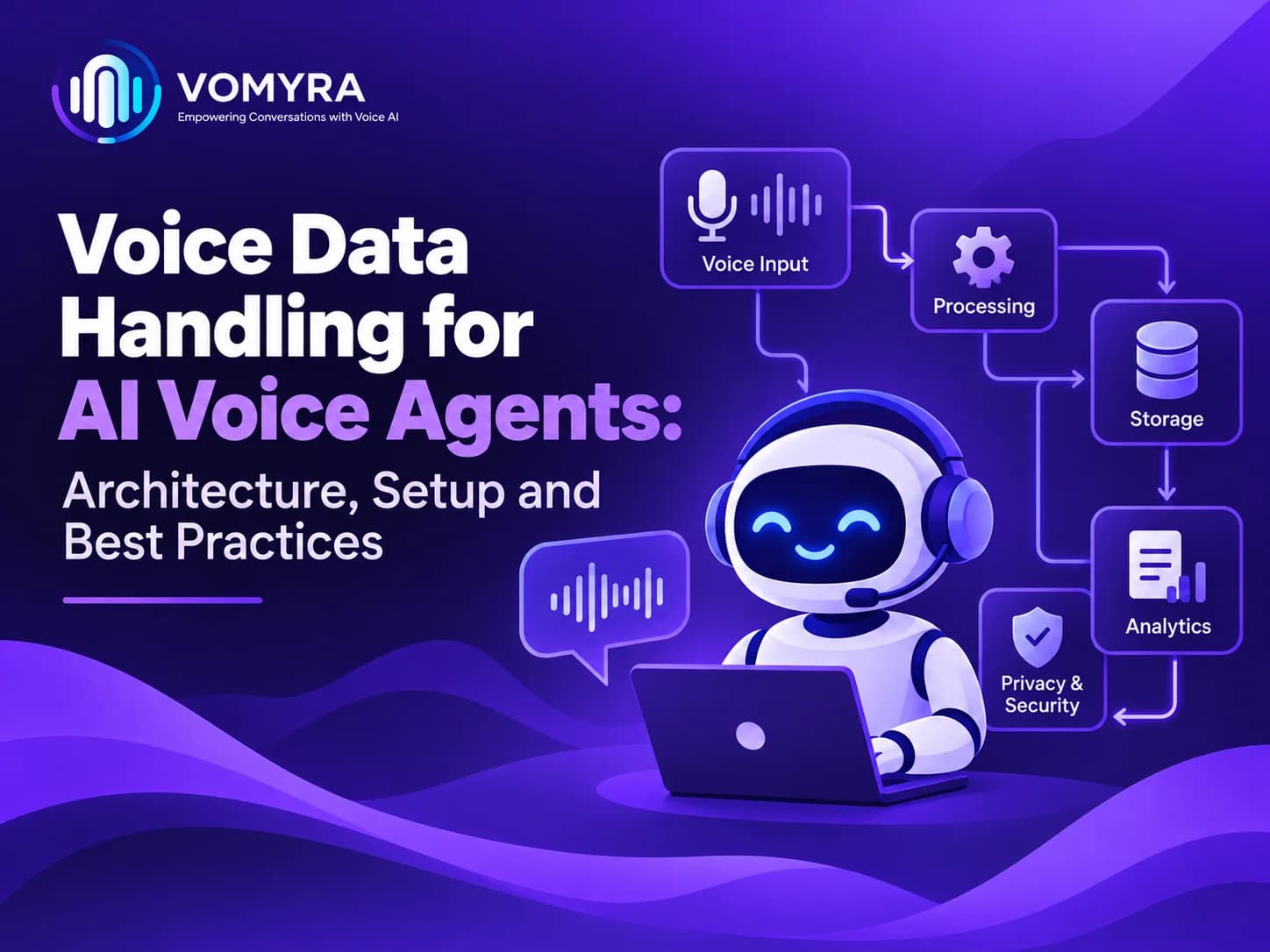
A reliable AI Voice Agent Data Architecture defines how information moves between the different components of a voice application.
A typical workflow includes the following stages:
- Audio collection: The system receives the customer’s voice through a phone call or microphone.
- Speech recognition: Audio is converted into text using a speech-to-text service.
- Request processing: The language model analyses the text and identifies the customer’s intention.
- Tool interaction: The agent retrieves or updates information through connected applications when required.
- Response generation: The system prepares a suitable response.
- Speech generation: Text is converted into audio and delivered to the customer.
- Data management: Relevant call details, summaries and logs are handled according to retention and access policies.
Separating these stages makes the system easier to maintain. Developers can update speech recognition, language models or storage services without redesigning the entire application.
AI Voice Data Processing: From Audio to Useful Information
AI Voice Data Processing begins when the system receives an audio stream. The audio may be processed in small segments rather than waiting for the entire conversation to finish.
Speech recognition identifies spoken words and converts them into text. The language model then uses this text to understand the request and decide what action is required.
For example, when a customer says, “Please reschedule my appointment for Friday,” the system must identify the requested action, understand the date and retrieve the relevant booking information.
The process may also include:
- Noise reduction to improve speech recognition.
- Language detection for multilingual conversations.
- Speaker identification where appropriate and permitted.
- Extraction of important details such as names, dates and phone numbers.
- Detection of incomplete or unclear information.
Accuracy is important at this stage. If the system misunderstands a date or customer detail, it may perform an incorrect action. Important information should be confirmed before completing sensitive operations.
Real-Time Voice Data Processing and System Performance
Real-Time Voice Data Processing allows an AI agent to respond while the customer is still on the call. Instead of waiting for the full recording, the system processes incoming audio continuously.
This approach helps maintain natural conversations, especially when customers expect quick answers.
Developers should pay attention to:
- Streaming audio: Process audio in smaller segments to reduce waiting time.
- Low-latency communication: Avoid unnecessary delays between system components.
- Interruption handling: Allow customers to speak again before the agent finishes its response.
- Context management: Retain relevant conversation details without sending unnecessary information repeatedly.
- Failure recovery: Handle network interruptions and unavailable services gracefully.
A system should also provide a short response when an external operation takes time. This prevents customers from assuming that the call has disconnected.
Voice Data Pipeline for AI Agents
A Voice Data Pipeline for AI Agents connects the services responsible for receiving, processing, transmitting and managing voice information.
The pipeline should be designed around the actual requirements of the business. A customer support agent may need access to CRM records, while a booking agent may require calendar information.
The following table shows the main pipeline stages and their responsibilities.
| Pipeline stage | Main responsibility | Important consideration |
| Audio input | Receive customer speech | Audio quality and secure transmission |
| Speech recognition | Convert audio into text | Accuracy and language support |
| AI processing | Understand requests | Context and input validation |
| Tool integration | Access external systems | Permissions and authentication |
| Response generation | Prepare an answer | Accuracy and response time |
| Audio output | Deliver spoken response | Clarity and natural delivery |
| Data storage | Save required records | Retention and access controls |
Vomyra focuses on connecting voice interactions with practical business workflows. A well-designed pipeline can help businesses manage customer conversations while keeping information organised across connected systems.
Voice Data Management: Storage, Access and Retention
Voice Data Management determines what information should be stored, where it should be stored and who can access it.
Not every customer conversation needs to be saved as a complete recording. In some cases, storing a short summary, call outcome and relevant customer details may be enough.
Before choosing a storage approach, developers should define:
- Which data must be retained.
- Whether full audio recordings are necessary.
- How long different records should be stored.
- Which employees or services can access the information.
- How customers can request deletion where applicable.
- How backups and deleted records are managed.
A clear retention policy prevents unnecessary data collection and reduces storage costs.
Voice Data Storage and Security Best Practices
Voice Data Storage and Security should be considered during system design, not added after deployment. Voice applications may process personal and confidential information, so weak access controls can create serious risks.
Some important practices include:
1. Use Encryption
Protect data during transmission and while stored. Secure communication protocols and appropriate encryption methods help reduce the risk of unauthorised access.
2. Apply Role-Based Access
Give employees and connected services access only to the information needed for their responsibilities. Administrative access should be limited and monitored.
3. Avoid Unnecessary Recording
Do not collect or retain complete conversations unless there is a clear business or legal requirement. Explain recording practices to customers where required.
4. Protect Sensitive Information
Avoid exposing passwords, payment details and other confidential information in ordinary call logs. Use suitable masking or redaction methods where appropriate.
5. Monitor System Activity
Maintain security logs for important actions, including data access, updates and deletion requests. Review unusual activity and investigate potential security incidents.
Vomyra encourages businesses to consider privacy and security alongside the performance of their voice automation systems.

Setting Up a Reliable Voice Data Workflow
Before deploying an AI voice application, developers should test the complete data flow rather than checking individual components separately.
A practical setup process includes:
- Identify the types of information the voice agent needs.
- Select speech recognition and text-to-speech services.
- Design the AI processing and integration architecture.
- Choose suitable storage and database services.
- Define authentication and access permissions.
- Establish retention and deletion policies.
- Test call quality, response times and error handling.
- Monitor the application after deployment.
Vomyra supports the development of business-focused voice automation, where reliable data workflows are essential for handling customer interactions.
Conclusion
Voice Data Handling for AI Voice Agents requires a structured approach to audio processing, information transfer, storage and security. Every stage, from receiving customer speech to saving call records, should have a clearly defined responsibility.
A strong architecture combines efficient processing, controlled access, secure storage and sensible retention policies. By following these practices, developers can build voice applications that manage customer conversations more reliably while protecting the information shared during calls.
FAQs
1. What types of data do AI voice agents process?
They can process audio recordings, speech transcripts, customer details, conversation context, tool responses and call summaries.
2. How is voice data processed in real time?
Incoming audio is divided into smaller segments, converted into text and processed by the AI system to generate responses during the conversation.
3. Should AI voice agents store every call recording?
No. Recording decisions should depend on business requirements, customer consent where applicable, legal obligations and data retention policies.
4. How can developers secure voice data?
They should use encryption, role-based access, secure authentication, limited data collection and regular security monitoring.
5. Why is a voice data pipeline important?
It connects audio input, speech recognition, AI processing, external tools, response generation and storage into one organised workflow.