Sales teams across India are being restructured from the ground up in 2026. Not in the abstract, future-state sense that technology articles typically describe, but in measurable, operational ways that show up in CRM records, monthly revenue reports, and hiring decisions being made right now.
Vomyra AI Voice Agent is the no-code AI voice agent platform India sales teams across real estate, fintech, restaurants, healthcare, and recruitment are using to drive these changes without adding headcount, without engineering resources, and without the long deployment timelines that once made voice AI inaccessible to businesses outside the enterprise tier.
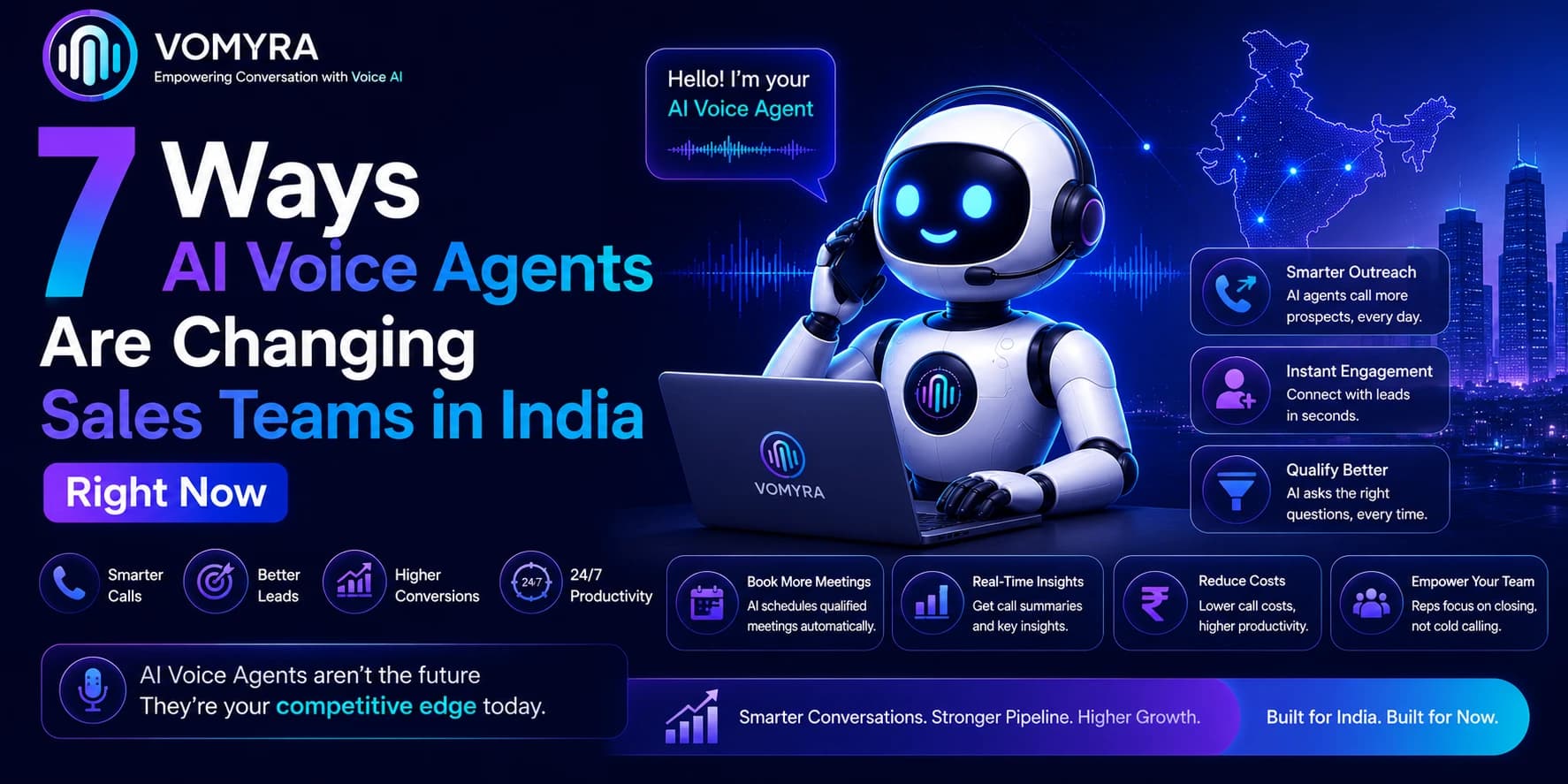
This post documents seven specific changes happening in Indian sales teams today, why each one matters for revenue, and what it looks like in practice.
Way 1: First Contact Happens in Seconds, Not Hours
The single most measurable change AI voice agents produce in Indian sales operations is first-contact speed. A human SDR team at a mid-market Indian company calls back inbound leads at an average of 4.6 hours after submission. An AI voice agent calls back within 45 to 90 seconds, around the clock, including nights, weekends, and public holidays.
Research consistently shows that the probability of qualifying a lead drops by more than 80 percent when first contact is delayed beyond five minutes of inquiry submission. At 4.6 hours, an Indian sales team is operating in the lowest-conversion window for essentially every lead it generates.
This change is structural, not incremental. An AI phone agent with Indian number calling every new lead within 60 seconds does not require a larger team or longer shifts. It requires a platform that runs continuously without breaks.
For real estate developers handling portal inquiries, an AI voice agent for real estate India calls back every lead before a competitor’s human SDR has even opened the CRM. For fintech companies running weekend campaigns, AI voice agent for fintech India qualification calls reach prospects on Saturday afternoon rather than Monday morning. The first-contact speed advantage compounds across every lead the business generates.
Way 2: Qualification Runs 24 Hours a Day Without Shift Premiums
43 percent of Indian business inquiries arrive outside standard working hours. Under a human-only calling model, these leads wait until the next business day, by which point their interest has dropped and the competition has often already called.
An AI lead qualification voice bot India deploys to cover every hour of every day at the same cost per call regardless of the time. There is no shift premium for a 3 AM qualification call. There is no morale problem with an SDR being asked to work midnight shifts.
The AI voice agent handles the 2 AM hospital appointment request, the Saturday morning loan inquiry, and the Sunday evening property inquiry with identical quality and identical speed.
For a clinic using AI dental appointment booking India functionality, after-hours coverage converts appointment requests that previously went to voicemail into confirmed bookings before the patient tries a different clinic the next morning.
For voice AI for ISP technical support handling customer service queries through the night, the call that would have sat in a queue until 9 AM gets resolved at 11 PM.
The cost of 24-hour coverage on a human team is approximately three times the cost of a standard single-shift team. On an AI calling platform for SMB India, the cost of a 2 AM call is identical to the cost of a 2 PM call.
Way 3: SDRs Stop Dialling Cold and Start Selling Warm
Before AI voice agents, the average Indian SDR spent 55 to 60 percent of their working day on cold outbound dialling, leaving voicemails, and handling repetitive FAQ calls. Approximately 25 percent of their time went to actual qualified conversations. The rest was attrition-generating busywork.
After deploying a multilingual AI calling bot India for top-of-funnel qualification, the distribution shifts. SDRs spend 65 to 70 percent of their day on warm conversations with prospects who have already been qualified, already confirmed their interest, and in many cases already indicated what specific questions they want answered before the meeting.
Every Vomyra AI Voice Agent call produces a structured qualification summary, a full transcript, and a lead score that arrives in the CRM before the SDR picks up the phone.
The SDR knows the prospect’s budget range, their current situation, their decision timeline, and the objection they raised during the AI qualification call. They enter the conversation with context that would previously have required their own discovery call to establish.
The result is a more engaged SDR team, measurably better conversion on the conversations that matter, and significantly reduced turnover in a role that previously suffered 80 to 120 percent annual attrition because the work was repetitive, demoralising, and poorly compensated relative to effort.
Way 4: Multilingual Coverage Becomes Operational, Not Aspirational
The practical challenge of serving Hindi, Tamil, Telugu, Marathi, Gujarati, Bengali, Punjabi, and Assamese-speaking customers through a single sales team is an economic and operational problem that most Indian businesses solve inadequately.
Hiring and training multilingual callers is expensive. Managing shift coverage across language requirements is complex. Quality degrades when a Telugu-speaking prospect reaches a Hindi-speaking caller.
A multilingual AI calling bot handles every language in the same platform with zero additional cost per language. Vomyra AI Voice Agent supports 32-plus Indian languages and dialects natively, including mid-sentence Hinglish code-switching.
Language detection is automatic based on the caller’s first response. The same campaign covers Hindi-speaking prospects in Jaipur, Tamil-speaking prospects in Coimbatore, and AI voice agent in Assamese language coverage for businesses serving Northeast India, without separate call lists or separate configurations.
For an AI receptionist India Hindi handling inbound calls for a national product, the ability to respond in a caller’s preferred language is not a premium feature. It is the baseline for a customer experience that produces conversion.
The Hindi AI voice assistant for business that greets a Tier 2 city prospect in their own language produces measurably higher engagement than one that defaults to English and expects the caller to adapt.
Way 5: Dormant Leads Generate Revenue Without Additional Acquisition Spend
Every Indian sales team with more than six months of CRM history is sitting on a database of leads that were contacted once or twice and went cold. These leads represent paid acquisition spend from Google Ads, portal listings, and outbound campaigns that returned nothing because the follow-up process broke down.
AI outbound calling India re-engages these databases systematically at low cost per call. Vomyra AI Voice Agent works through a cold lead list over weeks, opening with a fresh value angle, re-qualifying against the prospect’s current circumstances, and flagging those showing renewed interest for the human team.
At ₹5 per minute, reactivating a list of 1,000 cold leads at an average of three minutes per call costs ₹15,000. Converting 3 percent of those into customers at an average deal value of ₹48,000 generates ₹1.44 lakh in revenue from acquisition spend that had already been written off.
This is not a marginal improvement over manual reactivation. It is the difference between a systematic process that runs automatically and a manual task that gets deprioritised every week because the team has current leads to call.
Way 6: Follow-Up Consistency Stops Being a Management Problem
The most consistent feedback from Indian sales managers describing where pipeline leaks is follow-up. A prospect says “call me next Thursday.” The SDR logs it. Thursday arrives, the SDR has 40 other things happening, and the callback slips to Friday. The prospect has moved on.
AI voice agents follow up on every prospect at every configured interval without exception. A prospect who asked to be called next week receives a call next week. A demo no-show receives a callback 20 minutes after the missed slot.
A prospect who went dark after the second conversation receives a re-engagement call at the configured interval. None of these require a manager to check compliance or an SDR to remember a manually logged note.
Vomyra AI Voice Agent for outbound calls handles the entire follow-up sequence automatically, with every outcome logged in the CRM in real time.
A sales manager reviewing pipeline on Friday afternoon sees a complete, accurate record of every follow-up that was supposed to happen that week and every outcome it produced. There are no “I tried to call but…” entries because there are no entries that were not made.
No-show recovery alone, the automatic callback to prospects who missed a booked demo, consistently recovers 25 to 35 percent of missed meetings into rescheduled appointments across documented deployments.
At a typical Indian startup conversion rate from demo to close, that is a material addition to monthly revenue from a workflow that takes under an hour to configure.
Way 7: Recruitment and Onboarding Calling Gets Automated at Scale
The seventh change is one that operates inside the business rather than facing the customer. Indian companies hiring at volume face the same phone-based bottleneck in recruitment that they face in sales. An HR team processing 500 applicants for 20 positions makes hundreds of screening calls, most of which are repetitive questions about availability, notice period, salary expectations, and basic role fit.
An AI recruitment calling bot India handles the entire first-stage screening process. Vomyra AI Voice Agent calls every applicant within hours of application, asks the standard screening questions in the applicant’s preferred language (including Assamese, Bengali, Tamil, and other regional languages), scores the responses, and delivers a sorted shortlist to the HR team. The second-stage interview is with a human. The first stage is AI.
For businesses with seasonal hiring surges or persistent high-volume roles, this reduces the per-hire cost of the recruitment process significantly while improving candidate experience because every applicant receives a response rather than waiting in silence for days.
How These Seven Changes Add Up

Taken individually, each of these seven changes produces a measurable improvement in a specific metric. Taken together, they represent a fundamental restructuring of what an Indian sales team does and how it spends its time.
Vomyra AI Voice Agent is the no-code platform through which Indian businesses across real estate, restaurants, fintech, healthcare, hospitality, and recruitment are implementing all seven of these changes without engineering resources, without lengthy deployment timelines, and without enterprise-tier budgets.
The platform starts free with 500 monthly credits that renew every month with no expiry, and scales at ₹5 per minute with no minimum commitment.
The businesses seeing the clearest results from these seven changes are not the ones that deployed everything simultaneously. They are the ones that identified the single highest-leverage change for their specific operation, implemented it first, measured the outcome over 30 days, and used that data to justify the next step.
For most Indian sales teams, Way 1 is where to start: an AI voice agent calling every new inbound lead within 60 seconds, measured against the previous month’s contact rate and demo booking rate. The contact rate improvement alone is typically enough to demonstrate ROI before any of the other six changes are implemented.
A free trial of Vomyra AI Voice Agent covers 500 monthly credits, Indian +91 numbers, full multilingual support, CRM integration, and call transcripts before any payment is required.
Frequently Asked Questions
Which of the 7 ways delivers ROI fastest for an Indian sales team?
Way 1 (first contact in under 60 seconds) consistently produces the fastest measurable return because the gap between current average response time (4 to 6 hours) and AI response time (under 90 seconds) is large enough to produce a contact rate improvement within the first week of deployment.
Do human SDRs still have a role after AI handles qualification?
Yes, and a more productive one. SDRs stop spending time on cold dials and repetitive FAQ calls and start spending 65 to 70 percent of their day on warm conversations with pre-qualified prospects who have already confirmed interest.
How does Vomyra AI Voice Agent handle Hindi and regional Indian languages?
Native support for Hindi, Hinglish, Tamil, Telugu, Marathi, Gujarati, Bengali, Punjabi, Assamese, and 22 other Indian languages with automatic language detection and mid-sentence Hinglish code-switching handled without breaking conversation flow.
What is the free option for testing AI voice agents in India?
Vomyra AI Voice Agent provides 500 voice credits every month with no expiry, covering full deployment including Indian +91 numbers, multilingual support, CRM integration, and call analytics before any payment is required.
How long does deploying Vomyra AI Voice Agent take for a sales team?
Three to five working days for a single-workflow deployment on the no-code interface. No developer involvement and no engineering resources required at any stage.