There is an irony in the CRM business. You sell software that helps other companies follow up with leads on time, yet your own demo requests, trial sign-ups and renewals often wait in a queue.
A prospect fills in a form on a Tuesday afternoon. Your SDR team calls on Wednesday. By then the prospect had opened three other tabs and half forgotten why they asked. The same gap appears after sign-up, when a trial user never completes setup, and near renewal, when nobody reminds the customer.
AI voice agents for CRM vendors close these gaps. They call within minutes, ask the right questions, book the demo and pass the result back into your pipeline. This guide covers where they fit for CRM software vendors, the workflows worth building first, and the practices that keep them reliable.
Why CRM Vendors Are a Strong Fit for AI Voice Agents
- Speed to lead is the whole game. Demo requests are high intent. Calling in minutes instead of hours changes who books a meeting.
- The funnel has many touchpoints. Sign-up, activation, data import, team invite, upgrade and renewal each need a nudge, and each nudge is repetitive.
- Buyers are often small businesses. Many CRM buyers in India are SMEs who respond better to a phone call than to a long email sequence.
- Your own data gives clear triggers. Signed up, did not import contacts, did not invite a teammate, plan expiring in 30 days. These are exactly the events a voice agent can act on.
- Sales capacity is expensive. Hiring SDRs and onboarding specialists for every stage grows cost faster than revenue.
Key Use Cases for CRM Vendors
1. Instant Response to Demo Requests
When someone requests a demo, the agent calls within minutes, confirms the business type, team size and current process, and books a slot directly in your sales calendar. See our guide on using an AI voice agent for demo booking for the detailed workflow.
2. Lead Qualification Before Sales Time Is Used
Not every inquiry is a fit. The agent can ask about team size, industry, current tool, budget range and timeline, then score the lead so your sales team spends time on the right accounts.
3. Free Trial Activation
Many trial users sign up and stop. An agent can call those who have not completed a key step, such as importing contacts or creating a pipeline, ask what is blocking them and book a short onboarding session.
4. Onboarding Check-Ins
A short call a few days after sign-up can confirm that setup is going well, answer basic questions and flag customers who need a human onboarding specialist.
5. Trial-to-Paid Follow-Up
Near the end of a trial, an agent can check progress, answer plan and pricing questions and pass warm users to a salesperson.
6. Renewal and Failed-Payment Reminders
Calls about upcoming renewals or failed payments often recover revenue that email reminders miss.
7. Churn-Risk and Feedback Calls
Short voice surveys with customers who have gone quiet can show why. Transcripts help product and customer success teams spot repeated reasons for churn.
8. First-Line Support and Triage
An agent can answer common how-to and billing questions, log the rest as tickets and pass urgent issues to a human with context.
9. Partner and Reseller Follow-Up
If you sell through partners, an agent can follow up on partner leads, check their status and keep the pipeline from going stale.
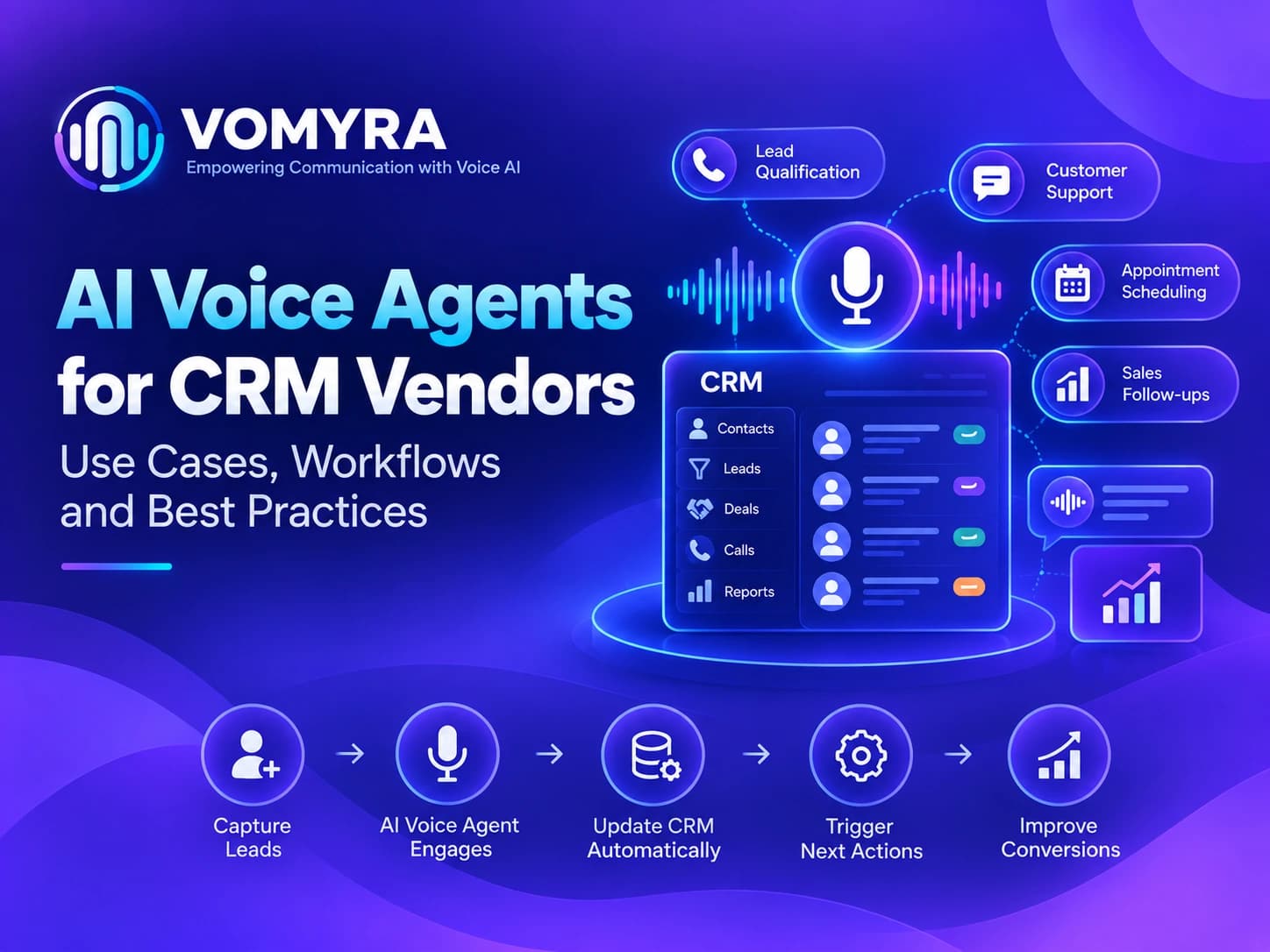
A Practical Workflow for CRM Vendors
- Trigger from your stack: demo form, sign-up, inactivity event, failed payment or renewal date.
- Instant call from the AI voice agent, using the script for that stage.
- Conversation: qualify, answer product questions, collect feedback or confirm a payment.
- Action: book a demo, schedule onboarding, send a payment link or create a ticket.
- CRM updates with the outcome, transcript and next step, so nothing lives only in a call log.
- Handoff: hot leads and unhappy customers go to the right person with a summary.
- Weekly review: read a sample of transcripts, tighten scripts and watch the numbers.
Manual Follow-Up vs AI Voice Agents for CRM Vendors
| Stage | Manual SDR / CS follow-up | With AI voice agents |
| Demo request response | Hours to a day | Minutes |
| Lead qualification | Depends on rep and workload | Same questions on every call |
| Trial activation outreach | Rarely systematic | Triggered by user behaviour |
| Onboarding check-ins | Limited by team size | Every new customer |
| Renewal and payment reminders | Ad hoc | Scheduled and consistent |
| Feedback and churn insight | Few conversations | Many, with transcripts |
| Language coverage | Limited to the team | Multiple Indian languages |
| Cost as volume grows | Rises with headcount | Scales without matching hires |
Benefits for CRM Vendors
More demos from the same traffic. Faster response and consistent follow-up raise the share of enquiries that become meetings.
Better activation. Calling stuck trial users helps recover some of them and shows where onboarding breaks.
Protected revenue. Renewal and payment reminders reduce involuntary churn.
Product insight at scale. Transcripts show objections, missing features and recurring questions you would otherwise miss.
A focused sales team. SDRs and account executives spend time on qualified conversations, not first-touch chasing.
Read Also: CRM Integration for AI Voice Agents: Practical Guide for Production Calling
Best Practices for CRM Vendors
Start with one high-intent trigger. Demo requests or trial inactivity are good first picks because the intent is clear and results are easy to measure.
Keep product knowledge accurate. Feed the agent your website, help centre and pricing, and update it whenever plans change.
Write short, honest scripts. Say who is calling and why, ask a few focused questions and offer a clear next step.
Connect it to your own systems. The call outcome should land in your CRM, calendar and billing or support tools, with the transcript attached.
Define when a human steps in. Set rules for large accounts, security or data questions, angry customers and anything outside the agent’s scope.
Respect consent and calling rules. Call only people who have reason to expect it, observe calling hours and honour opt-outs.
Measure outcomes, not calls. Track demos booked, activation rate, trial-to-paid conversion and renewal rate.

Build an AI Team for Your CRM Business
Your product helps customers follow up faster. Your own funnel should do the same.
Vomyra is India’s Agentic Voice AI Platform. It gives software teams a complete AI voice team (Research, Outreach, Qualification, Closing and Follow-Up agents), real Indian mobile numbers, human-like conversations in multiple languages and no-code setup, with unlimited calling plans.
If you want to cover demos, trials, renewals and reminders without growing headcount, test Vomyra on one workflow and measure the result.
FAQs
How can CRM vendors use AI voice agents?
They can use them to respond to demo requests, qualify leads, activate trial users, run onboarding check-ins, remind customers about renewals and failed payments, and collect feedback.
Will AI voice agents replace SDRs and customer success teams?
They take over repetitive first calls, reminders and routine check-ins. Your team still runs demos, handles complex questions, negotiates and manages key accounts.
Can an AI voice agent update our CRM after each call?
It should. Look for integration with your CRM, calendar and the tools that trigger your workflows, and check exactly which fields and transcripts are written back.
Do we need engineers to set up an AI voice agent?
Not on a no-code platform. Agents can be launched from your website, knowledge base or documents. Engineering help is only needed for deeper integrations with your own product.
Does it work for customers who speak Hindi or regional languages?
Yes, on platforms built for India. Vomyra supports multiple languages, including natural Hindi-English code-switching, which matters for SME customers outside the metros.
Is it safe to let an AI agent talk to prospects and customers?
It is safe when scripts are clear, scope is limited to approved topics, disclosure and opt-out rules are followed and transcripts are reviewed. A route to a human should always be available.
How do we measure whether it is working?
Compare demo-booking rate, time to first call, trial activation and renewal rate before and after launch, and review call transcripts for quality.