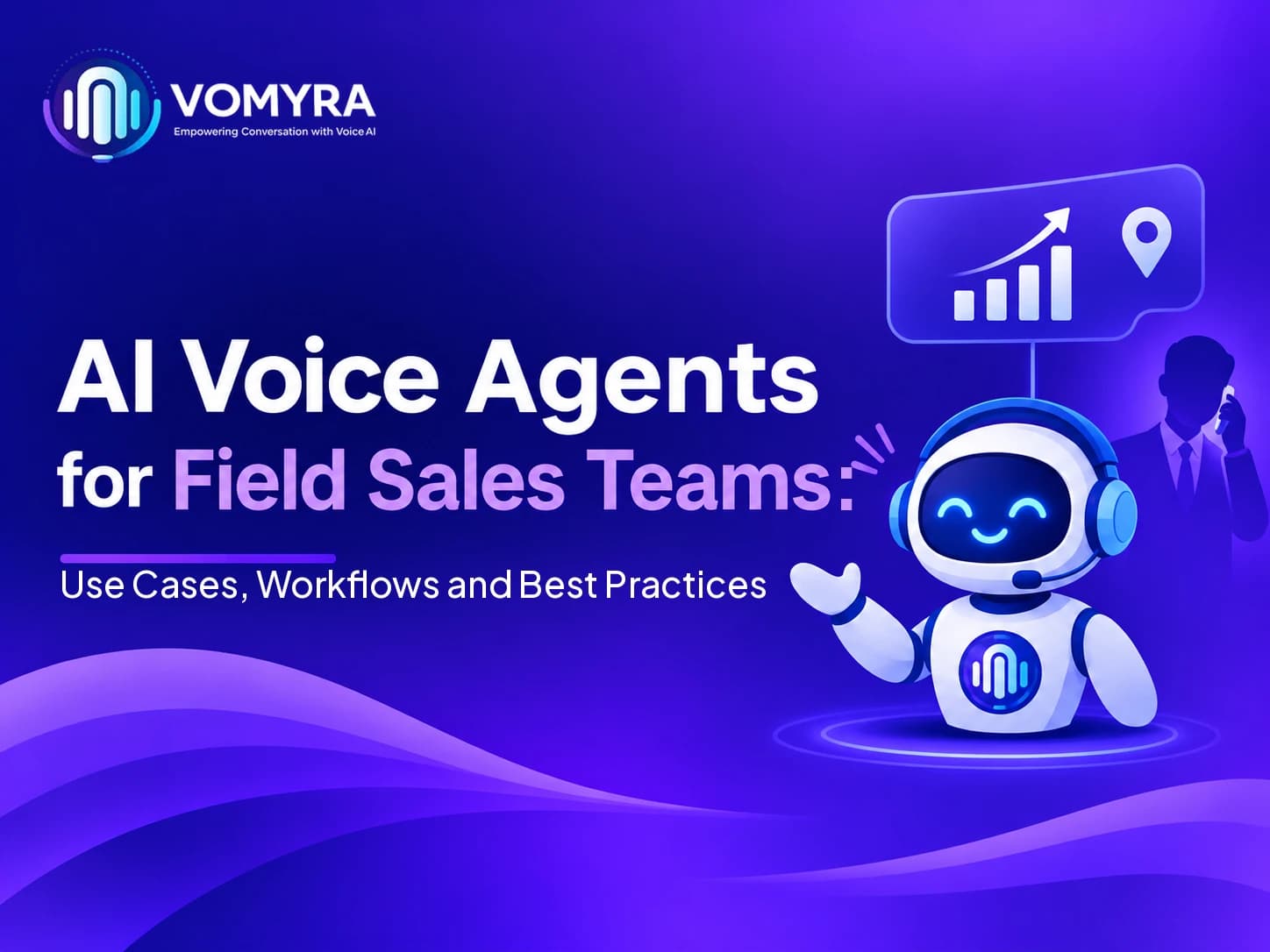
Field sales teams spend much of their working day speaking with customers, following up on leads, sharing product information, and coordinating with internal teams. However, managing these activities manually can take time away from important tasks such as customer meetings and closing deals.
Missed calls, delayed responses, and inconsistent follow-ups can also affect sales performance. AI voice technology offers a practical way to manage routine customer conversations. It can make calls, answer common questions, collect customer details, and schedule follow-ups based on business requirements.
With the right setup, AI Voice Agents for Field Sales Teams can help businesses maintain regular communication while allowing sales representatives to focus on building customer relationships.
Why Field Sales Teams Need Voice Automation
Field sales representatives often work across different locations and manage several customer accounts at once. They may need to contact new leads, check order requirements, confirm appointments, and update customers about products or services.
Handling every conversation manually creates several challenges:
- Missed follow-ups: Sales representatives may forget to contact leads at the right time.
- Time-consuming calls: Repeated conversations about pricing, availability, and product details consume working hours.
- Poor lead tracking: Important customer information can get lost when updates are not recorded properly.
- Delayed communication: Customers may have to wait for responses when representatives are travelling or attending meetings.
- Inconsistent conversations: Different representatives may share different information with customers.
AI-powered communication tools can help address these problems by handling repetitive calling activities and keeping customer interactions organised.
How AI Voice Agents Support Field Sales Operations
An AI voice agent uses speech recognition, natural language processing, and conversational AI to communicate with customers over phone calls. It can understand customer responses, follow conversation instructions, and take specific actions through connected business systems.
1. Lead Qualification and Initial Conversations
When a business receives new enquiries, the sales team needs to identify which prospects are genuinely interested. Calling every lead manually can delay the process.
An AI voice assistant for sales representatives can contact new prospects, introduce the business, ask relevant questions, and collect information about their requirements. For example, a company selling industrial equipment can use voice calls to understand the customer’s preferred product, purchase timeline, and approximate order quantity.
The collected information helps sales representatives prioritise leads before scheduling detailed discussions.
2. Regular Customer Follow-Ups
Following up at the right time is important for maintaining customer interest. However, sales representatives may handle dozens of conversations every day, making manual reminders difficult to manage.
Automated Sales Follow-Ups can help businesses contact prospects after product demonstrations, quotation requests, or initial discussions. The voice agent can ask whether the customer needs additional information and record their response.
These conversations also help businesses identify prospects who are ready for another discussion and those who need more time.
3. Order and Product Information
Customers frequently call sales representatives to ask about product availability, delivery schedules, order status, and pricing details.
An AI voice agent connected to approved business information can answer common questions without requiring a representative to handle every call. If a customer has a complicated request, the system can transfer the conversation or create a callback request.
This approach makes routine communication easier while keeping human representatives available for important customer discussions.
Common Use Cases Across Field Sales Teams
Different industries have different sales requirements. The following examples explain where voice automation can support daily operations.
| Industry | Common Requirement | How Voice Automation Helps |
| FMCG distribution | Retailer order collection | Calls retailers and records product requirements |
| Real estate | Property enquiry management | Collects budget, location, and property preferences |
| Pharmaceuticals | Distributor coordination | Shares approved product information and schedules discussions |
| Manufacturing | Dealer communication | Collects enquiries and identifies purchase requirements |
| Automotive | Test drive scheduling | Contacts interested buyers and confirms appointments |
| Wholesale businesses | Repeat order reminders | Contacts existing customers about upcoming requirements |
These applications show how AI-Powered Field Sales Automation can support businesses with regular customer communication.
For example, a distributor managing hundreds of retail outlets can use scheduled voice calls to collect reorder requirements. The sales team can then review the collected information and coordinate deliveries.
Building an Effective Voice Calling Workflow
A successful automation setup requires more than connecting a voice agent to a phone system. Businesses should define the calling process, customer information requirements, and actions that should happen after each conversation.
Step 1: Identify the Calling Objective
Start by deciding what the voice agent should achieve. Possible objectives include qualifying leads, collecting orders, confirming appointments, or contacting inactive customers.
Each calling campaign should have a clear purpose and a defined outcome.
Step 2: Prepare Conversation Scripts
Create simple conversation flows based on real customer interactions. Include an introduction, relevant questions, possible customer responses, and clear next steps.
The language should sound natural rather than like a recorded sales announcement. Keep questions short and avoid asking customers for unnecessary information.
Step 3: Connect Business Systems
Connect the calling system with the CRM or other business software used by the sales team. This allows customer details, call outcomes, and follow-up requirements to be recorded in one place.
Field Sales Call Automation becomes more useful when call information is available to representatives without requiring manual data entry.
Step 4: Set Follow-Up Rules
Define when another call should happen and which situations require human attention. For example, an interested prospect may need a callback from a sales representative, while an unanswered call may be scheduled for another attempt.
Step 5: Monitor and Improve Performance
Review call recordings, conversation outcomes, customer responses, and transfer requests. Use this information to improve scripts, adjust calling schedules, and identify areas where the agent needs better instructions.
Best Practices for Better Results
Businesses should focus on customer experience rather than simply increasing the number of automated calls.
Consider these practices:
- Keep conversations relevant: Use customer history and enquiry details to make calls more useful.
- Choose suitable calling times: Avoid contacting customers at inconvenient hours.
- Provide human assistance: Allow customers to speak with a representative when their requirements are complex.
- Protect customer information: Follow applicable privacy, consent, and calling regulations.
- Use accurate information: Connect the agent only to approved and updated business data.
- Review performance regularly: Track meaningful outcomes instead of focusing only on call volume.
An AI Voice Assistant for Sales Representatives should support the sales process, not replace the relationship-building work that human representatives perform.
Businesses can also use Automated Sales Follow-Ups to maintain communication with existing customers after purchases, product demonstrations, and service enquiries.

How Vomyra Can Support Field Sales Communication
Businesses looking to organise customer calling activities can explore Vomyra, an agentic voice AI platform designed to support automated business conversations.
Vomyra can help businesses manage customer interactions through AI-powered voice agents. Depending on the configured workflow and integrations, these agents can handle enquiries, collect information, qualify prospects, and trigger relevant follow-up activities.
For field sales operations, this can reduce the time spent on repetitive calling tasks and help representatives access useful customer information before their next conversation.
Businesses should begin with a clearly defined calling requirement, test the conversation flow, and gradually expand automation based on actual results. This approach makes it easier to understand where voice technology adds value.
Read More: AI Voice Agents for Indian Sales Teams: Use Cases, Workflows and Best Practices
Conclusion
Field sales operations depend on timely communication, organised customer information, and consistent follow-ups. Managing these activities manually becomes difficult as customer numbers and calling requirements increase.
AI Voice Agents for Field Sales Teams can help businesses handle routine conversations, collect useful information, and coordinate follow-up activities more efficiently. When combined with clear workflows, accurate data, and human support, voice automation can become a valuable part of a modern sales operation.
Frequently Asked Questions
1. What are AI voice agents used for in field sales?
They are used to contact prospects, qualify leads, answer common questions, collect order requirements, confirm appointments, and manage routine customer follow-ups.
2. Can AI voice agents qualify sales leads?
Yes. They can ask predefined questions about customer requirements, budgets, purchase timelines, and product interests. The collected responses help sales teams identify promising prospects.
3. Can voice agents manage customer follow-ups automatically?
Yes. They can initiate calls based on configured schedules and business events. They can also record customer responses and arrange callbacks when human assistance is required.
4. Do AI voice agents replace field sales representatives?
No. They support repetitive communication tasks, but relationship building, negotiations, product demonstrations, and complex sales discussions still require human involvement.
5. How can businesses measure the performance of voice agents?
Businesses can monitor successful call connections, qualified leads, appointment bookings, customer responses, follow-up completion, and the number of conversations transferred to human representatives.