Listen to any real phone call in India and you will hear it within seconds. “Haan, mujhe demo chahiye, but next week ke baad, Monday ko 4 baje ke around.”
That is Hinglish: Hindi and English mixed in one sentence, without the speaker even noticing. For millions of callers it is the default way of speaking on the phone. For an AI voice agent trained mostly on clean, single-language speech, it is one of the hardest things to get right.
This guide explains what Hinglish calling involves, why it trips up voice agents, and how to test, tune and run it in production.
What Is Hinglish Calling?
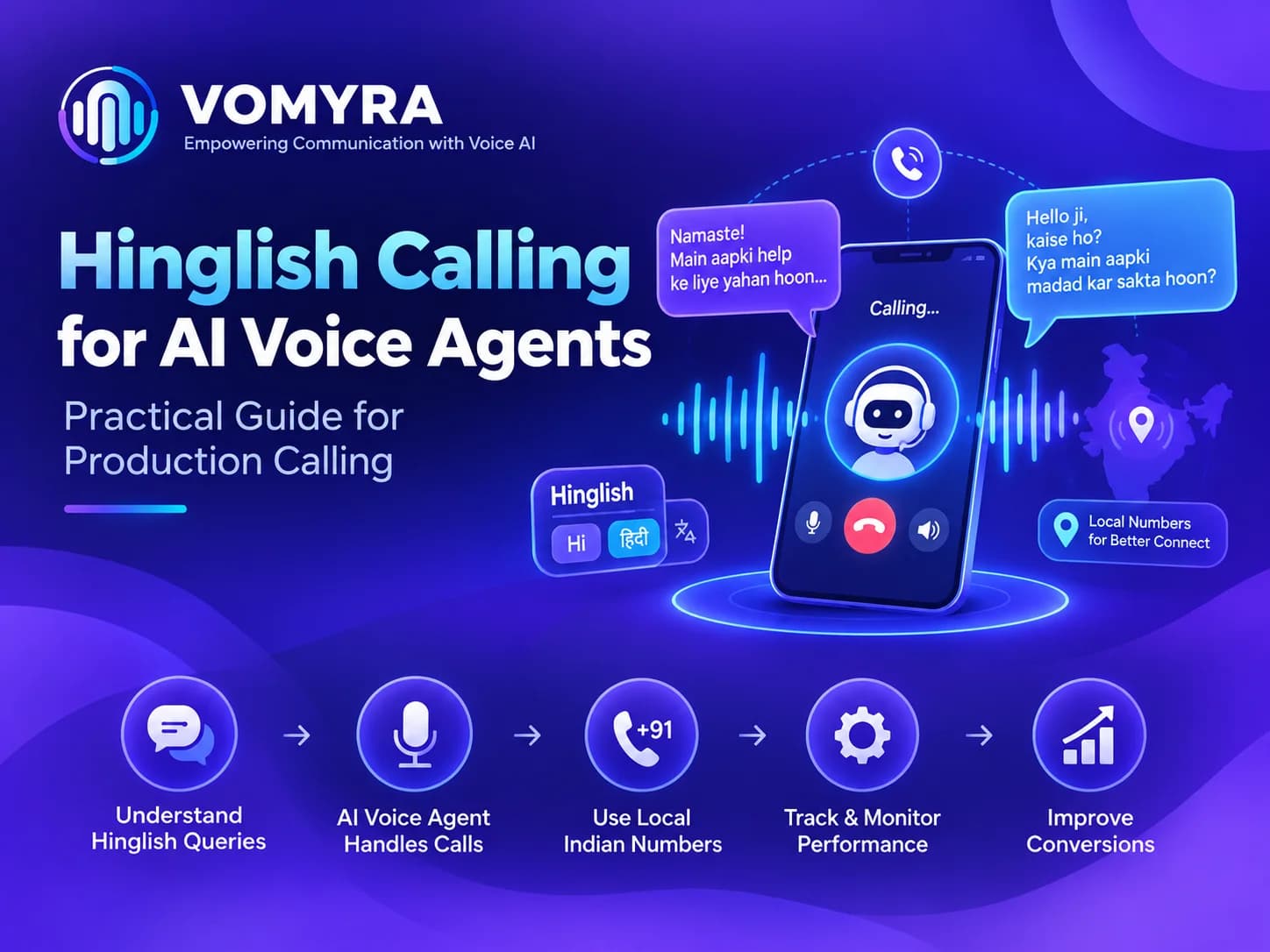
Hinglish calling means an AI voice agent holding a phone conversation with a caller who mixes Hindi and English, and replying in the same natural mix.
It is not a translation, and it is not switching languages on request. The agent has to follow a sentence that starts in Hindi, drops in an English product name, returns to Hindi for the verb and ends with an English number. It then has to answer in a way that sounds like a person, not a textbook.
Why Hinglish Matters for Indian Businesses
It is how many customers actually speak. In cities and increasingly in smaller towns, Hinglish is the everyday register for sales, support and service calls.
Pure Hindi can sound stiff. Formal Hindi (shuddh Hindi) on a sales call feels odd to many callers. Pure English can feel distant. A natural mix feels familiar.
Trust forms in the first few seconds. If the agent mishears the first sentence or replies in an unnatural tone, many callers hang up.
It affects outcomes, not just comfort. Misheard budgets, dates and names lead to wrong follow-ups, failed bookings and frustrated customers.
Why Hinglish Is Hard for Voice AI
Mixed-Language Sentences
Speech recognition models built for one language at a time can fail when the language changes mid-sentence. English words inside Hindi grammar are often transcribed wrongly or dropped. This is a major challenge for Hindi-English code-switching during live calls.
Romanised Hindi and Spelling Variants
The same Hindi word can be written many ways in Roman letters (“kal”, “kl”, “kaal”). If a transcript passes through the language model and text-to-speech layer in inconsistent spelling, answers and pronunciation can suffer. A Hindi AI voice agent therefore needs testing with the way people actually speak and write.
Numbers, Dates and Time
“Dedh lakh”, “do hazaar paanch sau”, “saade chaar baje” and “4:30 PM” all mean something specific. The agent must understand them and confirm the right value.
Names, Places and Brands
Indian names and local place names, spoken with different accents, are common failure points.
Accents and Background Noise
Calls come from moving vehicles, markets and homes, over mobile networks. A model tested on clean studio audio can behave very differently on these lines. This is especially important when using speech-to-text Indian languages in real-world calling environments.
Register and Tone
Replies need the right level of formality. “Aap” versus “tum”, polite phrases and common English fillers all shape how natural the agent sounds.
Pronunciation by the Voice
If the text-to-speech layer reads Roman Hindi as English, or English words with a Hindi accent in the wrong places, the call sounds artificial even when the content is correct. Good text-to-speech AI therefore needs to be tested with real Hinglish phrases.
Common Hinglish Problems and Fixes
| Symptom | Likely cause | What to do |
| Agent mishears half the sentence | Speech recognition not tuned for mixed speech | Test on real Hinglish calls and choose or tune the recogniser accordingly |
| Wrong amounts, dates or times | Weak number and entity handling | Read back key details and ask for confirmation |
| Reply sounds like a translation | Formal or literal phrasing | Write prompts and sample replies in natural spoken Hinglish |
| Odd pronunciation of Hindi words | Roman-script text read with the wrong accent | Test voices on Hinglish text and adjust spelling or pronunciation hints |
| The agent keeps asking “Hindi or English?” | No mid-call language handling | Let the agent follow the caller’s mix without asking them to choose |
| Names and places misheard | Accent and vocabulary gaps | Add known names and terms, confirm by repeating |
| Sounds robotic after a long reply | Long, written-style sentences | Keep spoken replies short, one idea at a time |
Best Practices for Hinglish Calling in Production
Test with real callers, not scripts. Use native speakers from different regions, on real phone lines, with background noise and natural interruptions. This helps evaluate multilingual AI voice agents under actual calling conditions.
Write prompts in the way people speak. Include sample Hinglish exchanges in your prompt design so the agent copies the register, not the textbook.
Keep replies short. Spoken Hinglish works in short sentences. Long paragraphs sound read out.
Confirm critical details. Read back names, numbers, dates, times and addresses before booking, quoting or charging.
Match the caller. If the caller leans towards English, learn that way. If they use more Hindi, follow. Do not force one language.
Handle failure gracefully. If the agent is not sure, it should ask once, politely, then offer a human handoff instead of guessing. A reliable AI calling agent should prioritize accurate information over completing every conversation automatically.
Review transcripts regularly. Look for misheard phrases, repeated clarifications and drop-off points, then update prompts, vocabulary and knowledge base.
Use a number callers recognise. A local Indian mobile number helps pickup, and a natural opening line in Hinglish helps keep people on the call.
Where Hinglish Calling Helps Most
- Lead qualification and follow-up for real estate, education, automotive and B2B sales.
- Collections and payment reminders, where understanding the amount and date is critical.
- E-commerce COD confirmation and delivery updates across tier 1, 2 and 3 markets.
- Appointment booking and reminders in healthcare, salons, clinics and services.
- Customer support and service calls for routine queries.
- Feedback and survey calls where a natural tone gets better answers.
These use cases are especially relevant for an AI phone agent because the conversation needs to continue naturally without forcing customers into a fixed language.

Voice AI Built for How India Actually Speaks
Hinglish support is more than a language setting. It is accurate recognition on real phone lines, replies that sound like a person, and a voice that feels familiar to the caller. A strong Voice AI platform needs to handle these elements together rather than treating language support as a simple setting.
Vomyra is India’s Agentic Voice AI Platform. It gives businesses a complete AI voice team (Research, Outreach, Qualification, Closing and Follow-Up agents) with human-like conversations in multiple languages, including natural Hindi-English code-switching, real Indian mobile numbers and no-code setup, with unlimited calling plans.
For businesses evaluating AI voice agents India, the important test is not simply whether an agent can speak Hindi or English separately. It is whether the system can understand natural mixed-language conversations and respond accurately on real calls.
If your customers speak the way most of India speaks on the phone, test Vomyra on your own calls and judge it by the results.
FAQs
What is Hinglish calling in AI voice agents?
It is an AI voice agent’s ability to understand and speak the natural mix of Hindi and English that many callers use, and to reply in the same style on a live phone call.
Can an AI voice agent understand Hinglish?
Many can, but quality varies a lot. Clean single-language demos do not show how an agent handles mixed sentences, so test with real Hinglish calls before you rely on one.
Why do voice agents struggle with Hinglish?
Speech recognition and language models are often trained mostly on single-language data. Mixed sentences, Roman-script Hindi, accents, numbers and names all add difficulty, especially on noisy mobile lines.
Is Hinglish the same as Hindi-English code-switching?
Yes, in everyday use. Hindi-English code-switching is the linguistic term for moving between languages within a conversation or sentence. Hinglish is the common name for the Hindi-English version.
How do I test a Hinglish AI voice agent before launch?
Run calls with native speakers on real phone lines, including different accents, background noise, interruptions, numbers, dates and names. Then review the transcripts line by line for errors.
Should the agent reply in Hindi, English or Hinglish?
Usually in the style the caller is using. A natural mix feels more human than forced pure Hindi or pure English, especially for sales and service calls.
Does Hinglish support work for other Indian languages too?
Not automatically. Each language, and each language-plus-English mix, needs its own testing. Strong Hinglish performance does not guarantee the same quality in Tamil, Telugu, Marathi or other languages.
What should happen if the agent does not understand the caller?
It should ask politely for clarification once, then offer another way forward, such as a callback or a human handoff, instead of guessing and getting details wrong.