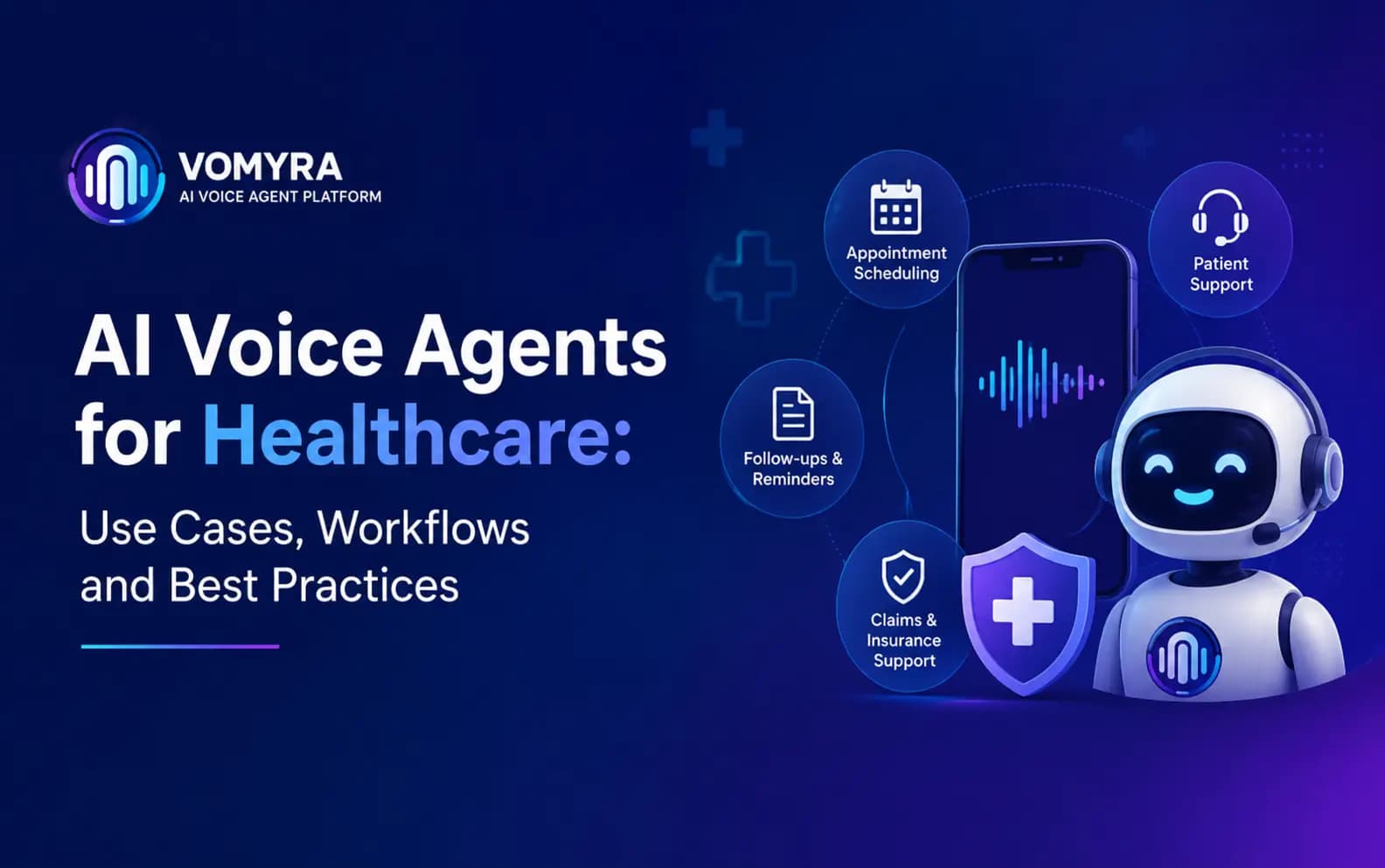
Healthcare front desks handle a constant volume of repetitive but essential calls – booking appointments, confirming visits, sending reminders, following up after consultations. Every one of these calls matters to the patient on the other end, but few of them require a doctor’s or nurse’s time, and most clinics don’t have enough front-desk staff to handle them promptly at scale.
Missed calls mean missed appointments. Missed reminders mean higher no-show rates. Missed follow-ups mean patients who don’t return for care they need.
AI voice agents are increasingly used to handle this layer of healthcare communication – answering and making calls instantly, at any hour, so clinical staff can focus on patient care instead of the phone.
This guide covers where AI voice agents fit into healthcare, key use cases, a practical workflow, and best practices for deploying them responsibly.
Why Healthcare Is a Strong Fit for AI Voice Agents
A few characteristics of healthcare communication make voice AI particularly effective here:
- High call volume, repetitive structure. Appointment booking, confirmations and reminders follow largely predictable patterns.
- Time-sensitive patient needs. A missed call about a follow-up or test result can have real consequences for patient care.
- Limited front-desk capacity. Clinics and hospitals are frequently understaffed for the call volume they receive, especially during peak hours.
- Around-the-clock demand. Patients don’t only need to call during business hours, but most front desks only operate within them.
These conditions make healthcare one of the clearer, higher-impact use cases for AI voice agents – not replacing clinical judgement, but absorbing the administrative call volume around it.
Key Use Cases for AI Voice Agents in Healthcare
1. Appointment Booking
Patients calling to book an appointment can be handled entirely by an AI voice agent – checking doctor availability, offering slots, and confirming the booking directly into the clinic’s scheduling system, without waiting on hold.
2. Appointment Reminders and Confirmations
Automated reminder calls ahead of a scheduled appointment reduce no-shows significantly, giving patients the option to confirm, reschedule, or cancel directly on the call.
3. Post-Consultation Follow-Ups
After a consultation or procedure, an AI voice agent can call to check on the patient’s recovery, remind them of medication schedules, or flag concerning responses for a clinician to review.
4. Test Result and Report Availability Calls
Rather than patients calling repeatedly to check if reports are ready, an AI voice agent can proactively notify them once results are available and guide them on next steps.
5. Insurance and Billing Queries
Common, repetitive billing and insurance questions – coverage details, payment confirmations, outstanding balances – can be handled by an AI voice agent, freeing administrative staff for more complex cases.
6. Patient Intake and Pre-Visit Information Collection
Before a first visit, an AI voice agent can call to collect basic patient information, medical history highlights, and insurance details, so the clinical team has what they need before the patient arrives.
7. Recall and Preventive Care Reminders
For patients due for a check-up, vaccination, or recurring screening, AI voice agents can run systematic recall campaigns – something most clinics don’t have the staff time to do consistently at scale.
A Practical AI Voice Agent Workflow for Healthcare
- Call trigger – A patient calls in, or the clinic’s system flags an outbound need (reminder, recall, follow-up).
- Identity and context check – The AI voice agent confirms patient identity and pulls relevant context from the clinic’s system.
- Core task handling – Booking, confirming, rescheduling, or answering the relevant query conversationally.
- Escalation logic – If the query involves clinical judgement, urgent symptoms, or anything outside defined scope, the agent escalates to a human staff member immediately.
- System update – Appointment changes, confirmations, or notes are updated directly in the clinic’s scheduling or records system.
- Follow-up scheduling – Where relevant, the next touchpoint (reminder, recall, post-visit check-in) is automatically scheduled.
- Call logging – Every call is transcribed and logged for administrative and compliance review.
The critical design principle throughout: the AI agent handles administrative and informational tasks, and hands off anything clinical to a human without hesitation.
Manual Front-Desk Calling vs AI Voice Agent Calling in Healthcare
| Factor | Manual Front-Desk Calling | AI Voice Agent |
| Call answer rate | Limited by staff availability | Every call answered instantly |
| Appointment reminder consistency | Depends on staff bandwidth | Automated, every time |
| No-show rate | Higher without consistent reminders | Reduced with systematic reminder calls |
| Availability | Business hours only | 24/7 |
| Recall campaign capacity | Rarely run consistently | Systematic, ongoing outreach |
| Cost per call handled | High during peak volume | Significantly lower at scale |
| Language coverage | Limited to staff’s languages | Multiple languages, including regional Indian languages |
| Documentation | Manual notes, often incomplete | Full transcripts and structured records |

Best Practices for Deploying AI Voice Agents in Healthcare
Keep clinical judgement with clinicians The agent should handle scheduling, reminders, and informational queries – never diagnosis, treatment advice, or anything requiring clinical judgement. Escalation paths need to be clear and immediate.
Design conservative escalation rules When in doubt, the agent should route to a human. This applies especially to anything involving symptoms, urgency, or emotional distress – false confidence here carries real risk.
Be transparent about AI involvement Patients should be able to tell they’re speaking with an AI voice agent, and easily reach a human staff member if they prefer.
Protect patient data carefully Healthcare calls involve sensitive personal information. Data handling, storage and access need to meet the same standards applied to any other patient record system.
Start with low-risk, high-volume tasks Appointment booking and reminders are typically the best starting point – high call volume, low clinical risk, and immediate impact on no-show rates.
Match language to your patient base Patients across India span a wide range of language preferences, particularly outside major metro areas. An agent that can converse in the patient’s preferred language will be more effective and more trusted than one limited to English.
Build an AI Team for Your Healthcare Front Desk
Healthcare communication doesn’t stop at business hours, and most front desks can’t keep up with the call volume they receive. That gap shows up directly in missed appointments, higher no-show rates, and patients who fall out of follow-up care.
Vomyra is India’s Agentic Voice AI Platform, built to give healthcare providers a complete AI voice team – handling appointment booking, reminders, follow-ups and recall campaigns around the clock, with clear escalation to your staff whenever a call needs a human.
Vomyra AI voice agents use real Indian mobile numbers and hold human-like conversations in multiple languages, so patients get a natural experience whether they’re booking a visit or receiving a reminder call.
If you’re evaluating how to reduce no-shows and free up front-desk capacity, Vomyra is built specifically for this – with unlimited calling plans and no coding required to get started.
FAQs
Can an AI voice agent give medical advice?
No, and it shouldn’t be configured to. AI voice agents in healthcare should be scoped to administrative and informational tasks – booking, reminders, follow-ups – with clear escalation to clinical staff for anything else.
Is patient data safe with an AI voice agent?
It should be, provided the platform follows appropriate data protection practices for healthcare information – this is a key question to ask any vendor before deployment, not an assumption to make.
Will patients accept talking to an AI instead of front-desk staff?
Acceptance is generally high for administrative tasks like booking and reminders, especially when the alternative is being on hold or unable to reach the clinic during busy hours, provided a human option remains available.
Can this work for a single clinic, not just large hospital chains?
Yes. Since these platforms don’t require coding to set up, individual clinics and small practices can deploy an AI voice agent configured around their own scheduling system and services.