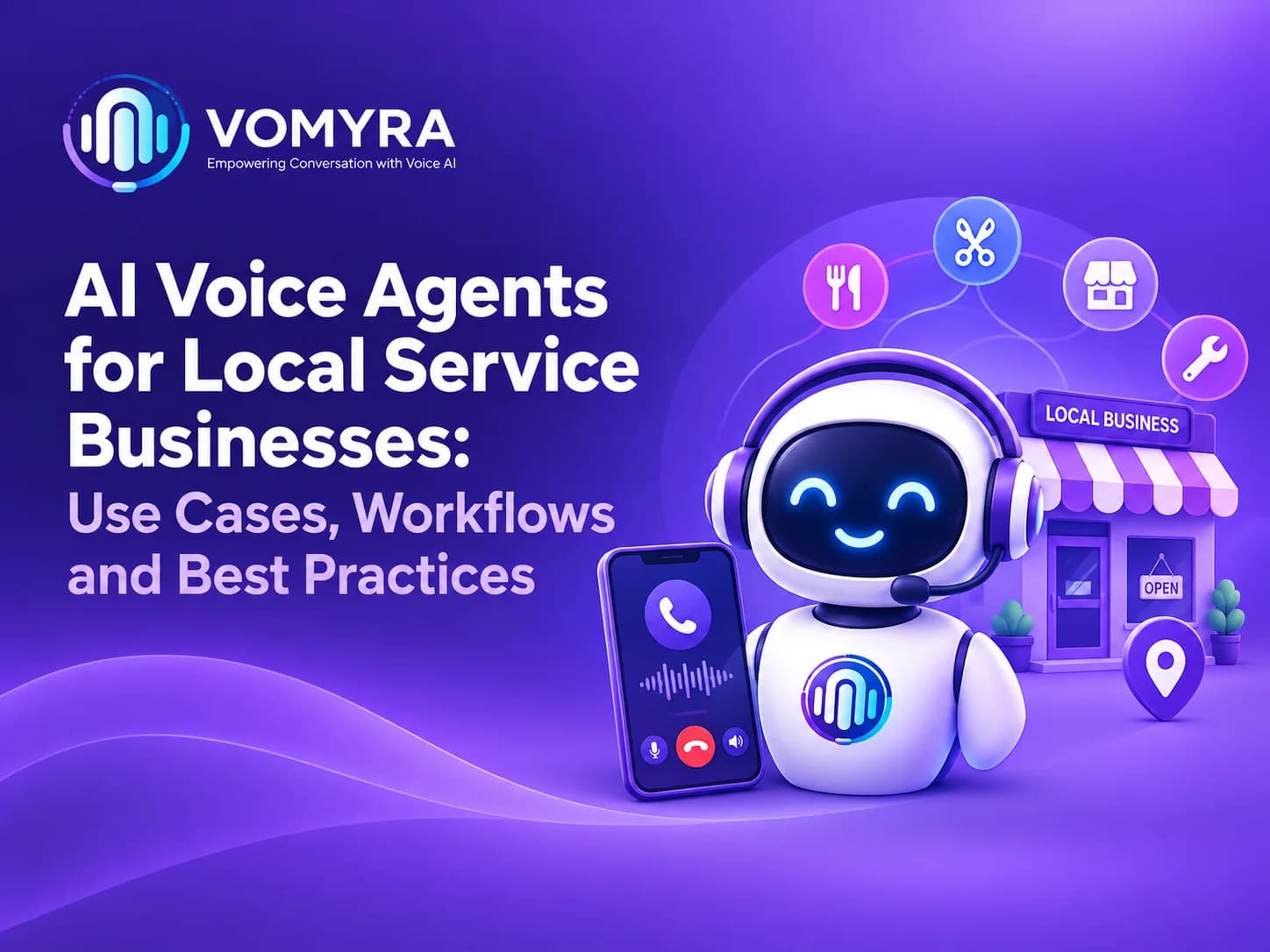
Local service businesses depend on phone calls to connect with customers, schedule appointments, answer questions, and win new jobs. However, handling every call can be difficult when staff are busy serving customers or working in the field. Missed calls often mean missed business opportunities.
AI Voice Agents for Local Service Businesses offer a practical way to manage these conversations without requiring someone to answer every call manually. They can respond to common questions, collect customer details, schedule appointments, and help businesses follow up with potential customers.
With a clear workflow, businesses can improve their phone support while allowing employees to focus on their main responsibilities.
What Are AI Voice Agents for Local Service Businesses?
AI voice agents are automated systems that communicate with customers through natural-sounding conversations. They use speech recognition, language processing, and voice generation to understand questions and provide relevant responses.
Unlike traditional phone menus that ask callers to press numbers, these systems allow customers to speak naturally. For example, someone calling a plumbing company can explain a leaking pipe problem and ask for the earliest available appointment.
Vomyra helps businesses explore voice-based automation for customer conversations and routine calling tasks. Depending on the setup, an AI voice agent can answer incoming calls, contact leads, collect information, and connect conversations with other business tools.
Why Local Service Businesses Need Voice AI
Local businesses often receive calls while their employees are attending appointments, travelling between locations, or helping customers in person. Hiring additional staff to handle every call may not be practical, particularly for small teams.
AI voice agents for local businesses can help address these problems in several ways:
- Fewer missed calls: Customers can receive a response even when employees are unavailable.
- Faster customer support: Common questions can be answered without waiting for a staff member.
- Better lead collection: The system can record customer details and service requirements.
- Simpler scheduling: Customers can request appointments through a phone conversation.
- Consistent communication: Callers receive a structured response based on the business’s rules.
These benefits make voice automation useful for businesses that want to handle more enquiries without adding unnecessary administrative work.
Common Use Cases of AI Voice Agents
1. Managing Incoming Customer Calls
Home service providers, repair companies, salons, and cleaning businesses receive calls throughout the day. Some customers want service information, while others need urgent assistance or want to check availability.
AI voice assistants for service businesses can answer routine enquiries, identify what the caller needs, and collect relevant details. If a conversation requires professional judgement, the agent can transfer the call or arrange a callback according to the business’s rules.
2. Booking and Rescheduling Appointments
Appointment management takes time, especially when customers call to confirm, cancel, or change their bookings.
With AI appointment booking and scheduling, a voice agent can ask about the preferred date, service type, and available time. When connected to a supported calendar or booking system, it can check availability and confirm an appointment according to configured rules.
For example, a dental clinic may use an agent to handle appointment requests while reception staff assist patients who are already at the clinic.
3. Qualifying New Leads
Not every inquiry becomes a paying customer. Service businesses need to understand the customer’s requirements before deciding which enquiries deserve immediate attention.
AI lead qualification for local businesses can involve asking questions about the required service, location, budget range, urgency, and preferred appointment time. The answers help the team identify suitable prospects and prepare for follow-up conversations.
Vomyra can be part of a workflow in which voice conversations support lead collection and follow-up. The actual process depends on the integrations and rules configured for the business.
4. Handling Missed Calls and Follow-Ups
A missed call from a potential customer can result in lost revenue, particularly when competitors are available to respond sooner.
Voice AI for local service providers can support callbacks, enquiry follow-ups, and appointment reminders. For instance, a home cleaning company may contact a person who requested a quotation but did not complete the booking.
Businesses should set clear rules for callback timing, customer consent, and opt-out requests. Automated follow-ups should be relevant rather than repetitive.
5. Answering Frequently Asked Questions
Customers regularly ask about service areas, opening hours, pricing ranges, booking policies, and availability. Answering the same questions repeatedly can consume valuable staff time.
Automated phone answering for local businesses allows an agent to respond using approved business information. If pricing depends on the job or an answer is unavailable, the agent should collect the details and arrange a conversation with a staff member instead of guessing.
How to Build an Effective AI Voice Agent Workflow
A useful workflow should solve a specific business problem. Automating every conversation from the beginning can create unnecessary complexity.
Step 1: Identify the Main Business Goal
Start by selecting one task, such as answering after-hours calls, collecting leads, or scheduling appointments. Define what a successful call should achieve.
For example, a plumbing company might want to capture the caller’s name, service address, plumbing issue, and preferred appointment time.
Step 2: Create a Clear Conversation Flow
Prepare the questions the agent should ask and the information it should provide. Keep conversations short, relevant, and easy to follow.
A typical workflow includes:
- Greet the caller and explain the purpose of the call.
- Understand the customer’s request.
- Ask relevant questions and collect necessary details.
- Provide approved information or check availability.
- Confirm the next step or transfer the call.
- Save the call outcome for the business team.
AI call automation for small businesses works best when the conversation has a clear purpose rather than following an unnecessarily long script.
Step 3: Connect the Required Business Tools
An AI voice agent becomes more useful when it can work with the systems a business already uses. Depending on available integrations, these may include calendars, customer relationship management software, lead forms, or notification tools.
Vomyra can support voice automation workflows, but businesses should verify which integrations and actions are available for their chosen setup before deployment.
Step 4: Test Before Launching
Test the agent with different accents, background noise, incomplete answers, unexpected questions, and requests it cannot handle. Check whether it collects information correctly and transfers difficult conversations when necessary.
Begin with a limited set of calls, review the results, and improve the workflow before expanding its responsibilities.
Best Practices for AI Voice Agents
Keep Conversations Natural and Useful
AI voice agents should ask one question at a time and avoid long explanations. Callers should understand what the system can do and how they can reach a human when needed.
Protect Customer Information
Collect only the information required to complete the task. Establish appropriate access controls, retention policies, and consent procedures for recordings and automated calls.
Set Clear Escalation Rules
Some conversations require a human, especially complaints, emergencies, unusual requests, or sensitive customer situations. Define when the agent must transfer a call or arrange immediate follow-up.
Measure Business Results
Track meaningful metrics instead of judging performance only by call volume. Useful measurements include:
- Call answer rate
- Qualified leads collected
- Appointments booked
- Missed-call recovery rate
- Successful call transfers
- Customer satisfaction
- Cost per qualified lead
Review these figures regularly to identify where the workflow needs improvement.

How to Choose the Right Voice AI Solution
Before selecting a platform, consider the number of calls your business receives, the complexity of your conversations, and the tools you already use.
Look for reliable call handling, suitable language support, configurable workflows, useful reporting, and clear human handoff options. Also check pricing, integration availability, data handling policies, and the ability to test the system before committing.
AI voice agents for local businesses should address a measurable problem. A small repair company may need basic call answering and lead collection, while a multi-location service provider may require more advanced routing and appointment management.
Conclusion
AI Voice Agents for Local Service Businesses can help companies manage customer calls, capture enquiries, schedule appointments, and improve follow-up without placing every task on their staff.
Their value comes from solving specific operational problems, not from automating conversations simply for the sake of using technology.
Businesses should start with one clear workflow, test it with real customer scenarios, and measure its results before expanding. With the right setup, Vomyra can help businesses explore voice automation that supports faster responses, better lead handling, and more organised customer communication.
Frequently Asked Questions
1. What are AI voice agents for local service businesses?
They are automated systems that speak with customers over the phone, answer common questions, collect details, and support tasks such as appointment requests and lead qualification.
2. Which businesses can benefit from AI voice agents?
Plumbers, electricians, cleaning companies, salons, clinics, repair services, and other appointment-based businesses can use them to manage routine calls and customer enquiries.
3. Can AI voice agents book appointments automatically?
Yes, when connected to a compatible scheduling system and configured with the necessary permissions. The agent can check availability, collect preferences, and confirm bookings according to business rules.
4. How do AI voice agents help generate more leads?
They can answer incoming enquiries, ask qualifying questions, capture contact information, and arrange follow-ups. This helps businesses respond to potential customers who might otherwise be missed.
5. Are AI voice agents suitable for small businesses?
Yes. Small businesses can begin with a focused use case, such as after-hours call answering or appointment requests. The best solution depends on call volume, budget, integration needs, and the level of automation required.