An AI voice agent that works well in English can still fail badly in India. The caller says “Mujhe kal ka appointment reschedule karna hai, around 4 PM”, and the agent either misses half the sentence or replies in a stiff register no one uses on a phone call.
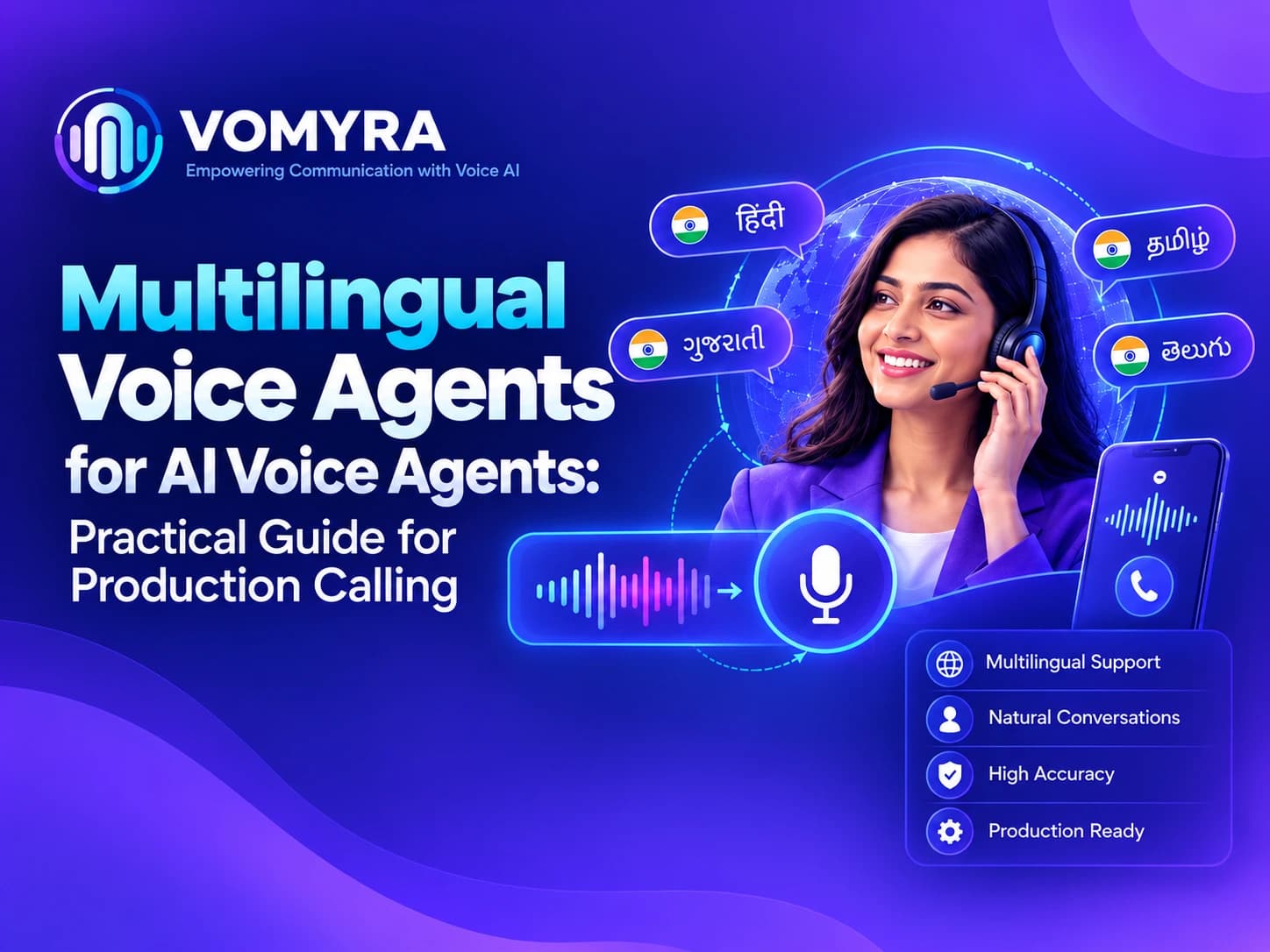
That is the gap between a multilingual demo and a multilingual product. India has 22 scheduled languages, many dialects and a habit of mixing languages in the same sentence. Voice agents that ignore this lose callers within the first few turns.
This guide explains how multilingual AI voice agents work, where they usually break, and how to test and run them in production.
Why Multilingual Support Matters in India
Customers prefer their own language. People are more at ease, and more honest, in the language they think in. That affects trust, comprehension and conversion.
Reach depends on it. English- or Hindi-only agents leave out customers in many states and in smaller cities, where regional languages dominate.
Mixed speech is normal. Hindi-English, Tamil-English and similar mixes are how many people actually talk. This is called code-switching.
Sensitive calls need clarity. Collections, healthcare and financial reminders go wrong quickly if the caller does not fully understand.
Competitors will cover it. As voice AI becomes common, language coverage becomes a baseline expectation, not a feature.
How a Multilingual Voice Agent Works
A typical cascaded voice agent has four parts, and each one has to handle language well:
- Speech-to-text (STT) turns the caller’s speech into text. It must recognise the language, accents and mixed speech.
- Language model understands intent and writes the reply in the right language and registers.
- Knowledge and tools supply facts, prices, availability and customer data, which may be stored in one language but needed in another.
- Text-to-speech (TTS) speaks the reply with natural pronunciation, rhythm and tone.
A weakness in any one of these shows up as a bad call. A strong language model cannot fix poor transcription, and a good transcript is wasted if the voice mispronounces a name.
Where Multilingual Voice Agents Break
Code-Switching
Models trained on clean single-language data struggle when a sentence mixes languages, or when English product names, numbers and addresses sit inside Hindi or regional speech.
Accents and Dialects
The same language sounds different across regions. An agent tuned on one accent can mishear another, especially on noisy mobile lines.
Names, Numbers and Addresses
Indian names, place names, amounts and dates are common failure points. “Do hazaar paanch sau” and “twenty-five hundred” must both be understood and confirmed correctly.
Uneven Quality Across Languages
Large models are often stronger in some languages than others. Replies can be fluent in Hindi and awkward in a regional language.
Script and Pronunciation
Transliterated text, such as Hindi written in Roman letters, can confuse text-to-speech and produce odd pronunciation.
Formal vs Spoken Register
Textbook language sounds unnatural on a call. People speak a colloquial version, and the agent should too.
Mid-Call Language Changes
A caller may start in English and move to their mother tongue when the topic gets complex. The agent needs to follow without asking them to choose again.
Knowledge Base Language
If product information exists only in English, the agent may translate on the fly and make errors. Key facts should be checked in each language.
Common Multilingual Problems and Fixes
| Symptom | Likely cause | What to do |
| Agent mishears mixed-language sentences | STT not tuned for code-switching | Test on real mixed speech and choose or tune STT accordingly |
| Wrong amounts, dates or names | Number and entity handling is weak | Add read-back confirmation for key details |
| Reply sounds stiff or translated | Formal register, literal translation | Write prompts and examples in natural spoken style |
| Strong in Hindi, weak in other languages | Uneven model quality | Test each language separately and set realistic scope |
| Odd pronunciation of brand or place names | TTS not tuned for them | Add pronunciation hints and review recordings |
| Agent keeps asking for language choice | No mid-call language detection | Allow detection and switching during the call |
| Wrong facts in a regional language | Knowledge base only in English | Review or provide key content per language |
Best Practices for Production
Decide your language list from data. Look at your leads, customers and call history, then pick the languages that matter first rather than aiming for all at once.
Test with real callers. Use native speakers, real phone lines, background noise and typical accents. Studio demos hide most problems.
Check each language separately. Quality in one language does not guarantee quality in another.
Read back critical details. Confirm names, numbers, dates and addresses before acting on them.
Write prompts for speech. Use short, natural sentences in the way people speak on calls, not formal text.
Keep a clear fallback. If the agent cannot follow, it should say so, switch to a language the caller prefers or hand over to a human.
Review transcripts by language. Track transcription errors, escalations and drop-offs per language and improve from there.
Match the number to the audience. Local mobile numbers help pickup, and the opening line in the caller’s likely language helps keep them on the call.
Read Also:Best Multilingual AI Voice Agents for India: Hindi, Tamil, Telugu, Kannada and More
Where Multilingual Voice AI Helps Most
- Lead qualification and follow-up across states without separate teams per language.
- Collections and payment reminders, where understanding is critical.
- Healthcare and appointment reminders for patients who prefer their own language.
- E-commerce COD confirmation and delivery updates in tier 2 and tier 3 markets.
- Real estate, education and automotive enquiries from regional audiences.
- Customer support for routine queries outside English-speaking metros.

Voice AI Built for How India Actually Speaks
Multilingual support is more than a language dropdown. It is accurate speech recognition on real phone lines, natural replies and a voice that sounds right to the person on the other end.
Vomyra is India’s Agentic Voice AI Platform, It gives businesses a complete AI voice team (Research, Outreach, Qualification, Closing and Follow-Up agents) with human-like conversations in multiple languages, including natural Hindi-English code-switching, real Indian mobile numbers and no-code setup, with unlimited calling plans.
If your customers speak more than one language, test Vomyra on your own calls and your own audience, and judge it by results.
FAQs
What are multilingual AI voice agents?
Multilingual AI voice agents can understand and speak more than one language, allowing customers to communicate in the language they prefer. Some agents can also switch between languages during the same call.
Can an AI voice agent handle Hindi-English code-switching?
Some AI voice agents can handle Hindi-English code-switching, but the quality varies. It is important to test them with real mixed-language conversations because single-language demos may not show how well the agent handles code-switching.
How many Indian languages should an AI voice agent support?
Start with the languages most of your customers use. Once those languages perform well, you can gradually add more. Good language quality is more important than simply supporting a long list of languages.
Is the quality the same in every language?
Usually, no. Speech recognition, language models, and AI voices can perform better in some languages than others. Each supported language should be tested separately for accuracy, natural conversation, pronunciation, and understanding.
How do I test a multilingual voice agent before launch?
Test it with native speakers on real phone calls. Include different accents, background noise, names, numbers, interruptions, and natural conversations. Review the call transcripts to identify language-specific errors.
Does language support affect pickup and conversion?
Language support mainly affects what happens after the customer answers the call. Speaking in a customer’s preferred language can help them stay engaged and feel more comfortable. Pickup rates are also influenced by factors such as the phone number used, call timing, and overall call experience.
What should happen if the agent does not understand the caller?
The agent should politely ask the caller to repeat or clarify the request. If it still cannot understand, it should offer another supported language or transfer the call to a human agent along with the conversation context guessing.