Claude Integration for AI Voice Agents: How to Build Smarter Voice Workflows
AI voice agents are changing how businesses manage customer calls, sales enquiries and support conversations. However, creating a voice agent that can respond naturally in real time requires more than speech recognition and automated replies. It needs fast audio processing, natural turn-taking, accurate responses and the ability to perform actions during a conversation.
Amazon Nova 2 Sonic addresses these requirements with a real-time speech-to-speech model available through Amazon Bedrock. It allows developers to build voice applications that understand spoken requests and generate spoken responses without relying on a traditional, separately connected speech-to-text and text-to-speech pipeline.
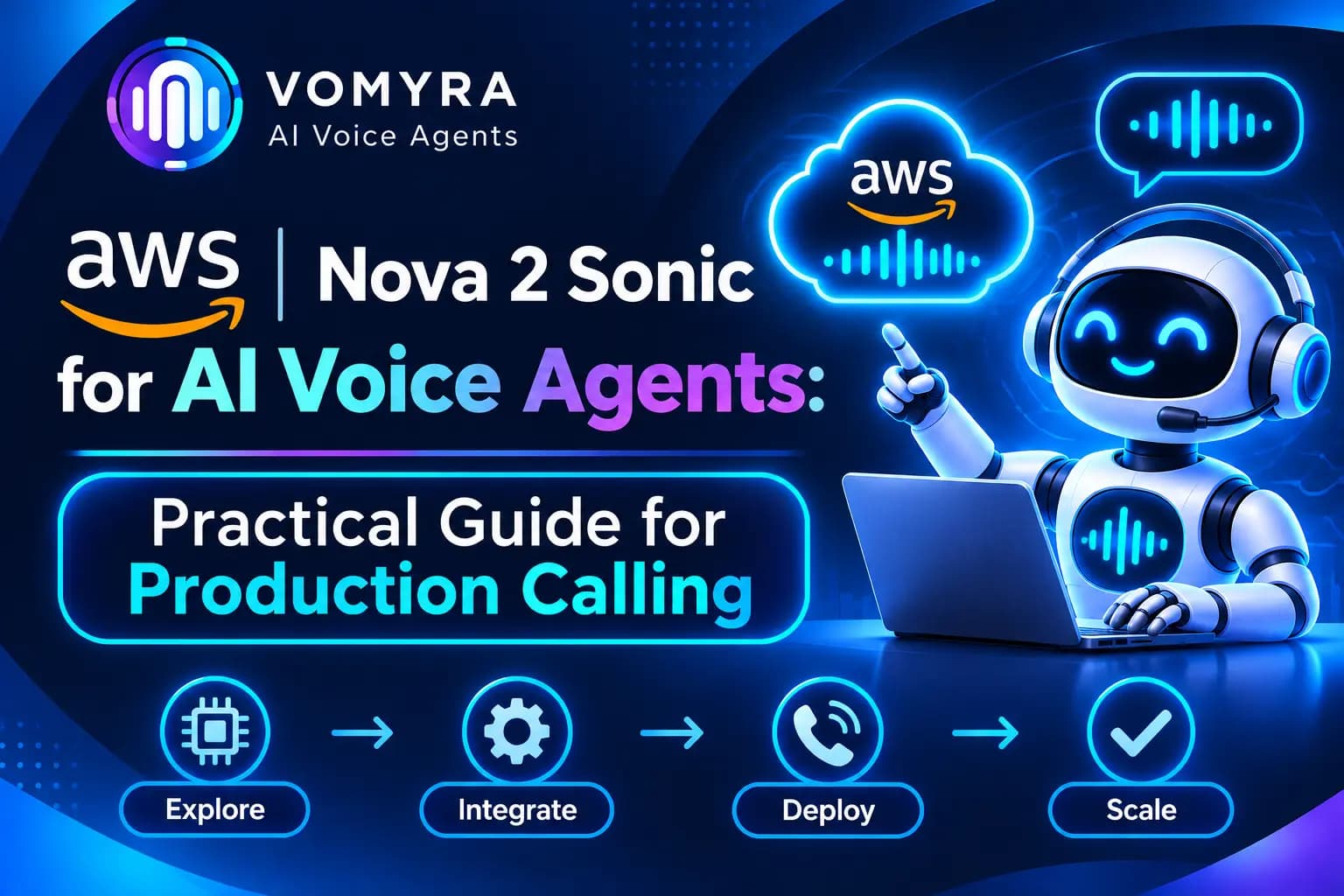
In this guide, we will explain how AWS Nova 2 Sonic works with AI voice agents, how to build a calling workflow, its practical business applications and the important factors to consider before production deployment.
What Is AWS Nova 2 Sonic?
Amazon Nova 2 Sonic is a speech-to-speech foundation model designed for real-time conversational AI. It processes incoming audio and generates spoken responses through Amazon Bedrock’s bidirectional streaming API.
In a traditional voice agent architecture, developers often connect three separate components:
- Speech-to-Text (STT) to understand customer speech.
- A Large Language Model (LLM) to generate responses.
- Text-to-Speech (TTS) to convert responses into audio.
Nova 2 Sonic combines speech understanding and speech generation within one model. This can simplify the architecture and support more natural conversations.
Key Features of Amazon Nova 2 Sonic
Real-Time Speech Processing: The model supports continuous, bidirectional audio streaming for interactive conversations.
Natural Turn-Taking: It can detect when a customer finishes speaking and when the AI agent should respond.
Interruption Handling: Customers can interrupt the agent without necessarily losing the conversation context.
Multilingual Communication: It supports English, Hindi, French, German, Italian, Spanish and Portuguese, with automatic language detection and switching.
Tool Calling: The model can request external tools to retrieve information or perform tasks through connected applications.
Asynchronous Task Execution: Certain tool operations can run in the background while the conversation continues.
Cross-Modal Interaction: Applications can combine text and voice input within the same conversation session.
These capabilities make Nova 2 Sonic useful for building conversational applications that require more than simple voice commands.
Read Also: AI Voice Agent for Customer Support: Workflow, Benefits and What to Automate
How AWS Nova 2 Sonic Works with AI Voice Agents
Nova 2 Sonic manages the speech interaction, but a complete AI voice agent also requires telephony, application logic and business integrations.
A typical production architecture includes a phone system, an audio streaming layer, Amazon Bedrock, a backend application and connected business tools.
Understanding the Complete Calling Workflow
Step 1: Customer Initiates a Call
A customer calls a business number connected to a telephony provider such as Twilio, Vonage or Amazon Connect.
Step 2: Call Audio Reaches the Application
The telephony system routes the audio to the voice application. The application handles audio conversion, streaming and communication with the model.
Step 3: Nova 2 Sonic Processes Speech
The application sends the customer’s audio through the bidirectional streaming API. Nova 2 Sonic understands the request and maintains conversational context.
Step 4: AI Generates a Spoken Response
The model generates a relevant response and streams audio back to the application. The application then delivers that audio to the caller through the telephony system.
Step 5: The Agent Performs Business Actions
If the customer requests an action, the model can initiate a tool call. For example, the application can check appointment availability, retrieve order information or update a CRM record.
Step 6: Conversation and Call Data Are Saved
The backend can store call outcomes, relevant customer details and task results for reporting and future follow-ups.
This architecture allows businesses to build voice agents that can communicate and perform useful tasks during calls.
Read Also: Claude Integration for AI Voice Agents: How to Build Smarter Voice Workflows
How to Build an AI Voice Agent Using Nova 2 Sonic
Developers can use Amazon Bedrock’s bidirectional streaming API to connect Nova 2 Sonic with a voice application.
Step 1: Configure Amazon Bedrock
Set up an AWS account and configure the required Amazon Bedrock access. Check model availability in your chosen AWS Region and configure IAM permissions.
The Nova 2 Sonic model ID is:
amazon.nova-2-sonic-v1:0
Step 2: Establish a Bidirectional Streaming Connection
Use the supported Bedrock streaming API to establish a session between your application and the model.
The application must manage session initialization, audio input events, model responses and session termination.
Step 3: Connect Telephony Infrastructure
Choose a calling provider based on your business requirements. Twilio, Vonage and Amazon Connect can provide the phone communication layer.
The telephony system handles incoming and outgoing calls, while your application connects call audio with Nova 2 Sonic.
Step 4: Configure the AI Agent
Create clear system instructions that define the agent’s role, business knowledge, conversation style and limitations.
For example, a customer support agent should know which questions it can answer, which information it can retrieve and when it should transfer a call to a human representative.
Step 5: Add Function Calling and API Integrations
Connect the agent with external tools through your backend. These integrations can support CRM updates, appointment booking, customer verification and order-status checks.
Always validate tool requests and enforce business permissions on the application side before performing important actions.
Step 6: Test the Calling Workflow
Test the complete system using real phone calls. Evaluate speech quality, response delays, interruptions, tool execution, network failures and call transfers before deployment.
Practical Use Cases of Nova 2 Sonic for AI Voice Agents
1. Customer Support Calling
Businesses can use AI voice agents to answer frequently asked questions, provide service information and manage routine customer enquiries. More complex issues can be transferred to human support teams.
2. Sales and Lead Qualification
Sales teams can automate initial conversations with new leads. The agent can ask about customer requirements, budget, product interest and purchase timelines before updating the CRM.
3. Appointment Booking
Healthcare providers, consultants and service businesses can automate appointment-related conversations. The agent can check available slots through a connected scheduling system and confirm bookings after validation.
4. Multilingual Customer Communication
Businesses serving customers across different regions can use supported languages to make conversations more accessible. Nova 2 Sonic also supports language switching within a conversation.
5. Order and Payment Follow-Ups
E-commerce and service businesses can automate selected order updates, payment reminders and follow-up calls through connected business applications, subject to applicable communication and consent requirements.
Benefits of Using Nova 2 Sonic for Production Calling

More Natural Voice Conversations
Real-time speech processing and interruption handling help create conversations that feel less like traditional automated phone menus.
Simplified Speech Architecture
Combining speech understanding and generation can reduce the need to manage separate STT and TTS model integrations.
Better Business Workflow Automation
Tool calling allows voice agents to connect conversations with CRM systems, databases and scheduling applications.
Multilingual Customer Engagement
Supported language detection and switching can help businesses serve customers who prefer different languages.
Flexible Application Development
Developers can connect Nova 2 Sonic with different telephony providers and backend systems to build workflows suited to their requirements.
Production Challenges and Best Practices
Manage the Eight-Minute Session Limit
Nova 2 Sonic has an eight-minute connection limit. Applications that need longer conversations should implement connection renewal and session continuation to maintain context.
Monitor Audio Latency
Poor network conditions and audio-processing delays can affect conversation quality. Monitor streaming performance and test the system under realistic calling conditions.
Secure Customer and Business Data
Use appropriate IAM permissions, secure connections and protected credentials. Limit access to customer records and avoid storing unnecessary sensitive information.
Handle Tool Failures
An API may fail or return incomplete information during a call. The agent should explain the issue clearly and provide an alternative, such as a human handover.
Monitor Conversation Quality
Track call completion, response latency, task success, tool errors, customer feedback and transfer rates. Regular evaluation helps improve the agent after deployment.
How Vomyra Can Support AI Voice Agent Workflows
Businesses need more than a conversational model to automate customer calling. They also need calling infrastructure, conversation management and connections with business applications.
Vomyra provides an AI voice agent platform for automating customer conversations and business calling workflows. Depending on the available model and telephony integrations, businesses can build workflows for lead qualification, customer support, appointment scheduling and follow-up calls.
Nova 2 Sonic can act as the speech-to-speech model within a compatible architecture, while the surrounding application manages telephony, business rules and connected systems.
Conclusion
Amazon Nova 2 Sonic provides developers with a speech-to-speech foundation for building real-time AI voice agents. Its multilingual support, natural turn-taking, interruption handling and tool-calling capabilities make it useful for production-oriented conversational applications.
However, successful deployment requires proper telephony integration, session management, secure API connections and reliable error handling. Businesses that combine these components can build AI voice workflows that support customer service, sales and everyday calling operations.
Frequently Asked Questions
1. What is AWS Nova 2 Sonic used for?
Amazon Nova 2 Sonic is used to build real-time conversational AI applications that understand spoken input and generate spoken responses. It can support customer service, sales calling and automated voice assistants.
2. Can Nova 2 Sonic be used for phone calls?
Yes. Nova 2 Sonic can be integrated with telephony platforms such as Twilio, Vonage and Amazon Connect. A separate application is required to connect phone audio with the model.
3. Does Amazon Nova 2 Sonic support Hindi?
Yes. It supports Hindi, along with English, French, German, Italian, Spanish and Portuguese.
4. Can Nova 2 Sonic connect with CRM systems?
Yes. Developers can use function calling and backend APIs to connect the AI voice agent with CRM platforms, databases and other business applications.
5. What is the connection limit of Nova 2 Sonic?
A single Nova 2 Sonic connection has an eight-minute limit. Applications requiring longer conversations need to implement connection renewal and session continuation.
6. Is Nova 2 Sonic suitable for production AI voice agents?
Yes, it can be used as part of a production voice architecture. However, developers must implement telephony connectivity, session management, security, monitoring and failure-handling workflows.