Customer service teams carry a workload that rarely matches their headcount. Call volume spikes unpredictably, a large share of calls are the same handful of routine questions, and the agents handling them often spend more time on repetitive queries than on the complex, judgement-heavy conversations that actually need their skill and attention.
AI voice agents are changing this balance — not by replacing the team, but by absorbing the repetitive, high-volume layer of calls so human agents can focus on the conversations that genuinely benefit from a person. For customer service teams specifically, this shows up less as a single tool and more as a shift in how the team’s time gets allocated.
This guide covers where AI voice agents fit into how customer service teams actually operate, key use cases, a practical workflow, and best practices for introducing voice AI without disrupting the team or the customer experience.
Why Customer Service Teams Are a Strong Fit for AI Voice Agents
A few realities of running a customer service team make voice AI a particularly meaningful shift for this function specifically:
- Call volume rarely matches staffing. Peak hours, product launches, billing cycles and seasonal spikes routinely generate more calls than a fixed team can answer promptly.
- A large share of queries are repetitive. Order status, account balance, basic troubleshooting and policy questions make up a significant portion of most service teams’ call volume, yet each still consumes a full agent interaction.
- Agent burnout is a real, ongoing cost. Constantly fielding the same routine questions, especially under high call volume, contributes directly to agent fatigue and attrition — a persistent challenge for service team leaders.
- Off-hours coverage is expensive to staff. Round-the-clock human coverage for call volume that isn’t consistently high overnight is difficult to justify financially for most teams.
- Quality and consistency vary by agent. Newer or less experienced agents may handle the same query differently than a tenured one, creating inconsistency the customer notices.
An AI voice agent addresses each of these directly — absorbing repetitive volume, extending coverage, and giving the team more consistent baseline quality on routine queries, while keeping human agents focused on what needs them most.
Key Use Cases for AI Voice Agents in Customer Service Teams
1. First-Line Call Triage and Resolution
An AI voice agent can answer incoming calls instantly, resolve routine queries directly — order status, account information, basic FAQs — and route anything more complex to the right team or agent, with context already gathered.
2. Off-Hours and Overflow Coverage
Calls outside business hours, or during volume spikes beyond the team’s current capacity, are answered and handled in real time rather than going to voicemail or a long queue.
3. Post-Call Follow-Up
For issues that need further investigation, an AI voice agent can handle the follow-up call once a resolution is ready, freeing agents from having to personally track and place every callback.
4. Appointment, Callback and Service Scheduling
Where service requests require booking a callback, technician visit, or follow-up appointment, an AI voice agent can handle the scheduling directly, syncing with the team’s existing calendar or ticketing system.
5. Customer Satisfaction and Feedback Calls
After a support interaction or ticket resolution, AI voice agents can call to gather feedback, giving team leads visibility into service quality trends without adding to agent workload.
6. New Agent Support and Consistency
By handling a meaningful share of routine queries directly, AI voice agents reduce the volume of repetitive calls new agents need to learn on, letting onboarding focus more on complex scenarios sooner.
7. Peak Period and Campaign Surge Handling
Product launches, billing cycles, or promotional campaigns that generate temporary call spikes are absorbed without needing to bring in temporary staff or ask existing agents to take on overtime.
A Practical AI Voice Agent Workflow for Customer Service Teams
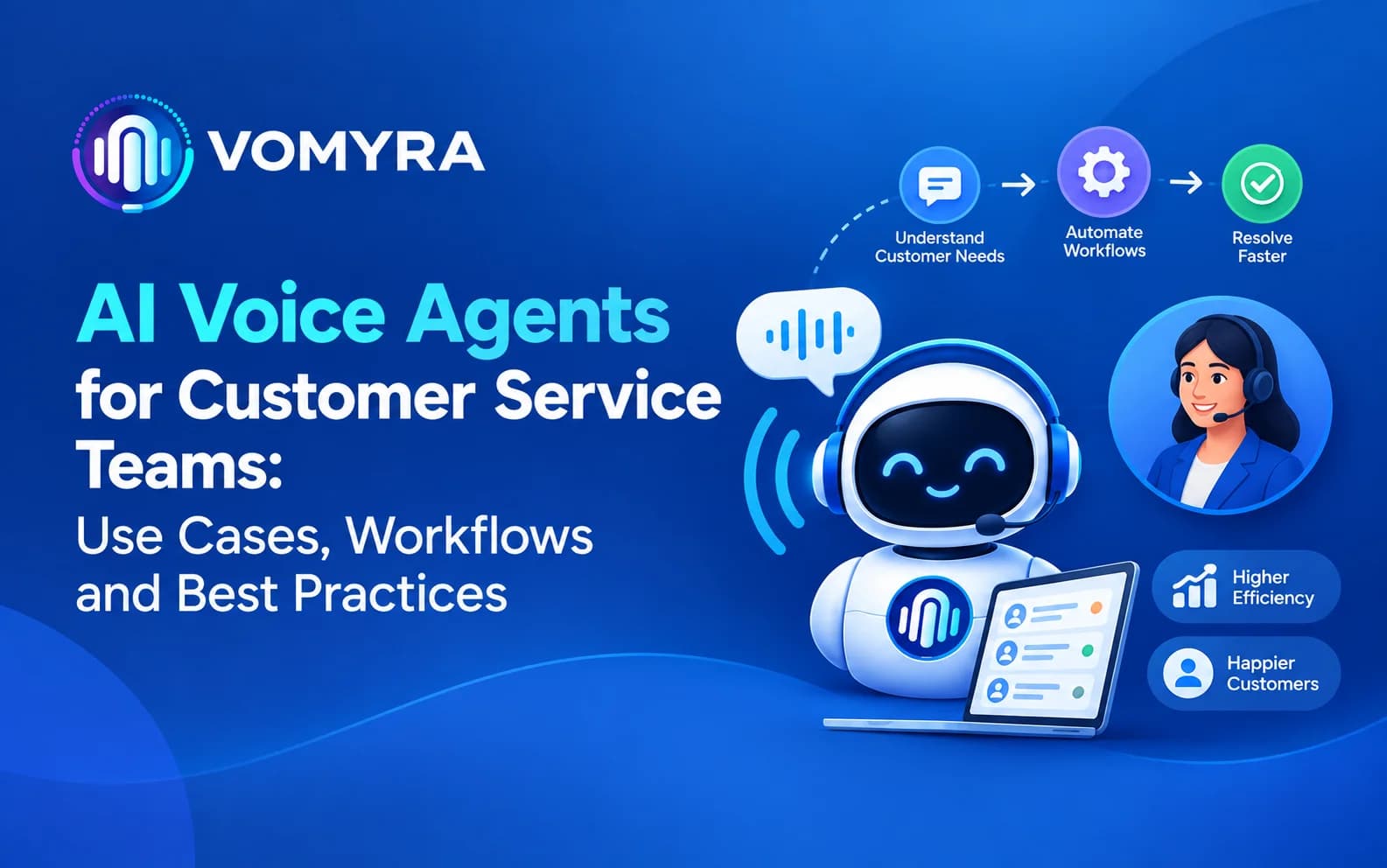
- Call answered instantly — The AI voice agent picks up every call immediately, regardless of volume or time of day.
- Intent and context identification — Through natural conversation, the agent identifies what the customer needs and pulls relevant account or ticket history.
- Direct resolution where possible — Routine queries are resolved on the call, without needing to reach a human agent at all.
- Escalation with full context — Calls needing human judgement are routed to the right agent or team, with a summary of the conversation so the customer doesn’t repeat themselves.
- Ticket and CRM update — Every call outcome, resolution status and note is logged automatically into the team’s existing systems.
- Follow-up where needed — Callbacks, satisfaction checks, and unresolved issue follow-ups are scheduled and handled automatically.
- Reporting for team leads — Call volume, resolution rates, and escalation patterns are available in structured data, giving leads visibility into where the team’s time is actually going.
Manual-Only Service Teams vs AI-Supported Service Teams
| Factor | Manual-Only Customer Service Team | AI-Supported Customer Service Team |
| Call answer time | Hold queues during peak volume | Instant, every call |
| Availability | Limited to staffed hours | 24/7 |
| Handling of routine, repetitive queries | Consumes agent time on every call | Resolved directly, no agent needed |
| Agent workload during spikes | Overtime or temporary staffing needed | Absorbed automatically, no extra hiring |
| Consistency of routine answers | Varies by agent experience | Same accurate response every time |
| New agent ramp-up | Learning happens on live routine calls | More capacity to focus on complex scenarios |
| Escalation handoff | Customer often repeats information | Full context passed automatically |
| Visibility into call patterns | Manual reporting, inconsistent | Structured data across every call |
Key Benefits for Customer Service Teams
Lower agent workload on repetitive queries Agents spend less time on the same routine questions repeated across hundreds of calls, freeing capacity for complex or sensitive conversations.
Reduced burnout and attrition pressure Removing the most repetitive, least engaging share of call volume can meaningfully improve day-to-day agent experience, particularly during high-volume periods.
No more missed or queued calls Every call gets answered instantly, removing hold times as a source of customer frustration and reducing pressure on the team during spikes.
Better new agent onboarding With less need to staff up specifically for routine call volume, onboarding can focus more directly on the judgement-based scenarios agents actually need to learn.
Lower cost of scaling coverage Extending hours or handling seasonal spikes no longer requires proportionally scaling headcount.
Clearer visibility for team leads Structured call data across both AI-handled and escalated calls gives leads a clearer picture of volume patterns, common issues, and where the team’s time is genuinely needed.
Best Practices for Introducing AI Voice Agents to a Customer Service Team
Positioning it as capacity, not replacement Framing the rollout around absorbing repetitive volume — not replacing agents — matters both for team buy-in and for setting the right expectations internally.
Start with the highest-volume, lowest-complexity queries Order status, account balance, and basic FAQs are typically the best starting point — high impact, low risk, and easy to measure.
Keep escalation paths clear and fast. Agents should be able to trust that anything genuinely complex reaches them quickly, with full context, rather than the AI agent attempting things outside its scope.
Involve team leads in defining scope The people closest to the actual call patterns are best placed to define what the AI agent should and shouldn’t handle directly.
Monitor transcripts alongside existing QA processes Extend existing quality monitoring practices to AI-handled calls, rather than treating them as a separate, unreviewed category.
Communicate the change to customers appropriately Being transparent that customers may be speaking with an AI voice agent, with an easy path to a human, helps maintain trust during the transition.

Give Your Customer Service Team More Capacity, Not More Headcount
The biggest constraint most customer service teams face isn’t skill or effort — it’s the sheer volume of repetitive calls competing for the same limited hours. An AI voice agent doesn’t replace what your team does well; it takes on the volume that keeps them from doing it.
Vomyra is India’s Agentic Voice AI Platform, built to help customer service teams handle routine queries instantly, escalate complex calls with full context, and extend coverage without adding headcount. Vomyra AI voice agents use real Indian mobile numbers and hold human-like conversations in multiple languages, integrating directly with the CRM and ticketing systems your team already relies on.
If you’re evaluating how to give your service team more capacity without more hiring, Vomyra is built specifically for this — with unlimited calling plans and no coding required to get started.
FAQs
Will AI Voice Agents Replace Customer Service Jobs?
The more common pattern is a shift in what human agents spend their time on rather than a wholesale replacement of the team. AI voice agents can handle repetitive, high-volume queries, while human agents can focus more on complex, judgement-heavy conversations that require personal attention and decision-making.
How Do We Decide What the AI Voice Agent Should Handle Versus Escalate?
This is best defined by reviewing actual call data. The most frequent and lowest-complexity query types are usually a practical starting point for AI handling. Businesses can then expand the agent’s scope gradually as its performance is reviewed and validated.
Does This Work Alongside Our Existing Ticketing or CRM System?
Yes, when the AI voice agent platform is properly integrated with existing systems. Call outcomes, resolutions, customer information, and escalations can be synced with the CRM or ticketing system, allowing teams to manage AI-handled interactions without creating a separate, disconnected workflow.
Can Customer Service Teams Serving Multiple Languages Use This Effectively?
Yes. AI voice agent platforms that support multiple languages can help customer service teams handle conversations across different regions and language preferences. This can be particularly useful for businesses serving customers with varied communication needs.
How Do Agents and Team Leads See What the AI Is Handling?
A well-built platform can provide call transcripts, interaction history, and structured reporting for AI-handled calls. This gives team leads visibility into conversations, customer queries, resolutions, and escalations, helping them review performance and identify areas that may need improvement.