Quick Answer
Traditional AI voice agents typically follow a Speech-to-Text → Text Processing → Text-to-Speech workflow. GPT Realtime introduces a speech-to-speech approach that processes voice conversations in real time, creating more natural interactions with fewer delays and more human-like responses. As speech to speech AI India adoption grows, businesses are moving away from robotic voice systems toward AI conversations that sound and feel much closer to real human communication.
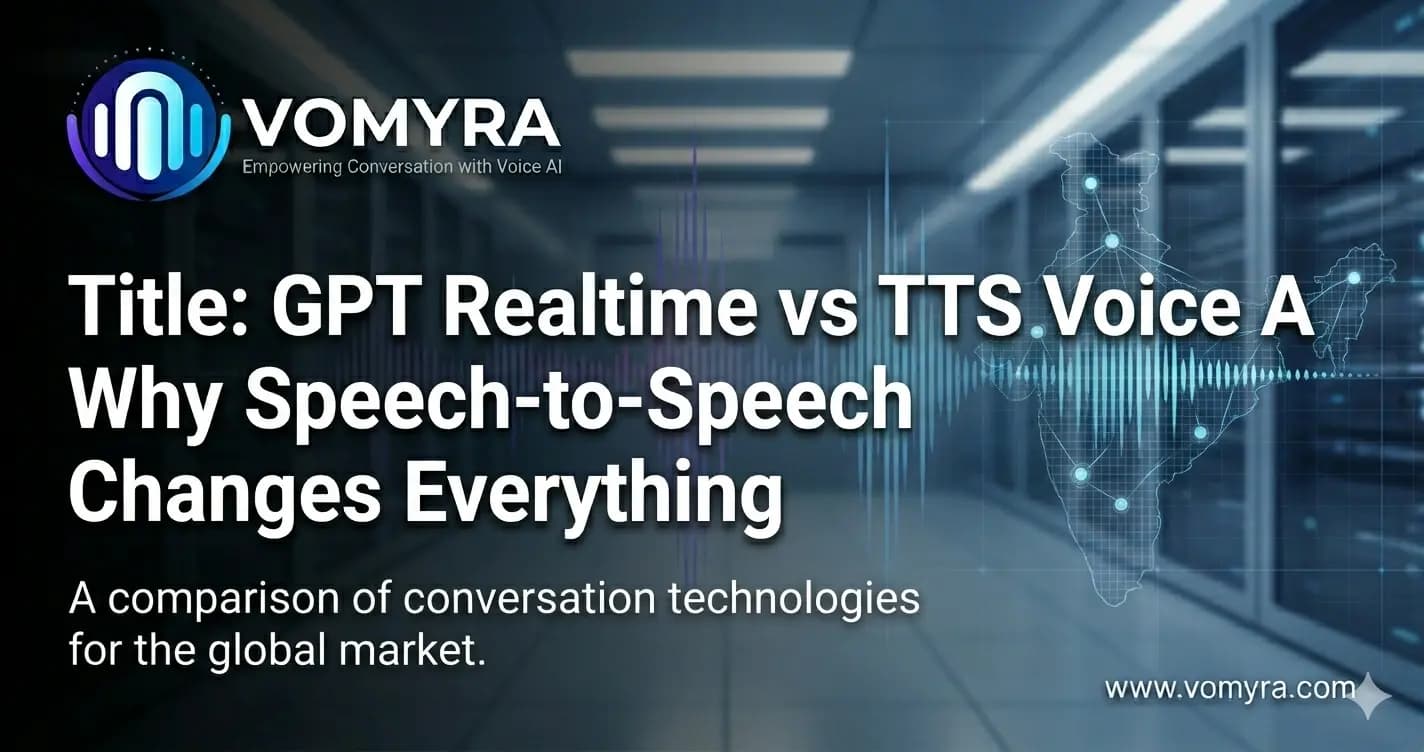
GPT Realtime vs TTS Voice Agents: Why Speech-to-Speech Changes Everything
For years, most AI voice agents have followed the same formula.
A customer speaks.
The system converts speech into text.
The AI processes the text.
A text-to-speech engine converts the response back into audio.
The process works.
Yet something often feels missing.
The conversation may be accurate.
The answers may be correct.
Still, customers frequently describe the experience as robotic.
There is usually a small delay.
The rhythm feels unnatural.
Interruptions become difficult.
The emotional tone rarely matches the conversation.
This is where GPT Realtime and modern speech-to-speech AI systems are creating a major shift.
Businesses across hospitality, healthcare, real estate, restaurants, education, and customer support are beginning to realize that voice AI is not just about answering questions.
It is about creating conversations that feel natural.
And that difference matters more than most people think.
What Is a Traditional TTS Voice Agent?
TTS stands for Text-to-Speech.
Most voice bots used today follow a multi-step process.
Step 1: Speech Recognition
The customer’s voice is converted into text.
Step 2: AI Processing
The AI reads the text and generates a response.
Step 3: Text-to-Speech Output
The response is converted back into spoken audio.
The customer hears the reply.
The process repeats for every interaction.
This architecture helped launch the first generation of voice assistants.
Many businesses still use it today.
Why Do Traditional TTS Voice Agents Sound Robotic?
This is one of the most common complaints businesses hear from customers.
The issue is rarely the intelligence of the AI.
The issue is often the communication layer.
Several factors contribute to the robotic feeling.
Multiple Processing Steps
Each conversation requires several conversions.
Voice becomes text.
Text becomes a response.
The response becomes synthetic audio.
Every step introduces slight delays.
Customers notice these delays even if they only last a second.
Generic Text-to-Speech Voices
Many TTS platforms rely on the same voice libraries.
Thousands of businesses end up sounding nearly identical.
A hotel.
A restaurant.
A real estate company.
An insurance agency.
Often using almost the same voice.
That creates a generic customer experience.
Lack of Natural Emotion
Human conversations contain:
- Excitement
- Curiosity
- Empathy
- Urgency
- Reassurance
Traditional TTS systems often struggle to capture these subtle changes naturally.
Interruptions Feel Unnatural
People interrupt each other during conversations.
That is normal.
Traditional voice agents often wait until the speaker completely finishes before responding.
Real conversations rarely work that way.
What Is GPT Realtime?
GPT Realtime represents a newer approach to voice communication.
Instead of treating speech as text first and voice second, GPT Realtime processes voice conversations in a much more direct way.
The AI listens continuously.
It responds faster.
It understands conversational flow more naturally.
It can react to pauses, interruptions, tone changes, and speech patterns with greater accuracy.
The result feels much closer to talking with a person rather than interacting with software.
What Is Speech-to-Speech AI?
Speech to speech AI India solutions focus on direct voice interaction.
Rather than relying heavily on multiple text conversion stages, speech-to-speech systems are designed to preserve more of the natural characteristics of conversation.
This includes:
- Tone
- Emotion
- Speaking rhythm
- Natural pauses
- Conversational flow
- Faster responses
Customers experience fewer awkward gaps and more natural exchanges.
Why Is Speech-to-Speech AI Becoming Popular in India?
India’s customer service environment is heavily voice-driven.
Customers frequently call businesses for:
- Hotel bookings
- Restaurant reservations
- Property inquiries
- Insurance support
- Loan applications
- Healthcare appointments
- Educational admissions
People often prefer speaking rather than typing.
This makes voice quality extremely important.
A poor voice experience can reduce trust quickly.
A natural voice experience can improve engagement almost immediately.
That is one reason searches around:
- speech to speech AI India
- Voice AI India
- AI phone agent India
- AI voice assistant India
- Realtime AI voice agent
- Conversational AI India
- AI calling platform India
have increased significantly.
GPT Realtime vs Traditional TTS Voice Agents
| Feature | Traditional TTS Agent | GPT Realtime Speech-to-Speech |
| Response Speed | Moderate | Faster |
| Conversational Flow | Structured | Natural |
| Interruptions | Limited | More natural |
| Emotional Understanding | Basic | Better context awareness |
| Voice Experience | Often robotic | More human-like |
| Customer Engagement | Moderate | Higher |
| Real-Time Interaction | Limited | Stronger |
Why Does Speech-to-Speech Feel More Human?
Human conversations are not perfect.
People pause.
They interrupt.
They change tone.
They react emotionally.
They sometimes stop mid-sentence and continue.
Speech-to-speech AI handles these patterns more naturally.
Instead of feeling like a sequence of commands and responses, the interaction feels conversational.
Customers often describe it as smoother and more comfortable.
What Industries Benefit Most From Speech-to-Speech AI?
Almost every customer-facing business can benefit.
Some industries see particularly strong results.
Hospitality
Hotels and resorts receive constant booking inquiries.
Guests expect fast and natural conversations.
A robotic voice can feel impersonal.
A natural voice can create a stronger first impression.
Restaurants
Food ordering conversations often move quickly.
Customers ask questions.
They change orders.
They interrupt.
Speech-to-speech AI handles these interactions more naturally.
Real Estate
Property buyers often have detailed questions.
Natural conversations help build trust and maintain engagement.
Healthcare
Patients are often seeking information during stressful situations.
A calmer and more human-like voice experience can improve comfort levels.
Financial Services
Banks, insurance companies, and lending businesses depend heavily on customer trust.
Voice quality can influence how customers perceive the brand.
Why Voice Identity Is Becoming More Important
Businesses spend years building their brand.
Their logo is unique.
Their website is unique.
Their marketing is unique.
Then customers call and hear the exact same AI voice used by hundreds of other businesses.
Something doesn’t match.
Customers remember voices.
Voice identity is becoming a major part of modern customer experience.
This is where many businesses are beginning to move beyond generic TTS solutions.
How Vomyra Takes a Different Approach
Many AI platforms focus only on automation.
The voice itself often becomes an afterthought.
Vomyra approaches the problem differently.
Vomyra is the only platform in India where you can build an AI agent in your own voice in just 10 seconds.
No generic TTS.
No selecting a random voice from a library.
No sounding like every other company.
Guests hear YOU.
Not a bot.
This creates a very different customer experience.
A hotel owner can let guests hear their own voice.
A consultant can allow prospects to hear a familiar voice.
A restaurant owner can create an AI ordering assistant that sounds authentic rather than artificial.
The technology handles the conversations.
The voice remains uniquely yours.
Why Custom Voice AI Matters More Than Businesses Realize
Most customers may not understand the technical difference between TTS and speech-to-speech systems.
They do notice how the conversation feels.
A familiar voice can create:
- Higher trust
- Better engagement
- Stronger brand recognition
- More memorable customer interactions
- Greater comfort during conversations
Voice becomes part of the customer experience rather than just a delivery mechanism.
What Should Businesses Look For in a Modern Voice AI Platform?
Real-Time Conversations
Customers expect immediate responses.
Natural Speech Flow
Conversations should feel fluid rather than scripted.
Voice Ownership
Businesses increasingly want AI agents that sound like them.
Multi-Language Support
India’s market requires language flexibility.
CRM Integration
Customer interactions should connect with existing systems.
Human Escalation
Complex conversations should move to human representatives when needed.
Is Traditional TTS Going Away?
Not completely.
TTS still serves many use cases.
Basic notifications.
Announcements.
Simple automated tasks.
These applications continue to work well.
The shift is happening in customer-facing conversations.
Businesses want interactions that feel natural.
Customers expect experiences that feel more human.
Speech-to-speech systems are moving the industry in that direction.
Summary
The difference between GPT Realtime and traditional TTS voice agents goes far beyond response speed. Traditional systems often rely on multiple conversion layers that can introduce delays and create robotic interactions. Speech to speech AI India solutions are changing this by creating more natural conversations with faster responses, better interruption handling, and improved conversational flow. As businesses focus more on customer experience, the future of voice AI is moving toward real-time, natural communication. Platforms like Vomyra are taking this further by allowing businesses to build AI agents using their own voice, creating interactions that feel familiar, authentic, and human.
Frequently Asked Questions (FAQs)
What is speech-to-speech AI?
Speech-to-speech AI allows users to communicate with AI through direct voice conversations, creating more natural interactions than traditional text-based voice systems.
What is the difference between GPT Realtime and TTS voice agents?
Traditional TTS voice agents convert speech into text and then convert AI responses back into speech. GPT Realtime focuses on real-time conversational interactions that feel more natural and responsive.
Why do traditional AI voice agents sound robotic?
They often rely on generic text-to-speech voices, multiple processing steps, unnatural pauses, and limited emotional expression.
What are the benefits of speech-to-speech AI?
Benefits include faster responses, natural conversations, better interruption handling, improved customer engagement, and a more human-like experience.
What makes Vomyra different?
Vomyra is the only platform in India where businesses can create an AI agent in their own voice in about 10 seconds. Customers hear the business owner’s voice instead of a generic text-to-speech voice.
Which industries benefit from speech-to-speech AI?
Hospitality, restaurants, healthcare, real estate, finance, education, and customer support businesses can all benefit from natural voice AI conversations.