Voice automation has become an essential component of modern business communication, enabling organizations to manage customer interactions with greater efficiency, accuracy, and scalability.
Businesses handling inbound support, outbound sales, appointment scheduling, customer verification, and lead qualification increasingly rely on AI-powered voice solutions to streamline communication while reducing operational costs.
However, the effectiveness of an AI voice solution depends not only on conversational intelligence but also on its ability to integrate seamlessly with existing telephony infrastructure.
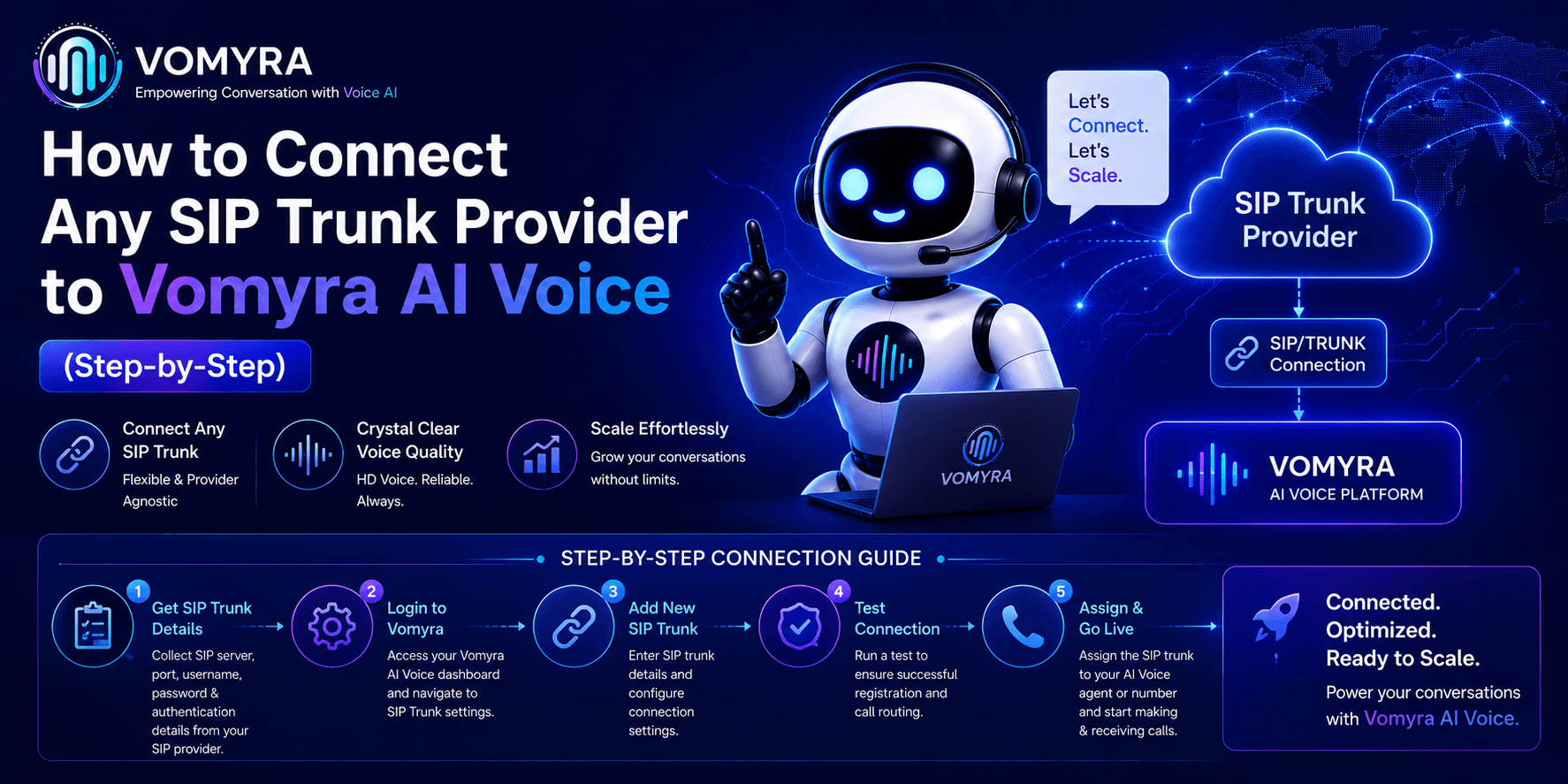
Connecting a SIP trunk provider with an AI voice platform allows businesses to continue using their preferred telecommunication services while introducing intelligent voice automation into everyday operations.
A properly configured SIP trunk enables reliable voice connectivity between business phone systems and AI-powered communication platforms.
This integration allows organizations to retain existing business numbers, improve call quality, simplify call routing, and support large-scale voice automation without replacing their entire communication infrastructure.
Businesses searching for an AI voice agent India solution often prioritize platforms that support flexible SIP connectivity because it provides greater operational freedom and compatibility with multiple telecom providers.
Vomyra AI Voice Agent simplifies this process through a flexible architecture that enables businesses to integrate their preferred SIP trunk provider without requiring extensive technical expertise.

Understanding SIP Trunk Integration for AI Voice Automation
Session Initiation Protocol, commonly known as SIP, serves as the communication standard responsible for establishing, managing, and terminating voice calls over internet-based networks.
Rather than depending entirely on conventional telephone infrastructure, SIP trunking enables businesses to route voice traffic digitally between telecommunication providers and business communication systems.
Within an AI-powered environment, SIP trunk integration creates a direct communication pathway between customer calls and intelligent voice agents. Every inbound or outbound conversation passes securely through the configured SIP connection before being processed by the AI platform.
This architecture enables businesses to automate customer communication while maintaining their preferred telecom infrastructure.
Organizations implementing a no-code AI voice agent platform India generally require compatibility with existing communication systems to avoid unnecessary infrastructure changes.
Why SIP Trunk Integration Is Important
Business communication environments vary considerably depending on organizational size, operational requirements, regulatory compliance, and existing infrastructure investments.
Replacing established telecommunication systems often introduces unnecessary costs, operational disruptions, and implementation delays.
SIP trunk integration eliminates these challenges by allowing organizations to continue using existing telecom services while expanding communication capabilities through AI-powered automation.
Reliable SIP connectivity also contributes to improved call quality, lower latency, enhanced scalability, and centralized communication management. Businesses operating across multiple locations can manage voice communication through a unified infrastructure while maintaining consistent customer experiences.
For organizations evaluating a Vapi AI alternative India, flexible SIP compatibility represents an important consideration because it allows greater freedom in selecting preferred telecom providers instead of depending on restrictive communication ecosystems.
Preparing Before Connecting a SIP Trunk Provider
Successful SIP trunk integration begins with proper preparation. Businesses should first evaluate their communication infrastructure to ensure compatibility between their telecommunication provider, network configuration, and AI voice platform.
Although implementation requirements vary depending on the selected provider, several technical prerequisites remain common across most enterprise environments.
Network stability plays an essential role in maintaining high-quality voice communication. Adequate internet bandwidth, low network latency, secure firewall configurations, and optimized Quality of Service settings contribute directly to reliable call performance.
Businesses should also verify SIP credentials, authentication information, and domain configuration before beginning the integration process.
Step 1: Configure the SIP Trunk Connection
The first stage of integration involves establishing communication between the SIP provider and the AI voice platform. This configuration typically requires authentication credentials, server addresses, transport protocols, and communication ports supplied by the telecom provider.
After entering the required connection information, the platform verifies communication with the SIP server before activating the connection. Successful authentication confirms that voice traffic can be transmitted securely between both systems.
A properly configured SIP connection forms the foundation for every automated interaction processed by the AI platform. Voice quality, call reliability, response speed, and communication stability all depend upon accurate configuration during this initial stage.
Businesses implementing an AI voice agent India solution should verify every connection parameter carefully before proceeding to workflow configuration to prevent communication interruptions during production deployment.
Step 2: Assign Business Phone Numbers
Once the SIP connection has been established successfully, business phone numbers can be mapped to the AI voice environment. This process enables incoming customer calls to reach automated workflows without affecting existing communication channels.
Number assignment allows organizations to continue using familiar business contact numbers while replacing manual call handling with intelligent automation. Customers experience a seamless transition because external communication remains unchanged despite significant improvements within the internal communication infrastructure.
Businesses utilizing a free AI voice agent India during evaluation phases often test multiple communication scenarios using dedicated phone numbers before expanding deployment across larger operational environments.
Step 3: Configure AI Voice Workflows
Following successful number assignment, intelligent call workflows can be created according to organizational communication requirements. Workflow configuration determines how incoming calls are processed, how customer intent is identified, and how conversations progress throughout each interaction.
Modern AI voice platforms support visual workflow creation that enables businesses to design communication sequences without extensive programming knowledge.
Customer greetings, information collection, appointment scheduling, verification procedures, call transfers, lead qualification, payment reminders, and customer support interactions can all be customized according to operational objectives.
Vomyra AI Voice Agent provides configurable workflow capabilities that support diverse business communication scenarios while maintaining consistent customer experiences across every automated interaction.
Step 4: Test Call Routing and Voice Performance
After configuring AI workflows, comprehensive testing becomes essential to verify that every component of the communication system functions correctly.
Test calls help validate SIP connectivity, voice quality, workflow execution, response accuracy, latency, and call routing before the solution becomes available to customers. This stage reduces deployment risks by identifying configuration issues that could interrupt customer communication or affect operational performance.
Testing should include multiple communication scenarios representing actual business operations. Incoming calls, outbound campaigns, appointment requests, customer verification processes, lead qualification conversations, and call transfers should all be evaluated to ensure consistent performance.
Voice clarity, response timing, and workflow execution should remain stable under different network conditions while maintaining accurate conversational flow.
Step 5: Integrate Business Applications
Voice automation delivers greater operational value when connected with existing business applications. CRM systems, scheduling software, customer databases, helpdesk platforms, payment systems, and reporting tools allow AI voice interactions to exchange information automatically without requiring manual intervention.
Application integration enables AI voice agents to retrieve customer records, update appointment schedules, create support tickets, record conversation outcomes, verify account information, and synchronize business data in real time. This level of automation improves workflow efficiency while reducing repetitive administrative responsibilities across departments.
Step 6: Strengthen Security and Compliance
Voice communication frequently involves sensitive customer information, making security an essential component of SIP trunk implementation. Authentication controls, encrypted communication channels, access permissions, and network protection measures should be configured before production deployment to reduce operational risks.
Secure SIP authentication prevents unauthorized access while encrypted voice transmission protects communication between customers and business systems. Firewall policies, network segmentation, and continuous monitoring further strengthen infrastructure reliability by minimizing vulnerabilities that may affect communication performance.
Step 7: Monitor Performance and Optimize Continuously
Successful deployment represents the beginning of voice automation rather than the final stage of implementation. Continuous monitoring enables organizations to evaluate call quality, workflow efficiency, response accuracy, customer engagement, and overall operational performance using measurable communication data.
Performance reports help identify workflow bottlenecks, unsuccessful call scenarios, frequently asked customer questions, and opportunities for automation improvements. Businesses can refine conversation logic, improve response accuracy, optimize routing strategies, and expand automation capabilities according to evolving operational requirements.
Common Challenges During SIP Trunk Integration
Although SIP integration follows a structured implementation process, businesses occasionally encounter technical challenges related to authentication failures, network instability, firewall restrictions, codec incompatibility, and incorrect routing configurations. Most deployment issues originate from incomplete configuration rather than limitations within the AI platform itself.
Accurate credential verification, network optimization, secure firewall settings, and systematic testing significantly reduce implementation complexity. Organizations that establish clear deployment procedures generally experience faster implementation while minimizing operational interruptions during migration.
Selecting a platform capable of supporting multiple communication environments also simplifies future expansion. Businesses searching for a AI alternative India frequently prioritize deployment flexibility because communication requirements evolve alongside organizational growth.
Why Choose Vomyra AI Voice Agent
Modern organizations require communication platforms that integrate easily with existing telecommunication infrastructure while supporting future business expansion. Vomyra AI Voice Agent provides flexible SIP trunk compatibility, intelligent workflow automation, scalable deployment, and simplified configuration designed to support organizations across multiple industries.
The platform enables businesses to retain preferred telecom providers while introducing AI-powered customer support, lead qualification, appointment scheduling, outbound campaigns, verification processes, and operational automation without replacing existing communication systems.
Flexible workflow customization further enables organizations to adapt voice automation according to changing business objectives while maintaining operational consistency.
Businesses evaluating a free AI voice agent India solution before enterprise deployment also benefit from flexible implementation capabilities that simplify testing, workflow development, and performance evaluation before expanding automation across larger communication environments.
Conclusion
SIP trunk integration forms the technical foundation of modern AI-powered business communication by connecting existing telecommunication infrastructure with intelligent voice automation.
A structured implementation process that includes infrastructure preparation, secure authentication, workflow configuration, application integration, testing, monitoring, and continuous optimization ensures reliable communication while supporting long-term operational scalability.
Organizations implementing a no-code AI voice agent platform India gain the flexibility to automate customer communication without replacing existing telecom infrastructure or increasing implementation complexity.
Combined with intelligent workflow customization and reliable SIP connectivity, Vomyra AI Voice Agent enables businesses to modernize customer engagement, improve operational efficiency, and support scalable voice automation across diverse business functions.
Frequently Asked Questions
1. What is a SIP trunk in an AI voice platform?
A SIP trunk enables internet-based voice communication between a telecom provider and an AI voice platform, allowing automated inbound and outbound calling through existing business numbers.
2. Can any SIP trunk provider connect with Vomyra AI Voice Agent?
Yes. Vomyra AI Voice Agent is designed to support flexible SIP trunk integration, allowing businesses to connect compatible providers while maintaining existing communication infrastructure.
3. Why is a no-code AI voice agent platform India beneficial?
A no-code AI voice agent platform India allows businesses to configure workflows, automate conversations, and deploy AI voice solutions without requiring software development expertise.
4. Is SIP trunk integration secure?
When implemented with encrypted communication, secure authentication, firewall protection, and proper access controls, SIP trunk integration provides reliable and secure business communication.
5. Why do businesses look for a Vapi AI alternative India?
Businesses often seek a Vapi AI alternative India to gain greater deployment flexibility, simplified workflow customization, SIP compatibility, scalable automation, and improved control over communication infrastructure.