If you’ve built any kind of AI voice product recently, you already know the drill. One provider gives you the best voice quality, another has the smartest language model, a third handles telephony better, and none of them talk to each other cleanly.
So you end up stitching together five different APIs, maintaining five different integrations, and praying nothing breaks when one of them pushes an update.
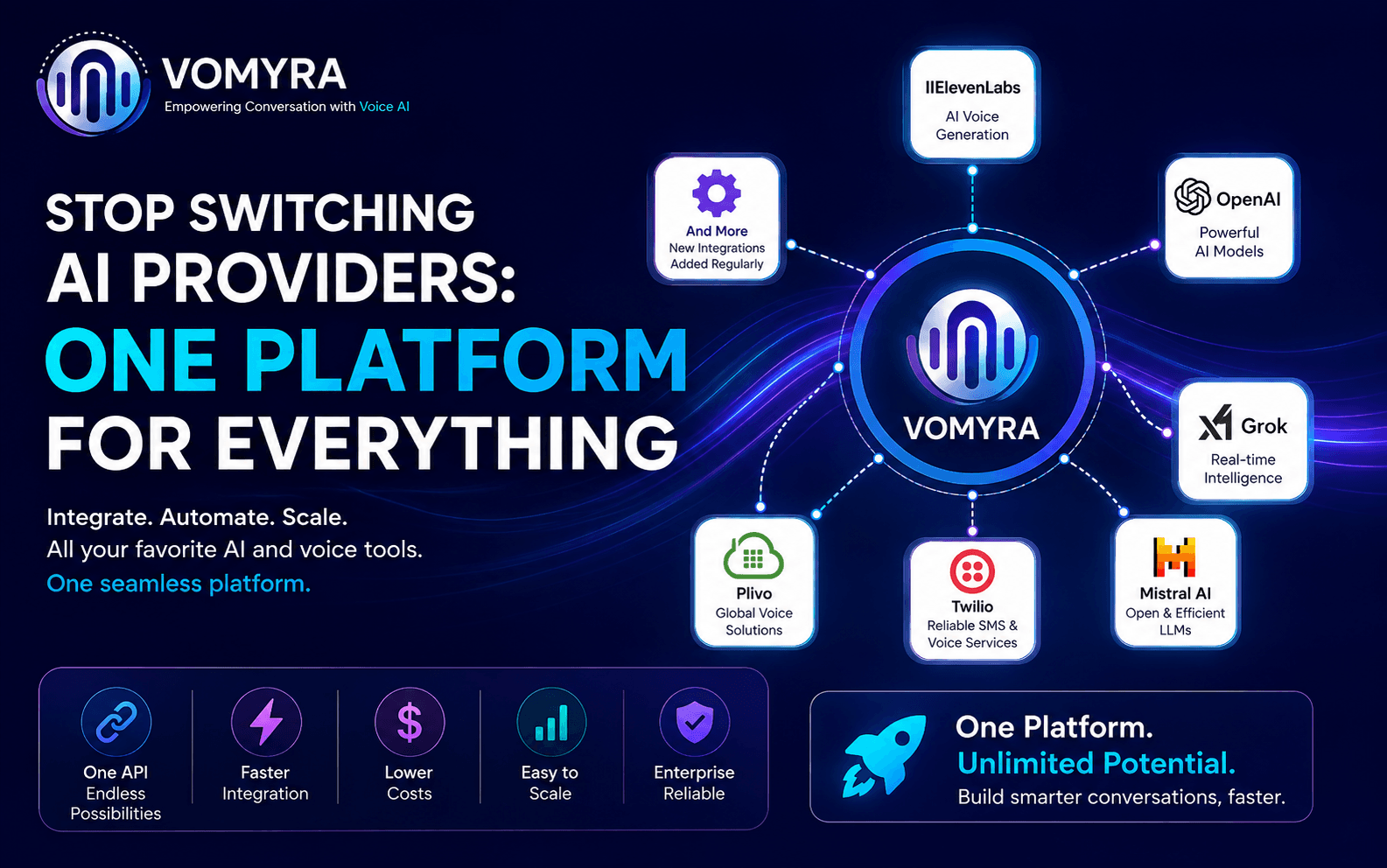
This is one of the most common, and most avoidable, problems businesses run into when building voice AI systems. A unified AI voice platform that connects providers like ElevenLabs, OpenAI, Grok, Mistral, Twilio, and Plivo under one roof removes this entire headache.
At Vomyra, this is exactly the problem we set out to solve, letting businesses use the best tools available without becoming full-time integration engineers.
Why Businesses End Up Juggling Multiple AI Providers
No single AI provider does everything best. Voice synthesis, language understanding, and telephony are three very different technical problems, and providers tend to specialize.
ElevenLabs built its reputation on natural, high-quality voice synthesis. OpenAI and Mistral offer strong language models for understanding and generating conversation. Grok brings its own take on reasoning and response generation. Meanwhile, Twilio and Plivo handle the actual telephony layer, the phone lines, call routing, and infrastructure that makes calls physically possible.
The problem isn’t picking one good provider. It’s that businesses often need pieces from several of them to get the best possible outcome, and building that integration from scratch is neither quick nor cheap.
The Real Cost of Managing Multiple Integrations
On the surface, using multiple providers sounds like flexibility. In practice, it usually creates more problems than it solves.
Development Overhead
Every provider has its own API structure, authentication method, and documentation. Integrating even two or three of them properly takes real engineering time, and that’s before you factor in ongoing maintenance.
Breaking Changes
APIs change. When one provider updates its endpoints or pricing structure, it can break your entire calling flow if you’re managing the integration yourself, often without warning.
Inconsistent Performance
Switching between providers for different tasks can create inconsistent latency and response quality, especially when handoffs between voice, language processing, and telephony aren’t tightly optimized together.
Vendor Lock-In Risk
Once a business builds deep into one provider’s ecosystem, switching later becomes expensive and time-consuming, even if a better or cheaper option becomes available.
This is exactly why more businesses are moving away from single-vendor setups and looking for AI voice agent platforms that already handle this complexity behind the scenes.
What a Unified Platform Actually Solves
Instead of manually connecting each provider, a platform that natively supports multiple AI and telephony providers lets businesses pick the best combination for their specific use case, without writing custom integration code for each one.
Flexibility Without Rebuilding
Want to test ElevenLabs for voice quality but keep OpenAI for conversation logic? Or switch from Twilio to Plivo for better regional call rates? With a unified setup, this becomes a configuration choice, not an engineering project.
Faster Time to Launch
Since the integrations already exist, businesses can go from idea to a working AI voice agent in days instead of months, without needing a dedicated development team for every provider connection.
Better Cost Control
Different providers price differently depending on usage volume and region. Having access to multiple options in one place makes it easier to optimize costs based on actual call patterns instead of being locked into one pricing structure.
Consistent Performance
When providers are integrated properly at the platform level, handoffs between voice synthesis, language processing, and telephony stay smooth, avoiding the lag or quality drops that often happen with loosely connected, self-built systems.
If you’re deciding between building this yourself or using an existing platform, this comparison on how Vomyra stacks up against other voice AI options breaks down what to actually look for before making that call.

Why This Matters More As AI Models Keep Changing
The AI landscape moves fast. What’s the best language model today might not hold that position in six months. New voice synthesis providers keep emerging, and telephony pricing shifts based on region and provider agreements.
Businesses that build tightly around a single provider often find themselves stuck when something better comes along, either because switching costs are too high or because their entire system was architected around one API’s quirks.
A platform-based approach avoids this trap entirely. Instead of betting on one provider staying the best forever, businesses can adapt as the landscape changes, swapping components without needing to rebuild their entire voice AI stack from scratch.
Real-World Impact for Different Business Types
This kind of flexibility isn’t just a technical nice-to-have, it directly affects how businesses operate day to day.
- Startups can experiment with different providers to find the right balance of cost and quality before scaling up.
- Growing businesses can switch telephony providers for better regional call rates without disrupting their entire calling system.
- Enterprises can maintain consistent voice quality and compliance standards while still having room to adopt newer models as they become available.
- Agencies building for clients can offer flexible setups tailored to each client’s budget and requirements, without maintaining separate custom builds for every account.
For a deeper look at how telephony providers specifically fit into this kind of setup, this breakdown on Exotel integration for Indian businesses is worth reviewing if you’re evaluating regional calling infrastructure options.
The Bigger Picture
The real value of a unified AI voice platform isn’t just convenience, it’s control. Businesses get to choose the best tools for their specific needs, adapt as better options emerge, and avoid getting boxed into decisions made months or years ago based on whatever was available at the time.
Instead of asking “which single provider should we commit to,” the better question becomes “which combination of providers actually works best for us right now, and how easily can we change that later if needed.”
Final Thoughts
Constantly switching or juggling AI providers isn’t a sign of a flexible system, it’s usually a sign of one that was never designed to handle change in the first place. A platform that already connects ElevenLabs, OpenAI, Grok, Mistral, Twilio, Plivo, and other leading providers removes that friction entirely, letting businesses focus on building a better voice experience instead of managing a growing list of API integrations.
For any business planning to scale voice AI seriously, this kind of unified approach isn’t just more convenient, it’s simply a smarter way to stay adaptable as the technology keeps evolving.
FAQs
1. Do I need technical expertise to switch between providers on a unified platform?
No, most platforms allow provider switching through simple configuration settings rather than custom coding.
2. Is using multiple providers more expensive than sticking with one?
Not necessarily, it often reduces costs since businesses can choose the most cost-effective provider per use case.
3. Can I use different providers for voice and language processing simultaneously?
Yes, that’s actually one of the main advantages, combining the strengths of different providers in one system.
4. What happens if a provider changes its pricing or API?
On a unified platform, these changes are typically managed at the platform level, reducing disruption to your existing setup.
5. Is this approach suitable for small businesses, or only large enterprises?
It works well for both, since smaller businesses benefit from flexibility and cost control just as much as larger ones.