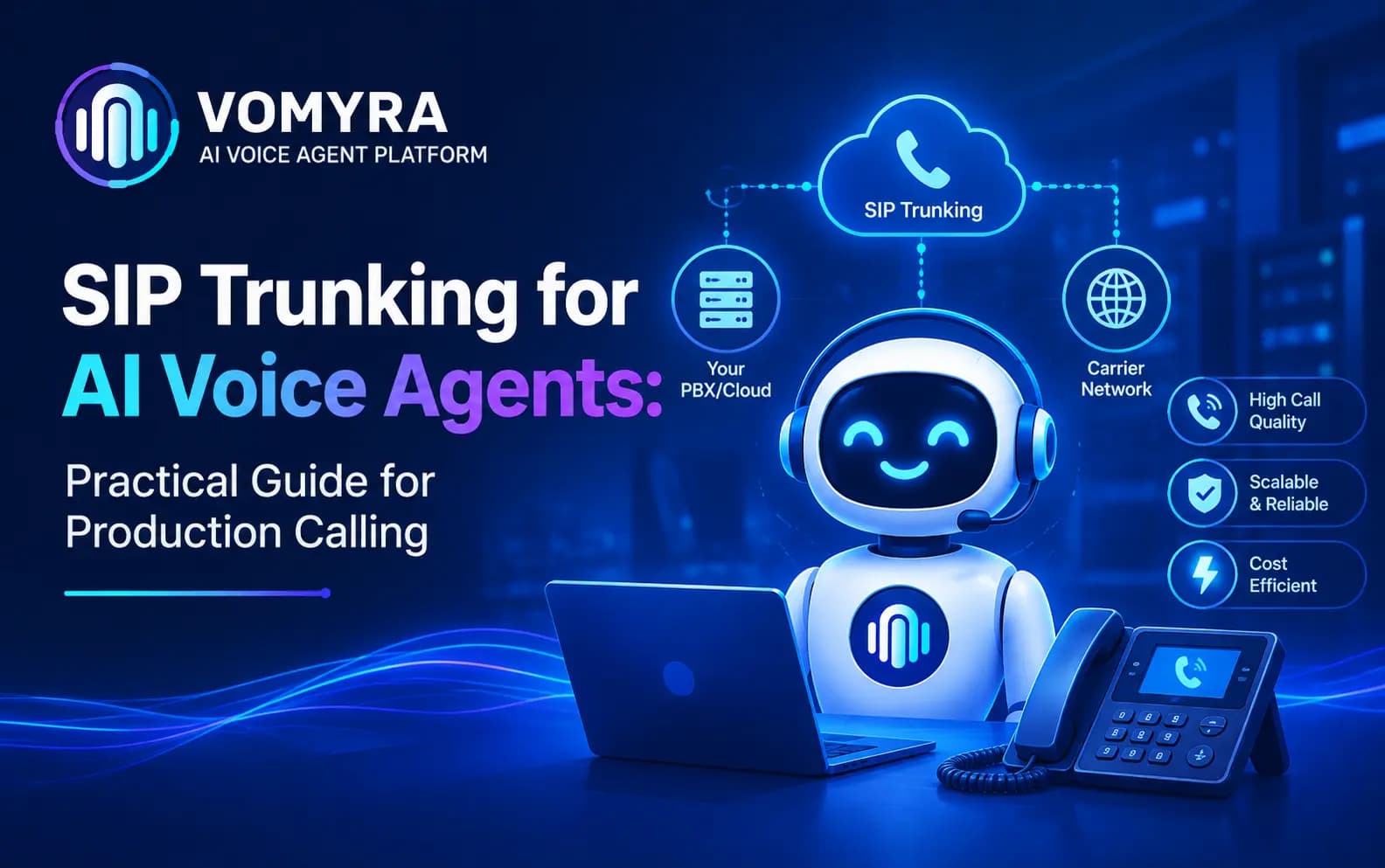
Every AI voice agent, no matter how good its conversation quality is, ultimately needs a physical path onto the phone network to actually make and receive calls. That path is almost always SIP trunking – the underlying telephony connection that carries voice traffic between a voice AI platform and the public phone network, or a business’s existing phone system.
It’s rarely the most exciting part of building or evaluating a voice AI setup, but it’s one of the most consequential. A brilliant conversational AI model connected through poor SIP infrastructure will still produce dropped calls, poor audio quality, and unreliable connectivity – problems that have nothing to do with the AI itself.
This guide covers what SIP trunking is, how it fits into an AI voice agent’s architecture, and what to evaluate before relying on it for production calling.
What Is SIP Trunking?
SIP (Session Initiation Protocol) trunking is a method of delivering voice calls over an internet connection rather than traditional physical phone lines. A “trunk” is essentially a virtual connection that carries multiple simultaneous calls between two systems – in this case, typically between a voice AI platform and either the public telephone network or a business’s own phone infrastructure.
For an AI voice agent, SIP trunking is what allows it to:
- Place outbound calls to real phone numbers
- Receive inbound calls to a business number
- Handle multiple calls simultaneously, since a single trunk can carry many concurrent sessions
- Connect to existing business phone systems, such as a PBX, for call transfers and integration
Without a reliable SIP trunking setup, none of the conversational capability of a voice AI system matters – there’s no dependable way to actually get the call connected.
Why SIP Trunking Quality Matters for AI Voice Agents
A few aspects of SIP trunking directly affect how an AI voice agent performs in production:
Call Connection Reliability
Poor-quality or poorly configured trunks can result in failed call attempts, calls that connect but drop shortly after, or delays in call setup – all of which undermine an otherwise well-built voice agent before the conversation even begins.
Audio Quality
SIP trunk quality affects the clarity of both directions of audio – how well the AI voice agent hears the caller, and how natural the agent’s voice sounds to them. Poor audio quality can also degrade speech-to-text accuracy, since the transcription engine is working with a lower-quality signal.
Concurrent Call Capacity
Since a voice AI system’s value often comes from handling many calls simultaneously – outbound campaigns, high inbound volume – the SIP trunk’s capacity for concurrent sessions directly limits how much scale is actually achievable.
Latency
SIP trunk routing adds to the overall latency budget of a call. A trunk with efficient, well-routed infrastructure contributes less delay than one with inefficient routing paths, which matters given how sensitive voice conversations are to response timing.
Regional Number and Carrier Support
For businesses calling within a specific country or region, the trunk provider’s relationships with local carriers affect both call quality and, in some markets, pickup rates – calls routed through recognisable local numbers and well-connected carrier relationships tend to perform differently than poorly routed international routing.
Read Also- AI Voice Agents for E-Commerce: Use Cases, Workflows and Best Practices
How SIP Trunking Fits Into an AI Voice Agent’s Architecture
In a typical setup, the flow looks like this:
- Call initiation – Either an inbound call arrives at a business number, or the voice AI platform initiates an outbound call.
- SIP trunk connection – The call is routed through the SIP trunk, connecting the voice AI platform to the public telephone network or the business’s existing phone system.
- Media stream established – Once connected, the audio stream flows in both directions over the trunk, carrying the caller’s voice to the AI system and the agent’s generated speech back to the caller.
- AI processing – The voice AI platform’s speech-to-text, reasoning, and text-to-speech components process the live audio stream, exchanging audio for text and back throughout the trunk connection.
- Call control – The SIP trunk also carries call control signals – transfers, holds, hangups – allowing the AI voice agent to hand off a call to a human, place a caller on hold, or end the call appropriately.
The trunk itself doesn’t handle any of the AI’s conversational intelligence – it’s purely the transport layer. But if that transport layer is unreliable, everything built on top of it is affected.
What to Evaluate Before Going Live
Concurrent call capacity Confirm the trunk can support the peak simultaneous call volume your use case requires – a trunk sized for occasional calls will bottleneck an outbound campaign calling hundreds of contacts at once.
Regional carrier relationships For calling within India specifically, trunk providers with strong local carrier relationships and support for local number formats tend to deliver more reliable connectivity and better pickup rates than generic international routing.
Call quality monitoring Look for visibility into call quality metrics – dropped call rates, audio quality scores, connection failures – so issues can be identified and addressed rather than only discovered through customer complaints.
Redundancy and failover Production systems should have failover paths if a primary trunk or carrier route experiences issues, rather than a single point of failure taking down calling capability entirely.
Integration with existing phone systems If calls need to transfer to or from an existing business phone system, confirm the trunk setup supports this integration cleanly, including caller ID and call context passing through the transfer.
Compliance with local telephony regulations Number provisioning, caller ID requirements, and outbound calling regulations vary by market – trunk configuration needs to align with the regulatory requirements of the region being called into.
Common SIP Trunking Issues and What They Usually Mean
| Symptom | Likely Cause |
| Calls fail to connect | Trunk capacity exceeded, or routing/configuration issue |
| Audio is choppy or garbled | Poor network quality, insufficient bandwidth, or codec mismatch |
| Calls drop shortly after connecting | Trunk instability or carrier-side routing issues |
| Low pickup rates on outbound calls | Caller ID reputation, number type (local vs generic), or carrier routing quality |
| Delayed call setup | Inefficient trunk routing adding to connection latency |
| Inconsistent call quality across regions | Uneven carrier relationships or routing quality by region |
This is a useful starting point for diagnosing calling issues that aren’t related to the AI conversation itself, since these symptoms point specifically to the telephony layer rather than the language model, STT, or TTS.

Reliable Telephony Infrastructure, Already in Place
The telephony layer is easy to overlook when evaluating a voice AI platform, but it’s the foundation everything else depends on – no amount of conversational quality compensates for unreliable call connections or poor audio.
Vomyra is India’s Agentic Voice AI Platform, built on telephony infrastructure engineered for reliable connectivity across real Indian mobile networks, using real Indian mobile numbers with strong local carrier relationships. Businesses can launch complete AI voice agents – Research, Outreach, Qualification, Closing and Follow-Up – without needing to evaluate or manage SIP trunking themselves.
If you’re evaluating a voice AI platform for production calling, it’s worth testing Vomyra’s connection reliability and call quality under your own real calling conditions.
FAQs
Do I need to understand SIP trunking to use an AI voice agent platform?
Not in detail – most voice AI platforms handle the trunking setup as part of their infrastructure. It’s still worth understanding the basics when evaluating a platform’s reliability and asking the right questions about call quality and capacity.
Does SIP trunk quality affect speech-to-text accuracy?
Yes. Poor audio quality from a low-quality trunk connection can degrade the signal the speech-to-text engine works with, leading to more transcription errors regardless of how good the underlying STT model is.
Why do local phone numbers often perform better for outbound calling in India?
Calls placed through recognisable local mobile number formats, routed via strong local carrier relationships, tend to see better connectivity and pickup rates than calls routed through generic or international numbers.
Can SIP trunking support very high call volumes for outbound campaigns?
Yes, provided the trunk is provisioned with sufficient concurrent call capacity for the campaign’s peak volume – this is a key sizing consideration before launching a large outbound calling effort.