Most AI voice agents today are built on a cascaded pipeline: speech-to-text, then a language model, then text-to-speech, stitched together in real time. It works, and it’s what powers the majority of production voice AI platforms.
Speech-to-speech architecture takes a different approach. Instead of converting audio to text and back again, it processes and generates audio directly, without a text bottleneck in the middle. It’s a newer approach, and it’s starting to show up in production voice AI systems where latency and naturalness matter most.
This guide explains what speech-to-speech architecture actually is, how it differs from the cascaded approach, where it genuinely helps, and what production teams need to weigh before adopting it.
Cascaded vs Speech-to-Speech: The Core Difference
A cascaded AI voice agent pipeline looks like this:
Audio in → Speech-to-text → Language model (text) → Text-to-speech → Audio out
Each stage is a separate model, handing off text between them. This is well understood, easy to debug, and lets teams swap individual components – a better STT engine, a different language model – without rebuilding the whole system.
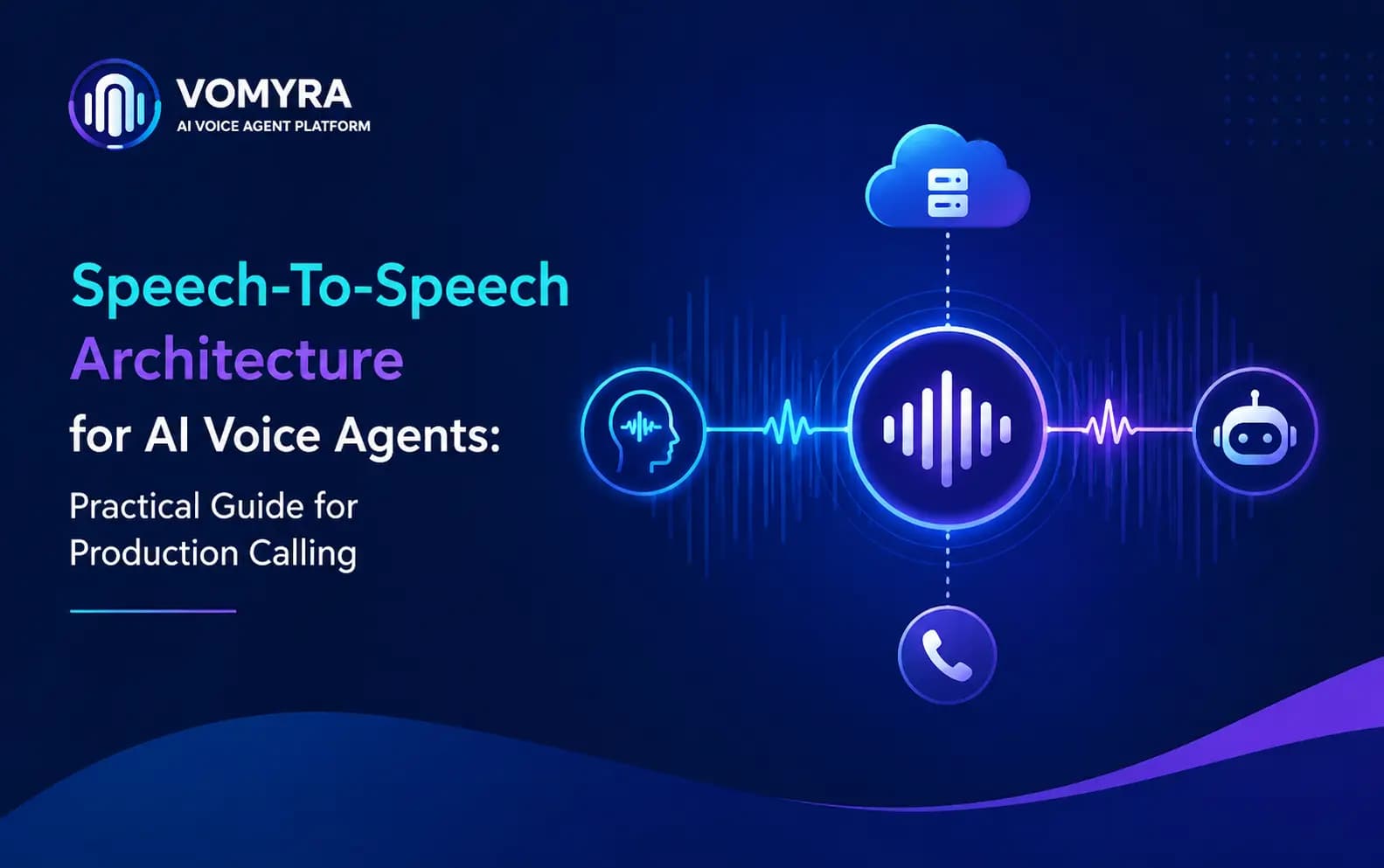
A speech-to-speech architecture collapses this into a single model, or a much tighter pipeline, that processes audio input and generates audio output directly:
Audio in → Speech-to-speech model → Audio out
There’s no intermediate text transcript driving the response. The model reasons and responds in the audio domain itself, which changes both what’s possible and what’s harder to control.
Why Speech-to-Speech Architecture Matters for AI Voice Agents
Lower Latency
Every conversion step in a cascaded pipeline – audio to text, text to response, response to audio – adds latency. Speech-to-speech models remove the text bottleneck, which can meaningfully cut the delay between a caller finishing a sentence and the agent responding.
For phone conversations, where natural turn-taking depends on responses landing within a few hundred milliseconds, this matters more than it might seem.
Better Handling of Tone, Emotion and Prosody
Text is a lossy representation of speech. It captures words, but not tone of voice, pace, emphasis or emotional cues. A cascaded system’s language model only ever sees the transcript – it has no idea if the caller sounded frustrated, hesitant or amused.
A speech-to-speech model processes the actual audio, so it can pick up on these signals and respond with matching tone – for example, slowing down and softening its response if a caller sounds confused or upset, rather than replying in a flat, uniform tone regardless of context.
More Natural Turn-Taking
Because speech-to-speech models work directly with audio, they can be better at judging natural conversational timing – pauses, overlaps, and when a caller is about to speak versus just pausing to think – rather than relying purely on silence-detection heuristics bolted onto a text pipeline.

Where Cascaded Architecture Still Wins
Speech-to-speech isn’t strictly better – it comes with real trade-offs that matter for production systems.
Debuggability In a cascaded pipeline, you can log and inspect the transcript at every stage, making it far easier to diagnose why an agent misunderstood something or gave a wrong answer. Speech-to-speech systems are harder to inspect, since there’s no clean text intermediate to audit.
Tool calling and structured logic Business logic – checking a CRM, applying qualification rules, deciding when to escalate – is naturally expressed in text and structured data. Cascaded pipelines integrate this cleanly at the text layer. Speech-to-speech models need this logic layered in carefully, and tooling here is still maturing.
Component flexibility With a cascaded pipeline, you can upgrade your STT engine, swap your language model, or change your TTS voice independently. A speech-to-speech model is more of a single unit, which can mean less flexibility to mix and match best-in-class components.
Compliance and auditability Many industries – BFSI, healthcare, government – need accurate, reviewable call transcripts for compliance. Cascaded pipelines produce this as a natural byproduct. Speech-to-speech systems typically still generate transcripts, but the reasoning that produced the response is less directly traceable to text.
Cascaded vs Speech-to-Speech: At a Glance
| Factor | Cascaded (STT → LLM → TTS) | Speech-to-Speech |
| Latency | Higher, due to multiple conversion steps | Lower, fewer conversion steps |
| Tone and emotion handling | Limited – model only sees text | Stronger – model hears actual audio |
| Debuggability | High – transcript visible at every stage | Lower – less clear text intermediate |
| Tool calling / business logic | Well-supported, mature tooling | Still maturing |
| Component flexibility | High – swap individual models | Lower – more of a single unit |
| Compliance and auditability | Strong, transcript-native | Workable, but reasoning less traceable |
| Maturity in production | Well-established | Newer, rapidly evolving |
Read Also: Speech-to-Speech vs Text-Based Voice Agents: Which Should You Use?
What This Means for Production Voice Agents
For most production use cases today – sales qualification, outbound calling, customer support, appointment booking – a well-built cascaded pipeline remains the more practical choice. It’s mature, debuggable, integrates cleanly with CRMs and business logic, and produces the transcripts many industries need for compliance.
Speech-to-speech architecture is most valuable where tone, emotion and ultra-low latency genuinely change the outcome – for example, sensitive support conversations, or use cases where the difference between a 300ms and 600ms response is noticeable to the caller.
In practice, many production-grade voice AI platforms take a hybrid approach: a fast, well-optimised cascaded pipeline as the default, with techniques borrowed from speech-to-speech research – streaming partial responses, prosody-aware TTS, better turn-taking prediction – layered in to close the gap on naturalness and latency, without giving up debuggability and business logic integration.
Practical Considerations Before Choosing an Architecture
If you’re evaluating or building an AI voice agent for production calling, a few questions matter more than which architecture sounds more advanced:
- Does the use case need fine-grained tone and emotion detection, or is clear, accurate, well-paced conversation enough?
- Do you need detailed, auditable transcripts for compliance, training, or CRM integration?
- How much business logic and tool-calling does the conversation require – checking systems, applying rules, updating records mid-call?
- What latency does the use case actually demand? A support call handling sensitive queries has a lower tolerance for delay than an informational callback.
- How mature does the vendor’s implementation need to be for the call volume and reliability you require in production?
For most businesses, the practical answer isn’t “cascaded or speech-to-speech” in the abstract – it’s choosing a platform that’s already solved these trade-offs at the infrastructure level.
Production-Grade Voice Infrastructure, Already Built
Choosing and optimising the right architecture – cascaded, speech-to-speech, or a hybrid – is a deep, ongoing engineering problem. Most businesses don’t need to solve it themselves; they need it already solved, reliably, at scale.
Vomyra is India’s Agentic Voice AI Platform, built on production-grade voice infrastructure that’s already engineered for low latency, natural conversation and reliable performance across real Indian mobile networks. Instead of choosing an architecture and building around it, businesses can launch complete AI voice agents – Research, Outreach, Qualification, Closing and Follow-Up – with the underlying voice engineering handled, and human-like conversations in multiple languages.
If you’re evaluating how to move from an architecture decision to a working, production-ready AI voice agent, Vomyra is built to get you there without the infrastructure build.
FAQs
Is speech-to-speech always faster than a cascaded pipeline?
Generally yes, since it removes conversion steps, but a well-optimised cascaded pipeline with streaming can still deliver latency low enough for natural conversation.
Do speech-to-speech models still produce a transcript?
Most implementations generate a transcript for logging and CRM purposes, but the model’s actual reasoning process doesn’t route through that text the way a cascaded pipeline’s does.
Which approach is better for regional Indian languages?
This depends more on the underlying language and voice model quality than the architecture itself – both cascaded and speech-to-speech systems need models specifically trained or tuned for the languages and accents in use.
Should I choose a vendor based on their architecture?
Architecture is one input, not the whole decision. Call quality, latency in real conditions, language support, reliability at your call volume and integration with your CRM matter just as much in practice.