AI voice agents are increasingly used for lead generation, appointment booking, customer support, sales follow-ups and outbound campaigns. However, deploying an AI voice agent is only one part of the process. Businesses also need to understand whether these conversations are producing meaningful results.
This is where conversion measurement becomes important.
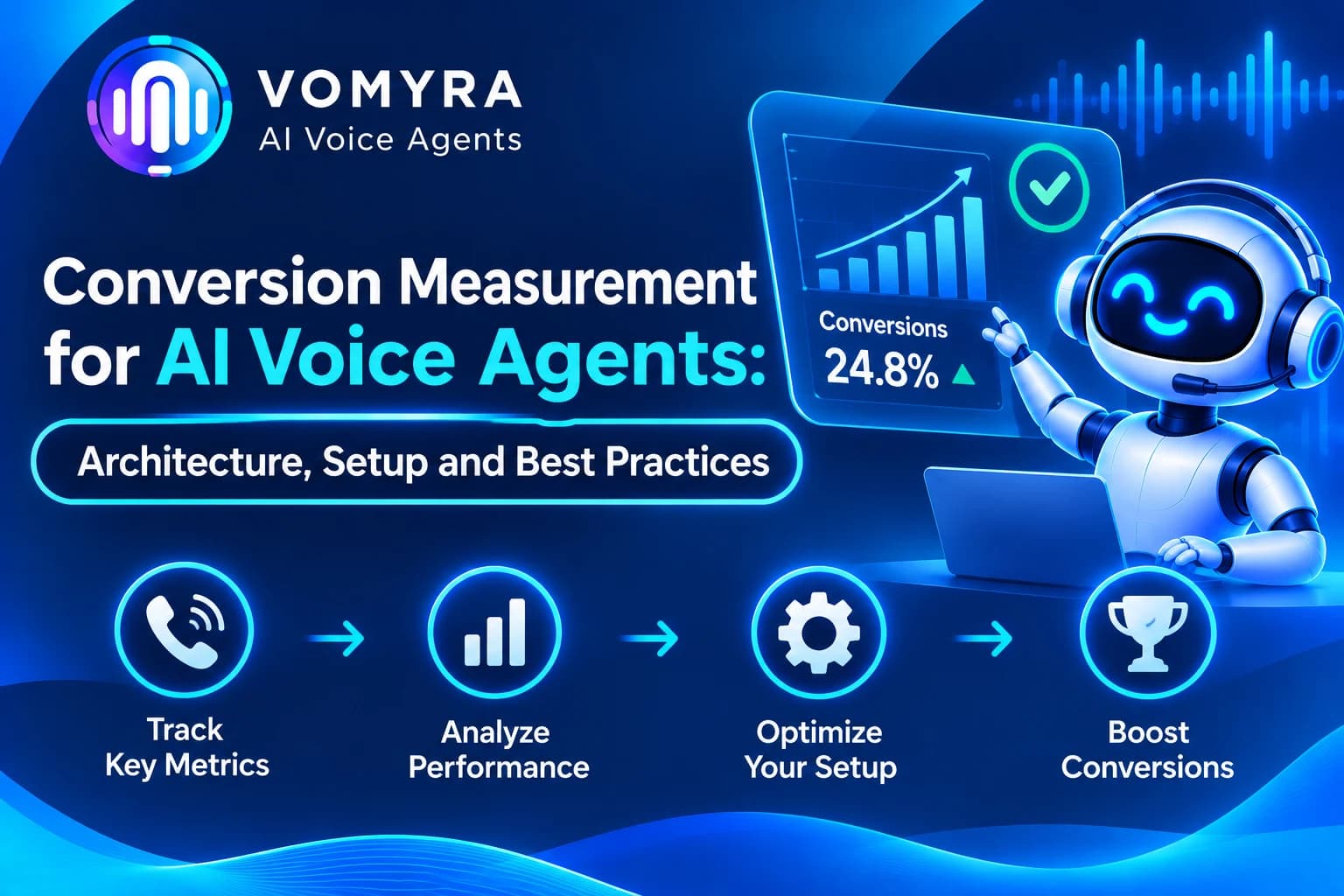
By tracking what happens during and after a voice interaction, businesses can identify successful calls, understand where conversations fail and improve their AI voice workflows. In this guide, we explore how conversion measurement works for AI voice agents, the architecture behind it, setup steps and best practices.
What Is Conversion Measurement for AI Voice Agents?
Conversion measurement is the process of tracking whether an AI voice conversation achieves a specific business objective.
A conversion does not always mean completing a sale. It depends on the purpose of the voice campaign.
For example:
- An outbound sales agent may measure qualified leads or product demos booked.
- An appointment booking agent may track confirmed appointments.
- A customer support agent may measure successfully resolved queries.
- A payment reminder agent may track completed payments.
- An inbound sales agent may measure enquiries converted into qualified opportunities.
The main objective is to connect voice interactions with measurable business outcomes rather than evaluating performance only through call volume or duration.
Why Is Conversion Tracking Important for AI Voice Agents?
Without proper measurement, businesses may know how many calls their AI agents make but not whether those calls generate value.
Conversion tracking helps businesses:
Measure campaign performance: Identify which campaigns, call scripts and workflows generate the most conversions.
Improve conversation quality: Understand where users lose interest, reject offers or abandon calls.
Optimise lead qualification: Evaluate whether AI agents are identifying relevant prospects accurately.
Understand customer behaviour: Analyse common objections, frequently asked questions and reasons for unsuccessful interactions.
Calculate business ROI: Compare campaign expenses with the revenue or business value generated.
For businesses running multiple AI voice workflows, these insights help prioritise improvements based on actual results.
Architecture of Conversion Measurement for AI Voice Agents
A reliable measurement system connects the voice agent, conversation events, backend systems and analytics platforms.
The typical architecture includes the following components:
1. Voice Interaction Layer
This is where the AI voice agent communicates with the customer. It includes speech recognition, language processing, text-to-speech and telephony connectivity.
The system captures call details such as call start time, duration, completion status and interaction identifiers.
2. Conversation and Event Layer
During a call, the AI agent generates events based on important conversation activities.
Examples include:
- Call initiated
- Call answered
- Customer intent identified
- Lead qualified
- Appointment requested
- Appointment confirmed
- Call transferred
- Conversation completed
These events provide structured information about what happened during the interaction.
3. Conversion Logic Layer
This component determines whether a conversation meets the business’s conversion criteria.
For example, a sales call may count as a conversion only when the customer meets qualification requirements and agrees to book a demo.
The conversion rules should be clearly defined rather than relying on a general positive conversation outcome.
4. CRM and Backend Integration
The system sends relevant call and conversion information to a CRM, scheduling platform or business application.
This helps connect voice interactions with customer records, sales opportunities and completed transactions.
5. Analytics and Reporting Layer
The final layer processes collected events and presents performance metrics through dashboards and reports.
Businesses can compare conversion rates across campaigns, agents, customer segments and time periods.
Key Metrics to Track for AI Voice Agent Conversions
Choosing the right metrics is essential. Tracking too many numbers without connecting them to business goals can make reporting confusing.
| Metric | What It Measures |
| Call Answer Rate | Percentage of initiated calls answered |
| Conversation Completion Rate | Percentage of calls reaching the defined end stage |
| Lead Qualification Rate | Percentage of conversations producing qualified leads |
| Conversion Rate | Percentage of eligible interactions achieving the target outcome |
| Appointment Booking Rate | Percentage of relevant calls resulting in bookings |
| Transfer Rate | Percentage of calls transferred to human agents |
| Drop-off Rate | Percentage of conversations abandoned before completion |
| Cost per Conversion | Campaign cost divided by completed conversions |
Businesses should select metrics based on the purpose of each AI voice workflow.
For example, a customer support agent should not be evaluated using the same conversion criteria as an outbound sales agent.
Read Also: Microsoft Foundry Voice Agents vs. Dedicated Voice AI Platforms
How to Set Up Conversion Measurement for AI Voice Agents
A structured implementation makes tracking more accurate and easier to maintain.
Step 1: Define the Conversion Goal
Start by deciding what a successful conversation means for your business.
For an outbound sales campaign, it could be a qualified lead. For an appointment agent, it could be a confirmed booking.
Avoid using vague goals such as successful call or positive interaction without defining what success actually means.
Step 2: Create a Consistent Event Structure
Define standard event names and the information each event should contain.
A typical event structure may include:
- Call ID and conversation ID
- Campaign or workflow ID
- Customer or lead reference
- Event name and timestamp
- Call outcome
- Conversion status
- Agent or workflow identifier
Use consistent naming conventions across all voice workflows to make reporting easier.
Step 3: Connect Your AI Voice Agent to the CRM
Integrate the voice platform with your CRM or backend application.
When a conversion occurs, update the relevant customer record with the call outcome, qualification status, appointment details or other required information.
This creates a connection between voice conversations and the wider sales or support process.
Step 4: Implement Webhooks and Event Tracking
Webhooks can send real-time event notifications from the voice platform to your backend.
For example, when an appointment is confirmed, the system can trigger a conversion event and update the CRM.
Use unique event identifiers and idempotency checks to avoid recording the same conversion multiple times.
Step 5: Build a Conversion Dashboard
Create dashboards that show the metrics most relevant to your business.
Useful dashboard views include campaign performance, conversion trends, call outcomes, agent-level results and cost per conversion.
Make sure reports distinguish between attempted calls, answered calls, qualified leads and final conversions.
Step 6: Test the Complete Tracking Flow
Before launching at scale, test different conversation scenarios.
Check whether the system records successful conversions, unsuccessful calls, transfers, interrupted conversations and repeated webhook events correctly.
Also verify that CRM updates and analytics reports match the actual call outcomes.
Best Practices for Accurate Conversion Measurement
1. Measure Business Outcomes, Not Just Call Activity
High call volume does not automatically mean good performance. Focus on qualified leads, completed bookings, resolved queries and other meaningful outcomes.
2. Separate Conversation Success from Business Conversion
An AI agent may complete a conversation successfully without generating a sale. Track conversation completion and business conversion as separate events.
3. Use Reliable Conversion Attribution
Connect each conversion to the correct campaign, call and customer record. Where a sale happens later, use CRM updates or backend transaction events instead of assuming the call itself completed the purchase.
4. Avoid Duplicate Events
Webhook retries and repeated customer interactions can create duplicate records. Use unique event IDs, timestamps and deduplication logic.
5. Review Failed Conversations
Analyse unanswered calls, customer objections, incomplete bookings and unsuccessful qualification attempts. These patterns can reveal improvements needed in prompts, workflows and call timing.
6. Protect Customer Data
Store only the information required for measurement, apply appropriate access controls and follow applicable privacy, consent and call-recording requirements.
7. Run Continuous Experiments
Test different opening statements, conversation flows and qualification questions. Compare results using consistent metrics before making changes permanent.
How Vomyra Can Support Conversion Measurement

Businesses using Vomyra can build AI voice workflows for inbound and outbound calling and connect voice interactions with broader business processes.
For effective conversion measurement, businesses should structure their workflows around clearly defined outcomes, capture relevant conversation events and connect those events to their CRM or backend systems.
With a consistent event structure and reporting process, teams can understand which voice workflows are generating qualified opportunities and where improvements are needed.
The focus should be on measuring meaningful business results rather than simply increasing the number of automated calls.
Conclusion
Conversion measurement helps businesses understand the actual value generated by AI voice agents. By combining structured conversation events, CRM integration, reliable attribution and meaningful analytics, organisations can evaluate performance beyond call volume.
A well-designed measurement architecture also makes it easier to identify weak points, optimise voice workflows and improve business outcomes over time.
Read Also: Mistral AI Integration with Voice Agents: Architecture and Practical Use Cases
Frequently Asked Questions
1. What is a good conversion rate for AI voice agents?
There is no universal benchmark. Conversion rates depend on the industry, campaign objective, audience quality, call timing and definition of a conversion. Businesses should establish a baseline using their own campaign data.
2. Which tools are used to track AI voice agent conversions?
Common components include AI voice platforms, CRM systems, backend databases, webhook integrations and analytics dashboards. The right combination depends on the business workflow.
3. Can AI voice agents track conversions in real time?
Yes. With event tracking and webhook integrations, important events such as qualified leads, confirmed appointments and completed transfers can be recorded and processed in near real time.
4. How do you calculate the conversion rate of an AI voice campaign?
A common formula is:
Conversion Rate = (Number of Conversions ÷ Number of Eligible Interactions) × 100
The denominator should be clearly defined. For example, a business may calculate conversions against answered calls or qualified conversations rather than all attempted calls.
5. Why should conversion measurement be connected to a CRM?
CRM integration connects voice interactions with customer records, sales opportunities and final outcomes. It helps businesses understand whether conversations eventually contribute to revenue or other business goals.