Ask an AI voice agent a question it genuinely knows the answer to, and it sounds impressive. Ask it something just slightly outside that – a pricing detail that changed last month, a policy exception, a product spec it was never actually given – and you’ll quickly find out whether it was built on a real knowledge base or just a clever prompt and a hopeful system message.
This is the quiet problem behind a lot of voice AI demos that look great on stage and then struggle on real calls: the conversation layer was polished, but the knowledge layer underneath it wasn’t designed properly. A knowledge base isn’t a nice-to-have add-on for a production voice agent – it’s the thing that decides whether the agent’s answers are actually true.
This guide covers what a knowledge base means specifically for AI voice agents, how to structure one so it reduces hallucinations instead of causing them, and how this fits into the bigger picture of building AI voice agents for production.
What Is a Knowledge Base for an AI Voice Agent?
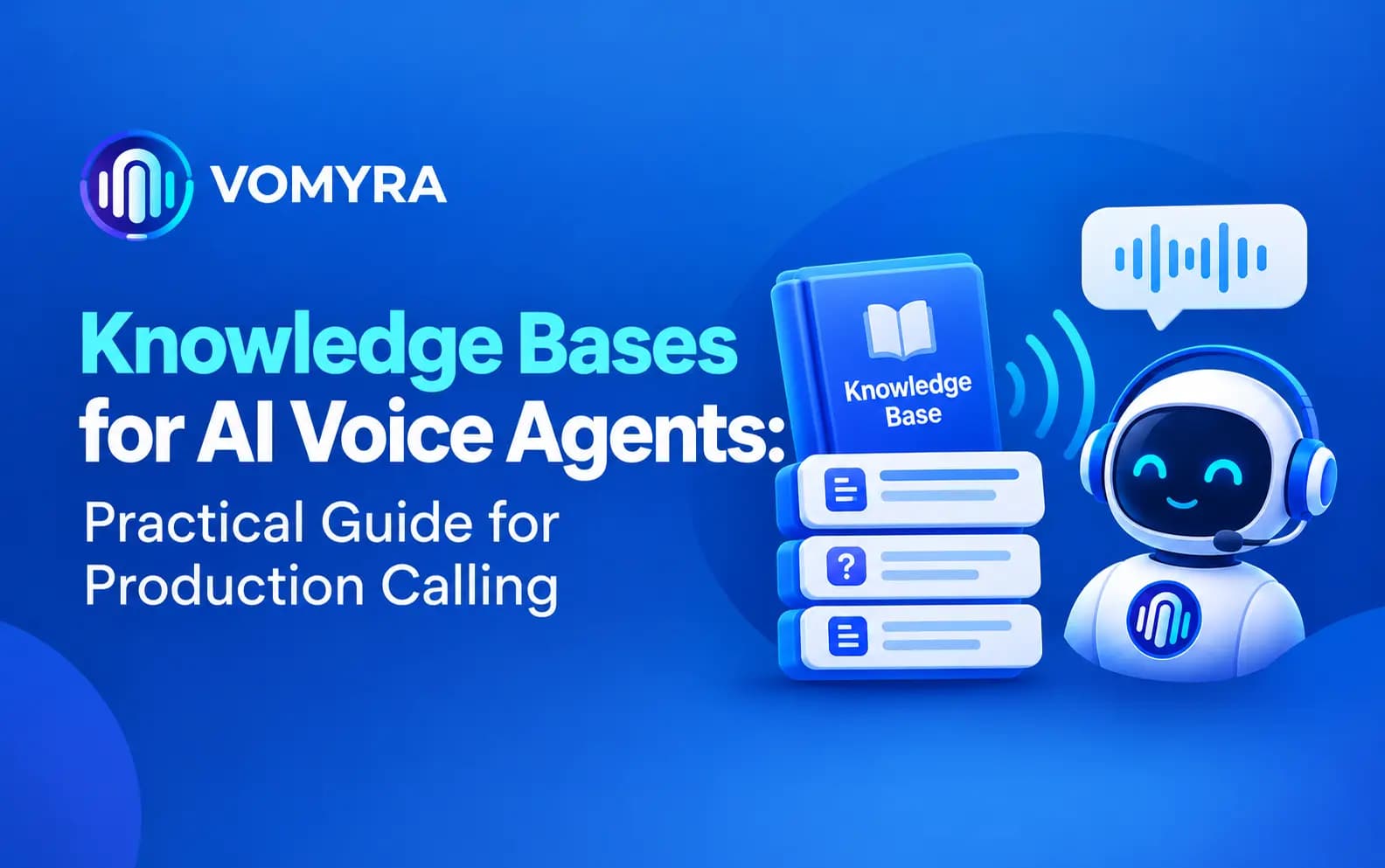
A knowledge base, in this context, is the set of information an AI voice agent draws on to answer questions accurately – product details, pricing, policies, FAQs, service information, or anything specific to the business it’s representing.
Instead of relying purely on what a language model was trained on (which is general, not specific to your business, and can be outdated), the agent retrieves relevant, current information from this knowledge base and uses it to shape its response.
This is usually built using retrieval – the system searches the knowledge base for the most relevant pieces of information based on what the caller just asked, and feeds that into the model alongside the conversation itself. The model then answers using that retrieved information, rather than guessing from general training data.
For voice specifically, this retrieval step has to happen fast enough not to disrupt the natural pace of a phone conversation – which is one of the key differences between building a knowledge base for a voice agent versus a text-based chatbot that has more tolerance for a slower response.
Why Knowledge Base Design Matters More for Voice Than Text
A few things make this especially important for anyone building AI voice agents for production, rather than just a text assistant:
There’s no room to double-check an answer A chatbot user can scroll up, re-read, or ask for a source. A caller on the phone can’t do any of that – if the agent states something confidently and it’s wrong, the caller has no easy way to catch it in the moment.
Hallucinations are harder to correct mid-call In text, a wrong answer is often followed by a correction a few messages later. On a voice call, by the time a hallucination is caught, the conversation may have already moved on, or the caller may have simply trusted what they heard.
Retrieval needs to be fast, not just accurate Searching a knowledge base takes time, and that time adds directly to the agent’s response latency. A knowledge base poorly structured for fast retrieval can make an otherwise well-built voice agent feel slow and unnatural.
Spoken answers need to be concise, not just correct A knowledge base built for a web FAQ page might return a long, detailed paragraph. A voice agent needs a much shorter, conversational version of that same fact – which affects how the content itself should be written, not just how it’s retrieved.
Read Also: SIP Trunking for AI Voice Agents: Practical Guide for Production Calling
How to Structure a Knowledge Base for a Voice Agent
Write for Retrieval, Not for Reading
Content written as long, flowing paragraphs is harder for a retrieval system to match precisely against a caller’s question. Structuring information as clear, distinct, well-labelled chunks – one fact or policy per entry – makes retrieval far more accurate than dense, multi-topic documents.
Keep Answers Short and Spoken-Friendly
Where possible, write knowledge base entries the way you’d actually say the answer out loud, not the way you’d write it in a help article. This reduces the work the language model has to do to convert a written fact into natural spoken language on the call.
Separate Stable Facts From Frequently Changing Information
Pricing, promotions, and availability change more often than core product information or policies. Structuring these separately makes it easier to keep the fast-changing content accurate without needing to review the entire knowledge base every time something updates.
Build In Explicit “I Don’t Know” Boundaries
A knowledge base should make it easy for the agent to recognise when a question falls outside what it actually knows – rather than the model filling the gap with a plausible-sounding guess. This is one of the most effective ways to reduce hallucinations in production.
Keep the Knowledge Base Current
An out-of-date knowledge base doesn’t just risk incomplete answers – it actively produces wrong ones, confidently delivered. Defining a clear update process, and ideally connecting the knowledge base directly to the source systems it reflects (a pricing sheet, a policy document, a CRM), keeps this from becoming a manual, easily neglected task.
Test Retrieval Against Real Caller Phrasing
Callers rarely phrase questions the way a knowledge base entry is written. Testing retrieval against the actual, messy ways people ask questions on real calls – not just clean, ideal phrasing – is what reveals whether the structure is actually working.
Common Knowledge Base Mistakes That Cause Hallucinations
| Mistake | Why It Causes Problems |
| One large, unstructured document | Retrieval pulls imprecise or irrelevant chunks, leading to answers built on the wrong context |
| No clear scope boundaries | The model fills gaps with plausible-sounding guesses instead of saying it doesn’t know |
| Outdated pricing or policy content | The agent confidently states information that’s no longer true |
| Written for reading, not speaking | Responses sound unnatural or overly long when converted to speech |
| No retrieval testing against real phrasing | The knowledge base looks complete but fails to surface the right content on actual calls |
| No process for updates | Knowledge drifts out of sync with the business over time, unnoticed until a caller is given wrong information |
Building AI Voice Agents for Production: Where the Knowledge Base Fits
A knowledge base is one layer in the broader stack involved in building AI voice agents for production – sitting alongside speech-to-text, the language model, text-to-speech, and the telephony layer that connects the call. Getting the conversation and voice quality right matters, but a production-ready agent also needs:
- Accurate retrieval, so the agent answers from real, current information rather than general model knowledge
- Clear escalation logic, for when a question genuinely falls outside the knowledge base’s scope
- Low-latency lookups, so retrieval doesn’t become the bottleneck in an otherwise fast conversation
- A feedback loop from real calls, so gaps and outdated content get caught and fixed based on what callers are actually asking
This is also where much of the practical learning in courses like DeepLearning.AI’s “Building AI Voice Agents for Production” focuses – not just on making a voice agent that talks naturally, but on the surrounding architecture, including how it grounds its answers in real information, that makes it reliable enough for actual business use.
How Different Platforms Approach Voice Agent Knowledge and Retrieval
Teams exploring how to build a voice AI agent generally run into a few different paths, each with its own trade-offs:
Building from scratch using a realtime voice agent framework, wiring together STT, an LLM, TTS, and a custom retrieval layer over your own knowledge base. This offers full control but requires meaningfully more engineering effort to get right, especially around latency and hallucination prevention.
Using an enterprise platform like Microsoft Copilot Studio, which supports voice agents through the Direct Line Speech channel, built on Azure AI Speech, allowing a Copilot Studio agent to answer calls using generative responses grounded in connected knowledge sources. This is a strong option for teams already invested in the Microsoft ecosystem, though it requires familiarity with Copilot Studio’s configuration and connectors.
Using a purpose-built voice AI platform designed specifically for business calling use cases – lead qualification, support, bookings – where the knowledge base setup, retrieval, and latency optimisation are already handled as part of the platform, rather than something a team needs to engineer themselves.
Which path makes sense depends largely on whether the goal is a highly customised, engineering-led build, or a faster path to a working, reliable voice agent for a specific business use case.

A Knowledge Base That Actually Keeps Your Voice Agent Accurate
The gap between an AI voice agent that sounds good and one that’s actually reliable usually comes down to what it’s grounded in. A well-structured knowledge base, with fast retrieval and clear boundaries on what the agent should and shouldn’t guess at, is what separates a confident-sounding demo from a voice agent businesses can trust with real customer calls.
Vomyra is India’s Agentic Voice AI Platform, built so businesses can launch AI voice agents grounded directly in their own website, knowledge base or business documents – without needing to engineer retrieval, latency optimisation, or hallucination prevention themselves. Vomyra AI voice agents – Research, Outreach, Qualification, Closing and Follow-Up – use real Indian mobile numbers and hold human-like, accurate conversations in multiple languages.
If you’re evaluating how to build AI voice agents for production without the underlying engineering overhead, Vomyra is built specifically for this – with unlimited calling plans and no coding required to get started.
FAQs
How do I build an AI voice agent knowledge base that prevents hallucinations?
Structure content as short, clearly scoped entries rather than long documents, keep stable and fast-changing information separate, build in explicit boundaries for what the agent shouldn’t guess at, and test retrieval against how real callers actually phrase questions.
What’s the difference between building AI voice agents for production versus a demo?
A demo often works with a small, clean set of test questions. Building AI voice agents for production means handling a knowledge base that’s large, constantly changing, and queried with messy real-world phrasing – all while keeping response latency low enough for natural conversation.
How does a Copilot Studio voice agent handle knowledge and retrieval?
A Copilot Studio voice agent typically uses the Direct Line Speech channel, built on Azure AI Speech, to handle the voice layer, while generative answers are grounded in the knowledge sources connected to the Copilot Studio agent – meaning the underlying knowledge base structure still matters for accuracy, the same as with any voice AI platform.
What is Direct Line Speech in Copilot Studio used for?
Direct Line Speech is the channel Microsoft Copilot Studio uses to connect a bot or agent to real-time voice interactions via Azure AI Speech, handling the speech recognition and synthesis layer so the underlying agent can focus on understanding intent and retrieving the right answer.
How do I build a voice AI agent that works in real time?
Realtime voice agents require a pipeline that handles speech-to-text, language understanding and knowledge retrieval, and text-to-speech generation quickly enough to keep response latency low – typically under a second – while also handling interruptions and natural conversational turn-taking. Courses like DeepLearning.AI’s voice agent offerings cover this pipeline in detail for teams building it themselves.
Can I make a voice agent without building the knowledge base and retrieval system myself?
Yes. Purpose-built voice AI platforms are designed to handle knowledge base setup, retrieval, and latency optimisation as part of the platform, letting businesses configure an agent around their own content without engineering the underlying retrieval system from scratch.