Businesses often have thousands of contacts stored in their CRM systems, but not every lead converts into a customer immediately. Some prospects stop responding, delay their purchase decisions or lose interest after an initial conversation. Reconnecting with these contacts can create new sales opportunities, but manually calling every inactive lead takes time and effort.
An AI voice agent for CRM re-engagement helps businesses automate these conversations. It can contact eligible leads, understand their current requirements, collect responses and update CRM records based on call outcomes.
This guide explains how AI voice agents support CRM re-engagement, which activities businesses can automate and how to build an effective follow-up workflow.
What Is an AI Voice Agent for CRM Re-Engagement?
An AI voice agent is a conversational AI system that can make or receive phone calls, understand spoken responses and respond according to configured instructions.
When connected to a CRM, it can identify eligible inactive leads and initiate re-engagement calls based on predefined business rules.
For example, a software company may have prospects who requested a product demo but never scheduled one. An AI voice agent can contact these leads, ask whether they are still evaluating software and record their latest requirements.
The goal is not simply to make more calls. It is to identify which prospects are still interested and help sales teams take the next appropriate action.
How AI Voice Agents Work with CRM Re-Engagement
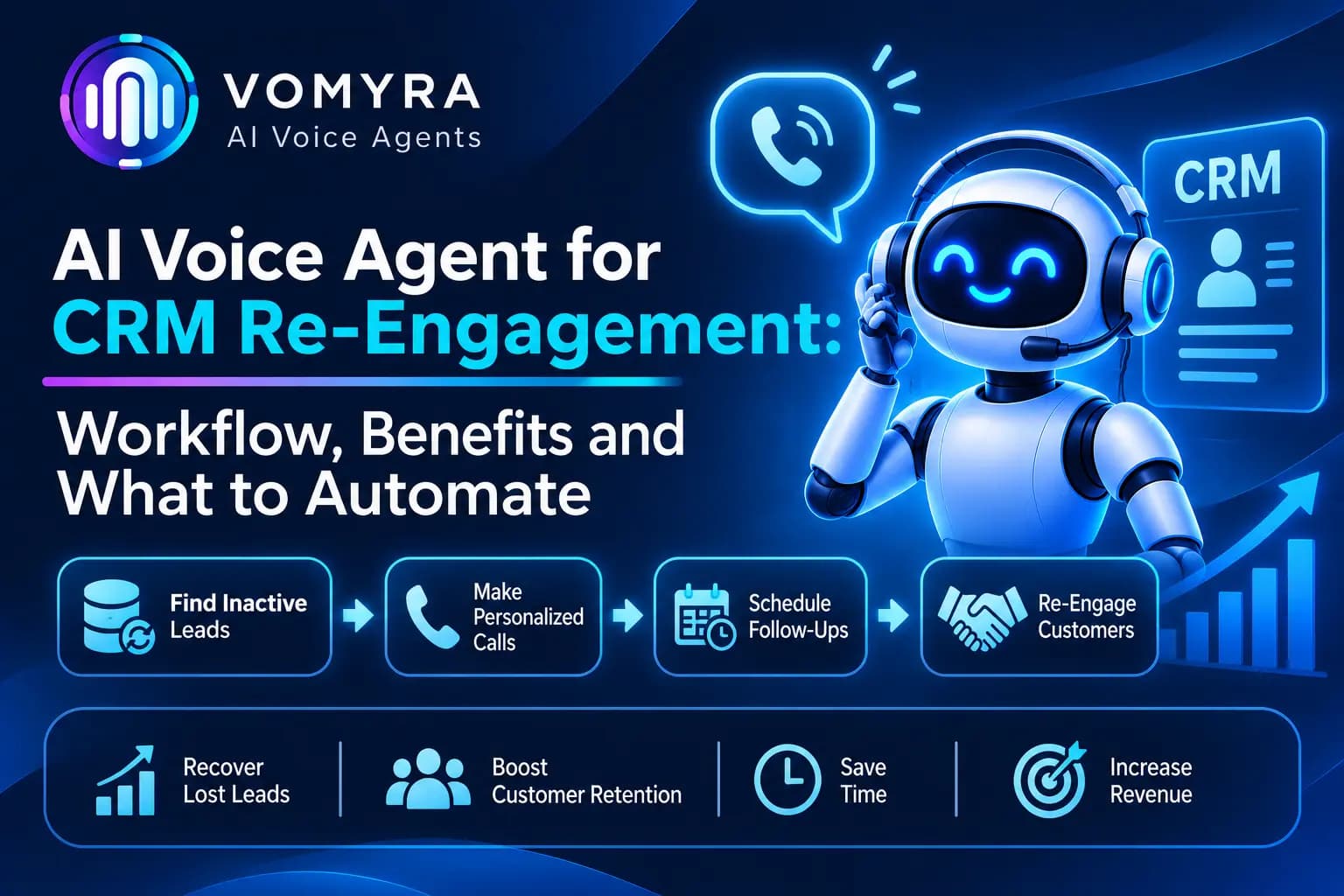
A CRM re-engagement workflow connects customer records, calling infrastructure and an AI voice agent platform.
1. Identify Inactive Leads
The CRM identifies contacts who have not responded, completed a purchase or engaged with the sales team within a defined period.
Businesses can create segments based on lead status, last interaction date, previous enquiry or product interest.
2. Trigger an Automated Calling Workflow
When a lead matches the selected conditions, the CRM or connected application sends the contact information to the AI voice agent platform through an API, webhook or supported integration.
The workflow can then initiate an outbound call according to the configured calling rules.
3. Start a Personalised Conversation
The AI voice agent introduces the business and explains the reason for contacting the prospect. It can refer to the previous enquiry or product interest using available CRM information.
4. Understand Customer Requirements
The agent asks relevant questions to determine whether the prospect is still interested, has already purchased a solution or wants to discuss the offering again.
5. Update CRM Records
After the call, the system can save the conversation summary, customer responses and call outcome. It can also update lead status or trigger another action based on the prospect’s response.
What Can Businesses Automate with AI Voice Agents?
Businesses should focus on repetitive re-engagement activities that follow clear rules and do not require complex human judgement.
1. Calling Inactive Leads
AI voice agents can contact eligible leads who have not interacted with the business for a defined period. The agent can check whether their requirements are still relevant and record their response.
2. Following Up on Old Enquiries
Some prospects enquire about a product or service but do not move forward. Automated calls can help businesses understand whether these prospects are still evaluating their options.
3. Appointment and Demo Reminders
If a prospect previously showed interest but did not schedule a meeting, the agent can offer available appointment slots through a connected calendar system.
4. Collecting Updated Customer Information
Business requirements can change over time. An AI voice agent can ask whether a prospect’s budget, timeline, location or service requirements have changed and update the relevant CRM fields.
5. Managing Callback Requests
When prospects are unavailable, the agent can record their preferred callback time and trigger a follow-up workflow based on their response.
6. Lead Segmentation and Routing
Based on conversation outcomes, leads can be categorised as interested, not interested, requiring follow-up or ready for a sales conversation. Relevant contacts can then be assigned to the appropriate sales representative.
Benefits of Using AI Voice Agents for CRM Re-Engagement
Better Use of Existing Leads
Businesses can reconnect with contacts already present in their CRM instead of relying entirely on new lead generation. This can help identify opportunities that may otherwise remain unattended.
Faster Follow-Ups
Automated workflows can initiate calls when leads meet predefined conditions, reducing delays caused by manual follow-up processes.
Reduced Manual Calling Work
Sales representatives spend less time making routine re-engagement calls and recording basic customer information.
More Organised CRM Data
Automatic updates help businesses maintain current lead statuses, call summaries and follow-up records.
Consistent Customer Communication
AI voice agents can follow approved conversation flows and qualification questions, helping businesses maintain consistency across routine calls.
Improved Sales Team Productivity
Sales representatives can focus on prospects who have expressed interest, requested a meeting or need detailed product information.
Read Also: Twilio Integration with AI Voice Agents: Complete Setup and Workflow Guide
How to Set Up an AI Voice Agent for CRM Re-Engagement
Step 1: Define Re-Engagement Conditions
Decide which contacts should enter the calling workflow. For example, businesses may select leads with no recent response, incomplete enquiries or pending product demonstrations.
Step 2: Connect Your CRM
Integrate the CRM with the AI voice agent platform using supported APIs, webhooks or integration tools. Configure the fields required for calling, such as contact name, phone number and previous enquiry details.
Step 3: Create Conversation Instructions
Prepare a clear introduction and questions that help the agent understand the prospect’s current interest. Avoid lengthy scripts and unnecessary questions.
Step 4: Configure Calling and Follow-Up Actions
Define what should happen when a prospect answers, does not answer, requests a callback or wants to speak with a representative.
Step 5: Set Up CRM Updates
Configure the system to save call outcomes, conversation summaries, updated requirements and next follow-up actions.
Step 6: Test the Complete Workflow
Test different customer responses, calling conditions, CRM updates and integration failures before deploying the workflow for live contacts.
Best Practices for CRM Re-Engagement Automation

Segment leads carefully: Do not call every inactive contact with the same message. Use previous interactions and customer interests to create relevant calling segments.
Personalise conversations: Refer to the prospect’s previous enquiry when appropriate instead of using a generic sales introduction.
Avoid excessive calls: Set reasonable calling frequency limits and respect customer preferences.
Enable human handover: Allow interested prospects to speak with a sales representative when they have detailed questions or want to discuss pricing.
Maintain data security: Protect CRM information, API credentials and customer contact details through appropriate access controls.
Follow consent and privacy requirements: Contact only eligible leads and follow applicable calling, consent, privacy and do-not-call regulations.
Measure performance: Track contact rates, reactivated leads, qualified opportunities, scheduled meetings and conversions to understand how well the workflow performs.
How Vomyra Supports CRM Re-Engagement Workflows
Vomyra provides an AI voice agent platform that businesses can use to automate customer conversations and calling workflows. For CRM re-engagement, businesses can configure workflows for inactive lead calling, enquiry follow-ups, customer requirement collection and appointment scheduling.
By connecting voice automation with CRM and other business systems, companies can organise conversations and make relevant customer information available to their sales teams. The available actions depend on the selected integrations, calling setup and business requirements.
Conclusion
Inactive CRM leads do not always represent lost sales opportunities. Some prospects may still be interested but need additional information, a reminder or a better time to continue the conversation.
An AI voice agent for CRM re-engagement helps businesses automate routine calls, collect updated requirements and organise follow-up activities. With suitable CRM integrations, clear calling rules and human handover options, businesses can reconnect with existing leads while allowing sales teams to focus on valuable conversations.
Frequently Asked Questions
1. What is CRM re-engagement automation?
CRM re-engagement automation uses configured workflows to reconnect with inactive leads or customers through calls, messages and other communication channels.
2. Can an AI voice agent automatically call inactive CRM leads?
Yes. When connected to a CRM, an AI voice agent can receive eligible lead information and initiate outbound calls based on predefined conditions and calling rules.
3. Can AI voice agents update CRM records after re-engagement calls?
Yes. With a suitable integration, they can save call outcomes, conversation summaries, customer responses and updated lead statuses.
4. Which CRM activities can AI voice agents automate?
They can support inactive lead calling, enquiry follow-ups, callback management, appointment scheduling, customer information collection and lead routing.
5. Which businesses can use AI voice agents for CRM re-engagement?
SaaS companies, real estate businesses, financial service providers, educational institutions, healthcare organisations and B2B service providers can use these workflows to reconnect with eligible leads and customers.