Phone calls continue to play an important role in how Indian businesses communicate with customers. From confirming orders and following up on enquiries to answering service questions, many companies still depend on calling teams to manage daily conversations.
However, handling a large number of calls manually can be difficult. Sales teams may miss new leads, support teams can spend hours answering repetitive questions, and follow-ups may get delayed during busy periods.
This is where AI voice agents can help. By connecting an AI voice agent with Exotel’s calling infrastructure, businesses can automate conversations while keeping phone calls as a familiar communication channel for customers.
Exotel provides voice APIs and real-time audio streaming capabilities that allow developers to connect phone calls with external conversational AI systems. In this guide, we will explain how the integration works, what businesses need, and where Indian companies can use Exotel-powered AI voice agents.
What Is Exotel Integration with AI Voice Agents?
Exotel integration with AI voice agents means connecting Exotel’s telephony infrastructure to an AI-powered conversational system.
Exotel manages the phone call, while the AI voice agent handles the conversation. When a customer speaks, their audio is streamed to the connected voice application. The AI processes the request and sends a spoken response back through the call.
For example, a customer calls an online store to ask about an order. Instead of waiting for a support executive, the customer can speak with an AI voice agent that checks the order information through a connected backend system and provides an update.
This setup can support both inbound and outbound calling workflows. Businesses can use it to answer incoming calls, contact customers for follow-ups, confirm appointments and qualify sales enquiries.
How Does Exotel Work with an AI Voice Agent?
Exotel offers a Connect Voice AI API that can connect an answered phone call to a conversational AI bot through a bidirectional WebSocket connection.
A typical integration involves the following steps:
- Call initiation: The customer calls a business number, or the business starts an outbound call through Exotel.
- Call connection: Exotel handles the call and connects it to the configured voice application.
- Audio streaming: The caller’s audio is streamed to the AI voice agent through WebSocket.
- AI processing: The voice system understands the request and prepares a response.
- Voice response: The generated audio is sent back to the caller.
- Business action: If required, the agent accesses connected systems to check information, book an appointment or update a customer record.
- Call completion: The system records the call outcome and can send status updates to the business backend.
The exact architecture depends on the AI platform and the type of calling workflow. The voice application must support Exotel’s streaming protocol and handle the audio formats, events and connection lifecycle correctly.
Key Components Required for Exotel and AI Voice Agent Integration
Before setting up the connection, businesses and developers should understand the main components involved.
1. Exotel Account and Virtual Number
You need an active Exotel account with the required voice services and a suitable ExoPhone or virtual number. This number can be used as the caller ID for outbound calls or as part of an inbound calling setup.
2. AI Voice Agent
The AI voice agent manages the conversation. It needs to understand customer requests, generate relevant responses and follow instructions defined for the business.
Depending on the architecture, it may use separate speech recognition, language model and text-to-speech services or a speech-to-speech model.
3. WebSocket Server
A WebSocket endpoint connects Exotel’s audio stream with the AI voice application. It receives incoming audio, processes events and sends the agent’s audio response back.
The endpoint should use secure WebSocket connections and follow Exotel’s documented streaming protocol.
4. CRM and Business Integrations
Connecting the agent to business systems makes the conversation more useful. A CRM can provide lead details, an order management system can return delivery information, and a calendar can help schedule appointments.
5. Call Monitoring and Status Updates
Businesses should also configure call status callbacks, error handling and monitoring. These help track whether calls were answered, completed, missed or failed.
How to Connect Exotel with an AI Voice Agent
There are two common approaches, depending on how much control the business needs over the call journey.
Approach 1: Direct Connect Voice AI API
The direct approach is useful when the AI bot handles most or all of the conversation. Exotel dials the number and connects the answered call directly to the bot’s WebSocket endpoint.
A simplified request looks like this:
curl -u ‘<API_KEY>:<API_TOKEN>’ \
-X POST \
‘https://api.in.exotel.com/v1/Accounts/<ACCOUNT_SID>/Calls/connect’ \
-F ‘From=+919876543210’ \
-F ‘CallerId=<EXOTEL_NUMBER>’ \
-F ‘StreamUrl=wss://your-server.com/media’ \
-F ‘StreamType=bidirectional’ \
-F ‘StatusCallback=https://your-server.com/callback’
Here, From is the destination phone number, CallerId is the Exotel number, and StreamUrl points to the bot’s WebSocket endpoint.
The API uses HTTP Basic Authentication with the API key and API token. Keep these credentials on the server and never expose them in public code.
This approach is suitable for outbound campaigns, surveys and appointment reminders where the bot can manage the complete call.
Approach 2: Connect Voice AI with Exotel Flow
Some businesses need more control before or during the AI conversation. For example, they may want to play a greeting, collect keypad input, provide a disclosure message or offer an option to speak with a human executive.
In these situations, an Exotel Flow can control the call journey.
A typical flow may look like:
Welcome message → IVR selection → AI voice agent → Human agent transfer (if required)
The Voicebot or Stream applet connects the call to the configured WebSocket endpoint. A Connect applet can be used to transfer the caller to a human representative.
This approach is useful for businesses with multiple departments, structured customer journeys or specific call-routing requirements.
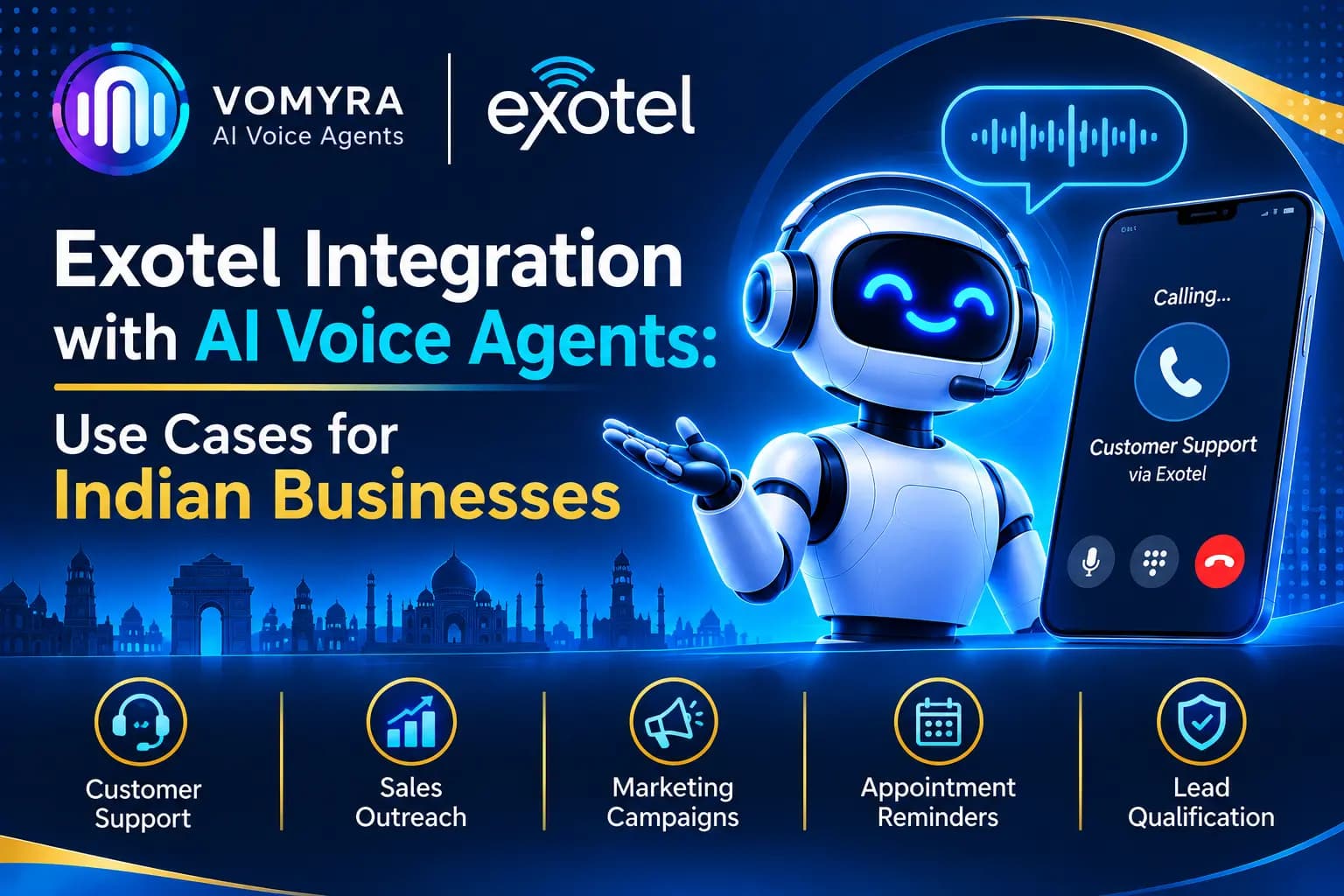
Use Cases of Exotel Integration with AI Voice Agents for Indian Businesses
1. Lead Qualification for Real Estate Companies
Real estate businesses receive enquiries through websites, property portals, advertisements and referral campaigns. Calling every lead manually can take time, especially when enquiries arrive outside office hours.
An AI voice agent connected through Exotel can contact new leads, ask about their preferred location, budget and property requirements, and record their responses.
Qualified prospects can then be passed to the relevant sales executive for a site visit or detailed discussion.
2. Order Confirmation and Delivery Updates for E-commerce
E-commerce companies and direct-to-consumer brands often need to confirm orders, coordinate deliveries and respond to customer questions.
An AI voice agent can make confirmation calls, ask customers to verify order details and collect delivery preferences. With access to an authorised order management system, it can also provide relevant delivery updates.
This can reduce repetitive calling work for customer support teams.
3. Appointment Reminders for Healthcare and Clinics
Clinics, diagnostic centres and healthcare service providers regularly contact patients about appointments and scheduled visits.
An AI voice agent can call customers before their appointment, confirm attendance and collect requests to reschedule. It can update the connected booking system when an authorised action is completed.
For sensitive healthcare conversations, the agent should follow strict data-access rules and transfer complex queries to qualified staff.
4. EMI and Payment Reminders for Financial Services
Banks, NBFCs and other financial service providers handle large volumes of payment-related communication.
AI voice agents can support routine reminder workflows by informing customers about upcoming due dates, collecting responses and recording follow-up requests.
Financial conversations require careful controls. Agents should avoid disclosing sensitive account details without proper verification and must follow applicable calling, consent and regulatory requirements.
5. Customer Support for Retail and D2C Brands
Retail businesses receive calls about product availability, returns, delivery status, store timings and service requests.
An AI voice agent can handle common questions using approved business information. When a request requires human attention, it can route the call to the appropriate support team.
This helps businesses manage routine enquiries without making customers navigate long IVR menus.
6. Education and EdTech Enquiry Follow-Ups
Educational institutions receive enquiries about courses, admission dates, fees and counselling sessions.
An AI voice agent can contact interested students, understand their course preferences, answer approved questions and schedule counselling calls.
It can also update the CRM so admission teams have the information they need before speaking with a prospective student.
7. Feedback and Customer Satisfaction Calls
Businesses can use automated voice agents to collect feedback after a purchase, delivery, appointment or support interaction.
The agent can ask a few simple questions, record the customer’s response and identify cases that need follow-up. This gives businesses a consistent way to collect feedback without requiring staff to make every call manually.
Read Also: AI Voice Agents for Real Estate Lead Management in the UAE
Benefits of Using Exotel with AI Voice Agents

Automated calling workflows: Businesses can automate repetitive inbound and outbound conversations, reducing the amount of manual calling required.
Real-time conversations: Bidirectional audio streaming allows the AI agent to listen and respond during an active call instead of relying only on recorded messages.
Better lead follow-ups: New enquiries can be contacted through defined workflows, helping sales teams respond more consistently.
Human handover: With an appropriate Exotel Flow, businesses can route calls to human representatives when a request needs personal attention.
Connected business systems: CRM, booking and other backend integrations allow the agent to retrieve relevant information and perform authorised actions.
Call tracking: Status callbacks and call records help businesses monitor outcomes and identify technical or operational issues.
Best Practices for a Reliable Exotel AI Voice Agent
A successful integration needs more than a working phone connection. Businesses should test the complete customer journey before using it at scale.
- Use clear conversation instructions: Define the agent’s role, approved information and actions it can perform.
- Test Indian language conversations: Evaluate Hindi, English and relevant regional languages using real customer speech and realistic phone audio.
- Manage response delays: Optimise audio streaming, model processing and backend requests to keep conversations natural.
- Handle interruptions: The agent should respond appropriately when a customer speaks before the previous response has finished.
- Protect customer data: Secure API credentials, restrict access to customer records and follow applicable privacy requirements.
- Provide human support: Define clear conditions for transferring calls that the AI cannot resolve.
- Follow calling regulations: Configure consent, calling preferences and applicable TRAI requirements for commercial communication in India.
- Monitor call outcomes: Review failed calls, incomplete conversations, transfer rates and customer feedback regularly.
How Vomyra Helps Businesses Deploy AI Voice Agents
Building an AI voice agent with telephony, speech processing, language models and business integrations can require considerable development work. Businesses need to connect these components, test their performance and maintain the system as their requirements change.
Vomyra provides a voice AI orchestration platform that brings speech models, language models, telephony and business tools together. Its platform supports different voice and language models, managed Indian numbers, and options to bring supported telephony providers through SIP.
Businesses can use Vomyra to build voice agents for lead qualification, customer support, appointment scheduling, sales follow-ups and other calling workflows. Its integration options include REST APIs, webhooks, CRM connections and other business tools.
For an Exotel-based architecture, Exotel can provide the telephony and audio-streaming layer while a compatible external voice application handles the AI conversation. The exact connection needs to be configured and tested against both platforms’ technical requirements; businesses should confirm provider compatibility before deployment.
If your team wants to manage voice models and business workflows through a dedicated platform, visit Vomyra to learn more about its AI voice agent capabilities.
Conclusion
Exotel integration with AI voice agents gives Indian businesses a way to automate phone conversations while continuing to use familiar calling infrastructure. With real-time audio streaming, connected business tools and suitable call flows, companies can support lead qualification, customer service, appointment reminders, order updates and feedback collection.
The right setup depends on the business workflow. A direct WebSocket connection may be enough for simple bot-led calls, while Exotel Flow is useful when IVR, call routing or human handover is required.
Before deployment, businesses should test audio quality, language handling, response time, security and calling compliance. A well-planned integration can help teams manage repetitive conversations more consistently while keeping human representatives available for complex customer needs.
Read More: Knowledge Bases for AI Voice Agents: Practical Guide for Production Calling
Frequently Asked Questions
1. Can Exotel connect with AI voice agents?
Yes. Exotel provides a Connect Voice AI API that can connect an answered phone call to an external conversational AI bot through a bidirectional WebSocket connection.
2. What is required to integrate Exotel with an AI voice agent?
The setup generally requires an Exotel account, API credentials, a suitable ExoPhone, a compatible AI voice application and a WebSocket endpoint. CRM or other backend integrations can be added based on the business workflow.
3. Can Exotel AI voice agents make outbound calls?
Yes. Exotel’s Connect Voice AI API supports outbound calls that connect to a bot after the recipient answers. This can be used for lead follow-ups, surveys, appointment reminders and other permitted calling workflows.
4. Can an Exotel-connected AI agent transfer calls to human executives?
Yes. An Exotel Flow can include a Connect applet to transfer a caller to a human representative. Businesses can configure handover rules for complex requests or situations where human support is needed.
5. Which Indian businesses can use Exotel with AI voice agents?
Real estate companies, e-commerce brands, healthcare providers, banks, NBFCs, educational institutions, retail businesses and service companies can use AI voice agents for suitable inbound and outbound calling workflows.
6. Does Vomyra support Exotel integration?
Exotel provides APIs and WebSocket streaming for connecting external voice bots. Vomyra provides voice AI orchestration, telephony options and business integrations. However, a direct native Exotel integration should be confirmed with the providers before implementation. A compatible custom connection may require additional configuration.